

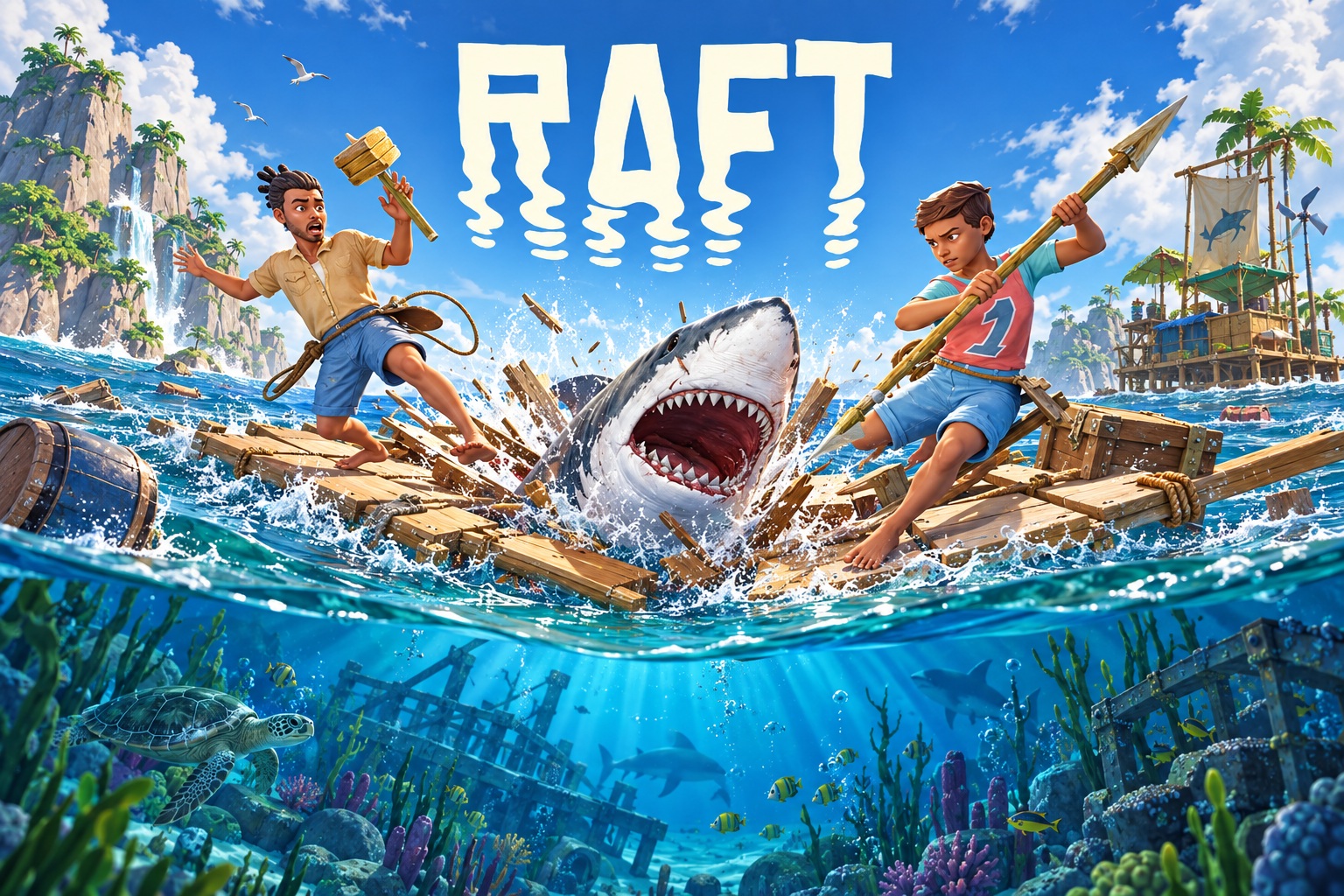
Raft is a classic ocean survival game built around starting on a tiny wooden platform in the middle of an endless sea and slowly turning that fragile beginning into a functioning floating home. Armed with little more than a hook, players must collect debris drifting past the raft, gather wood and other materials, craft essential equipment, expand the platform, find food, produce fresh water, and survive the constant threat of a hungry shark.
The appeal of Raft comes from how quickly ordinary objects become valuable. A single plank floating past may be exactly what you need to expand the raft or fuel an important survival station. Missing a piece of debris can matter when hunger or thirst is already becoming dangerous. The original prototype was deliberately focused around this simple survival loop: hooking debris, expanding the raft, growing plants, fishing, cooking food, purifying water, and surviving the shark.
Now playable online through Lemon Web Games, Raft can be experienced directly in your web browser as part of a growing collection of survival, crafting, building, exploration, simulation, and browser-playable games. Its web-based availability makes it easy to revisit this early ocean-survival experience, where every plank, piece of thatch, barrel, fish, cup of clean water, crop, raft extension, and shark attack contributes to the struggle to stay alive.
Starting With Almost Nothing
Raft begins by putting the player in an intentionally vulnerable position. There is no established base, stocked inventory, or comfortable supply of food and water waiting to be used.
Instead, survival begins with a tiny raft surrounded by ocean and a stream of floating materials moving past in the current. Those pieces of debris become the foundation of everything that follows.
This makes the opening minutes especially important. Players need to pay attention immediately because each missed resource is a missed opportunity to strengthen the raft or craft something essential.
The Hook Is Your Lifeline
The hook is one of the most important tools in Raft. Rather than walking across an island gathering materials, players throw the hook toward floating debris and pull useful resources back toward the raft.
This simple mechanic gives Raft much of its identity. The ocean itself becomes the player's supply line, constantly delivering materials that may drift away forever if they are not collected in time.
The earliest Raft prototypes were fundamentally built around hooking debris from the water and using those materials to expand the raft.
Floating Debris Becomes Your Entire Economy
When almost everything needed for survival comes from the ocean, even basic debris becomes valuable.
Wood can support construction and fuel survival equipment. Other floating materials contribute to ropes, tools, structures, and additional crafting recipes. Barrels are especially exciting because they can provide multiple useful resources at once.
This creates an addictive rhythm. Players constantly scan the water, identify useful targets, throw the hook, reel materials in, and immediately think about what those resources should become.
Expanding the Raft
One of the most satisfying parts of Raft is watching the starting platform gradually become larger.
Additional foundations provide more space for survival equipment, crops, storage, and movement. Early versions of the game eventually expanded the construction system with flooring, pillars, stairs, and walls, allowing the floating platform to become much more than a simple square of wood.
Every new section feels valuable because more space creates more options. At the same time, a larger raft also gives the shark more edges to attack, so expansion does not completely remove the danger.
Hunger and Thirst Keep the Pressure On
Collecting materials would be relaxing if survival needs were not constantly counting down in the background.
Hunger and thirst force players to divide their attention. It is not enough to build a larger raft if the character has nothing to eat or drink.
The prototype's early development added basic hunger and thirst systems alongside fishing, cooking, and water purification, establishing the survival loop that became central to Raft.
This keeps the game moving. Players are always preparing for the next problem before it becomes an emergency.
Fresh Water Is Essential
Thirst can become one of the most immediate dangers in Raft because being surrounded by ocean does not mean having drinkable water.
Players need to collect seawater and process it through a purifier before it becomes safe to drink. In the early version, this involves using the appropriate container, adding seawater to the purifier, providing fuel, and then collecting the purified water afterward.
That makes water production one of the first important survival systems to establish. Once a reliable purification routine is working, the player has more freedom to focus on expanding and improving the raft.
The Empty Tin Can and Early Water System
The original Raft prototype used an empty tin cup or can as part of the water-survival process. Players needed it to collect seawater and interact with the purifier rather than simply drinking directly from the ocean.
This tiny item becomes surprisingly important because clean water depends on it.
It is a good example of how Raft turns ordinary objects into essential survival tools. Something as simple as an empty container can become the difference between continuing the run and dying from thirst.
Fishing for Survival
Fishing provides another important source of food.
Once a fishing rod is available, players can catch fish directly from the ocean rather than depending entirely on whatever food appears among floating debris.
The early prototype added fishing and cooking as part of its expanding survival system, with fish becoming another renewable way to manage hunger.
This makes the ocean more than a source of construction materials. It becomes part of the player's food supply as well.
Cooking Food Before Eating
Raw survival ingredients become much more useful when players can cook them.
The grill provides a way to prepare fish and other suitable food, creating a more reliable hunger-management system.
Like the purifier, the grill also requires resources and planning. Players need to collect enough fuel and food to keep it useful, which connects cooking directly back to the hook-and-debris gameplay.
This interconnected design is what makes Raft's survival loop satisfying. One system constantly feeds into another.
Growing Food on the Raft
Crop plots allow players to begin producing food directly on their floating home.
Potatoes were part of the prototype's early farming system, with development eventually changing them from automatically growing in plots to being planted by the player.
Farming introduces an important change to the survival rhythm. Instead of depending entirely on whatever the ocean provides, players can begin creating renewable resources for themselves.
Watching crops grow on a tiny wooden platform surrounded by endless seawater also captures the strange charm of Raft perfectly.
The Shark Is Always Nearby
The shark is the constant threat that prevents the raft from ever feeling completely safe.
It circles nearby and periodically attacks the structure, damaging sections of the floating home that players have worked hard to build. The shark was introduced during the prototype period and could attack raft foundations, adding direct danger to the construction system.
This creates tension even during otherwise quiet moments. Players may be fishing, crafting, or organizing resources when suddenly the shark begins tearing apart the edge of the raft.
The ocean may look peaceful, but the shark ensures that survival never becomes completely comfortable.
Defending Your Floating Home
A larger raft represents progress, but it also becomes something worth defending.
When the shark attacks, players need to react quickly before a foundation section is completely destroyed. Losing part of the raft can also mean losing valuable space or equipment placed too close to the damaged area.
Weapons such as the spear give players a way to fight back when the shark attacks.
This creates another layer of resource management. Materials must be divided between expansion, survival equipment, food systems, tools, and defensive needs.
Building a Better Survival Setup
Early survival usually feels messy because the player is simply trying to stay alive. As the raft grows, however, it becomes possible to create a more organized setup.
A purifier can provide reliable water. A grill can handle food. Crop plots can produce plants. Storage and additional structures can make resources easier to manage.
Eventually the raft begins to feel less like an emergency platform and more like a floating base.
That transformation is one of the most satisfying parts of the game because every improvement comes directly from resources the player personally collected.
Inventory and Crafting
Crafting turns floating debris into useful survival equipment.
The early Raft development process gradually introduced an inventory and crafting menu, initially with only a small number of recipes before expanding into tools and structures such as grills, purifiers, hammers, fishing rods, and additional building components.
This gives every resource a purpose. Players are constantly asking what should be crafted next and whether limited materials are better spent on immediate survival or long-term expansion.
The right crafting decision at the right time can make the following minutes much easier.
The Building Hammer and Raft Expansion
The building hammer allows the player to transform collected materials into an increasingly complex raft.
Foundations increase usable space, while later construction options give players more freedom to build upward and organize the floating structure.
Expanding too quickly can still create problems if resources needed for food, water, or defense are spent entirely on construction.
This makes building both creative and strategic. A beautiful raft is useful only if the player can stay alive long enough to enjoy it.
A Survival Game Without Traditional Land Exploration
One of the things that made the original Raft concept unusual was its restraint.
The early game was centered almost entirely on surviving on the raft and collecting flotsam rather than freely exploring a huge terrestrial world. Islands were not part of the original early gameplay structure, making the ocean and the raft themselves the focus.
This limitation actually strengthens the experience. Players cannot simply walk away and search somewhere else when resources are scarce.
Whatever floats toward the raft becomes the opportunity.
Every Resource Feels Important
Raft is especially effective because it makes small resources feel meaningful.
A plank may become part of a foundation, fuel for cooking, or fuel for water purification. A food item may solve an immediate hunger problem or become more valuable after cooking.
Because resources have multiple uses, every crafting choice becomes a small strategic decision.
That makes successful survival feel earned rather than automatic.
From Tiny Platform to Floating Home
The most visible form of progression is the raft itself.
At the beginning, there is barely enough room to move. After collecting enough materials and surviving long enough, the platform begins spreading outward and eventually supports multiple survival systems.
The player's progress is therefore always visible. Instead of simply watching numbers increase, they can look around and see the physical result of hours spent collecting, crafting, defending, and building.
This sense of ownership is one of Raft's strongest qualities.
A Surprisingly Relaxing Survival Rhythm
Despite hunger, thirst, and shark attacks, Raft can also feel surprisingly peaceful.
There are long periods where the player simply watches the ocean, throws the hook toward floating debris, organizes materials, cooks food, and plans the next extension.
That contrast is part of the game's charm. Quiet resource gathering can suddenly turn into panic when thirst becomes critical or the shark attacks an important part of the raft.
The result is a survival experience that can move naturally between calm routine and sudden danger.
Why the Early Raft Experience Still Feels Special
The original version of Raft is much simpler than the later commercial game, but that simplicity gives it a distinct personality.
There are fewer systems competing for attention, which means the core survival loop remains extremely clear: collect debris, build, eat, drink, defend, and survive.
The prototype history shows how these foundations were established very early, with debris collection, raft expansion, crops, fishing, cooking, water purification, hunger, thirst, and shark attacks becoming the essential building blocks of the game.
For players who enjoy focused survival games, that stripped-down design can still be extremely satisfying.
Playing Raft Online Today
Through Lemon Web Games, Raft can now be played directly in your web browser with no downloads or setup required. Features of the web-based version include:
• Browser-based play for quick access
• No installation required
• Classic early Raft survival gameplay centered around the open ocean
• Hook-based collection of floating debris and resources
• Raft expansion, crafting, fishing, cooking, farming, and water purification
• Hunger and thirst survival systems with constant shark pressure
• Accessible play through Lemon Web Games
Playing Raft online today makes it easy to experience the simple survival concept that helped the game gain attention during its earliest development. The browser format makes it straightforward to jump onto the tiny raft, grab the hook, and immediately begin collecting whatever the ocean sends your way.
This early version is best enjoyed by focusing on survival priorities. Establish a reliable source of drinking water, secure food, gather materials constantly, defend the raft from the shark, and expand only when enough resources remain for essential needs.
Who Should Play Raft
• Players who enjoy survival and crafting games
• Fans of ocean settings and minimalist survival challenges
• Players who like resource gathering, building, fishing, farming, and crafting
• Fans of games where hunger and thirst create constant pressure
• Players who enjoy expanding and improving a base over time
• Anyone interested in experiencing the simpler early form of the Raft survival concept
Raft is especially suitable for players who enjoy survival games where progress is built slowly from very limited resources. There is something satisfying about turning pieces of debris floating through the ocean into a functioning home.
It is also a strong choice for players browsing the Lemon Web Games library in search of a survival experience that is easy to understand but constantly demanding attention.
Play Raft Online Now
Raft is now available to play online through Lemon Web Games, giving players a simple way to experience this classic ocean survival game directly in the browser. Its web-based format makes it easy to start playing without downloads or setup, while preserving the hook-based resource gathering, crafting, hunger, thirst, fishing, water purification, raft construction, and shark attacks that define the experience.
For players exploring the Lemon Web Games library, Raft offers a focused survival challenge where progress is visible in everything you build. A tiny wooden platform can gradually become a much larger floating base filled with the equipment needed to stay alive.
Playing Raft today is a chance to enjoy a browser-playable survival game built around scarcity, improvisation, and steady improvement. Whether approached as a crafting game, a base-building challenge, an ocean survival simulator, or a nostalgic look at the early Raft concept, it delivers enjoyable gameplay where every plank, fish, crop, cup of clean water, foundation, and shark attack matters.
Final Thoughts
Raft remains enjoyable because its central survival idea is so easy to understand. You are stranded on a tiny floating platform, useful resources are drifting past, and almost everything you need must be created from whatever you can pull out of the ocean.
Its greatest strength lies in how naturally the survival systems connect. The hook provides materials. Those materials become tools and structures. Structures create food and clean water. More materials expand the raft, while the shark constantly threatens to destroy the progress you have made.
Through Lemon Web Games, Raft becomes easy to access and enjoy directly in the browser. It remains a worthwhile game for players who enjoy survival, crafting, resource management, and base building. For anyone looking for a browser-playable experience built around floating debris, fresh water, hunger, fishing, sharks, and slowly transforming a tiny wooden platform into a floating home, Raft delivers a simple but memorable ocean survival adventure.











Comments 0