

The name "Twitter" may have disappeared from Elon Musk's social media platform when it was rebranded as X, but another company is now attempting to bring the familiar blue-bird era back to life. Virginia-based startup Operation Bluebird has officially launched Twitter.now, a new social network that aims to revive some of the identity and terminology associated with the original Twitter.
The project was first announced in December, when Operation Bluebird argued that the Twitter brand had effectively been abandoned following its replacement by X. Now, despite an ongoing legal dispute with Musk's company, the startup has opened an early-access version of the platform.
A Legal Fight Over the Twitter Name
Unsurprisingly, the attempt to revive Twitter did not go unnoticed.
According to the report, Musk took legal action against Operation Bluebird shortly after the project was announced, seeking to prevent it from launching under the Twitter name.
The dispute centres around whether X still possesses enforceable rights over the branding that it stopped actively using after Twitter became X.
An April 2026 hearing reportedly gave Operation Bluebird some confidence to proceed.
US District Court Judge Colm Connolly tentatively indicated that X appeared to have relinquished some of the former Twitter intellectual property, potentially including the famous bird logo, the word "tweet" and possibly the Twitter name itself.
Importantly, however, this was described as a tentative position rather than a final written ruling.
Operation Bluebird co-founder Stephen Coates nevertheless interpreted the development as sufficient justification to move forward with Twitter.now.
That means the platform may be live, but the broader legal question surrounding ownership of the old Twitter branding is not necessarily settled yet.
Twitter.now Brings Back Familiar Terminology
For longtime Twitter users, the new service is deliberately familiar.
Instead of trying to invent an entirely new social-media identity, Operation Bluebird appears to be leaning into the terminology and culture that millions of users associated with Twitter before the X rebrand.
Even the domain — Twitter.now — makes the intention obvious.
It is effectively presenting itself as an attempt to revive the social network that existed before the transition to X.
Whether users actually want another Twitter-like platform remains another question.
The social-media landscape has become much more fragmented in recent years, with users now spread across X, Threads, Bluesky, Mastodon and numerous smaller services.
Twitter.now therefore enters a considerably more crowded market than Twitter itself once dominated.
Vera Automatically Fact-Checks Tweets
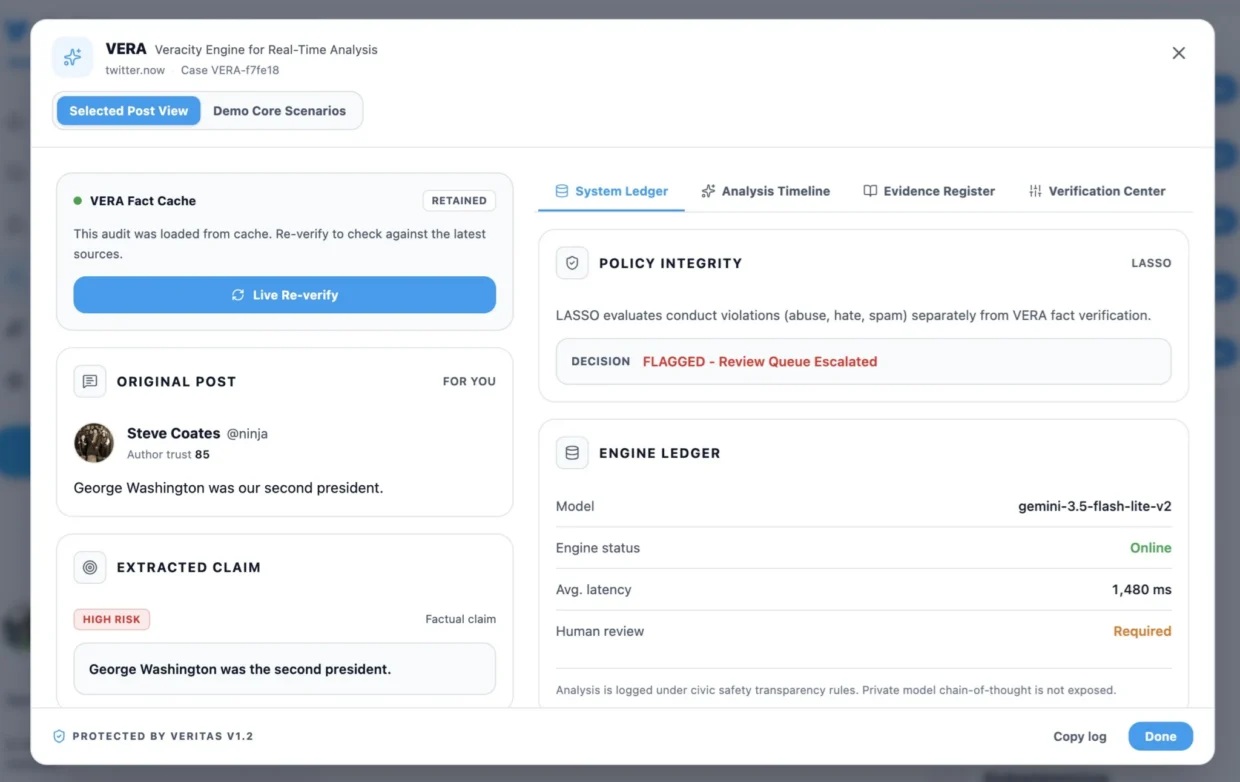
One feature helping Twitter.now distinguish itself is called Vera, short for "veracity engine for real-time analysis."
Vera is reportedly powered by Google Gemini and automatically analyses every tweet posted to the platform.
The idea is to provide real-time fact-checking alongside conversations rather than relying entirely on users, moderators or third-party fact-checking organisations to challenge questionable claims after they spread.
Operation Bluebird says it wants users to retain the freedom to express themselves while reducing the financial incentives that encourage sensational, misleading or harmful posts to become viral.
That touches on one of the biggest problems facing modern social media.
Platforms traditionally make money by maximising engagement.
Unfortunately, inaccurate or inflammatory content can sometimes generate enormous engagement precisely because it provokes strong reactions.
If Twitter.now genuinely intends to avoid financially rewarding that behaviour, its business model could become just as important as its moderation technology.
AI Fact-Checking Comes With Its Own Questions
Putting an automated AI fact-checker underneath every post sounds ambitious, but it also creates obvious challenges.
AI systems themselves are not infallible.
A model may misunderstand satire, lack sufficient context, struggle with rapidly developing news or provide confident conclusions when reliable information is still unavailable.
Political, scientific and social claims can also be more complicated than simply labelling something true or false.
The success of Vera will therefore depend heavily on how Twitter.now presents its findings.
If the system provides context and evidence rather than behaving like an unquestionable referee, it could potentially become useful.
If users believe the AI itself is biased, inaccurate or overly aggressive, however, the feature could quickly become another source of controversy.
The concept is nevertheless interesting because it attempts to integrate verification directly into the social-media experience instead of treating fact-checking as an entirely separate process.
Only Hundreds of Users So Far
Twitter.now remains extremely small compared with established social networks.
The report says the platform currently has only hundreds of users, meaning it is still very much an experiment rather than a serious competitor to X.
For comparison, successful social networks depend heavily on network effects.
A platform becomes useful because friends, journalists, organisations, celebrities, developers and communities are already there.
Convincing users to join a new service is therefore difficult even when the technology itself is good.
Twitter.now has one obvious advantage: its name.
For people who never became comfortable calling Twitter "X," seeing the old branding return could generate curiosity and nostalgia.
Whether that nostalgia can translate into a sustainable community is another matter entirely.
Early Access Costs US$20
There is also a barrier to joining.
Twitter.now is currently operating under an Early Access model, and creating an account costs US$20, roughly RM80 based on the conversion cited in the report.
Early users receive Founder status in return.
Charging for access is an unusual choice for a new social network because most platforms initially want as many people as possible to join.
However, there may be several reasons behind the strategy.
A paid entry fee could help cover infrastructure costs, discourage automated spam accounts and create a smaller community while the service is still being developed.
It could also help Operation Bluebird identify people genuinely interested in supporting the project.
The downside is obvious: convincing users to pay for an unfamiliar social network with only a few hundred members may be difficult when numerous established alternatives are available for free.
Can You Really Bring Back the Old Twitter?
The bigger question is whether the thing people miss about Twitter was actually the name and blue bird.
For some users, absolutely.
The branding became culturally significant over more than a decade.
Tweets, retweets and the little blue bird became part of everyday internet vocabulary.
But much of Twitter's appeal also came from the people using it.
Journalists, researchers, politicians, developers, celebrities and ordinary users all shared the same public conversation.
Simply recreating the name does not automatically recreate that community.
Twitter.now will therefore need to offer something compelling beyond nostalgia if it wants to become more than an interesting footnote in social-media history.
Vera could potentially provide that differentiation, particularly if users appreciate having additional context attached to questionable posts.
The Twitter Brand Still Has Extraordinary Recognition
One interesting part of this entire story is how powerful the abandoned branding remains.
Years after Twitter officially became X, millions of people still casually refer to the service as Twitter.
People continue to talk about tweets even though X officially renamed them posts.
That demonstrates how deeply the original brand became embedded in internet culture.
Rebranding something that recognisable is difficult because a company can change a logo overnight, but changing years of user vocabulary takes much longer.
Operation Bluebird appears to be betting that enough people still have an emotional attachment to the Twitter identity to give a new service using that name a chance.
Final Thoughts
Twitter.now is an unusual attempt to revive one of the internet's most recognisable social-media brands after its original owner chose to leave that identity behind.
Operation Bluebird has moved ahead with the platform despite an unresolved legal fight surrounding the former Twitter trademarks, apparently encouraged by a judge's tentative comments earlier this year.
The service currently remains tiny and requires a US$20 Early Access payment, but its Gemini-powered Vera fact-checking system gives it at least one feature that separates it from a simple Twitter clone.
Whether Twitter.now develops into a meaningful social network will depend on much more than owning a nostalgic name.
It needs users, communities, sustainable moderation and a reason for people to keep coming back.
Still, there is something undeniably strange about watching another company attempt to resurrect Twitter while the platform that actually was Twitter continues operating under the name X.
The blue bird may have disappeared from Elon Musk's platform — but apparently, someone else believes it still has plenty of life left.











Comments 0