

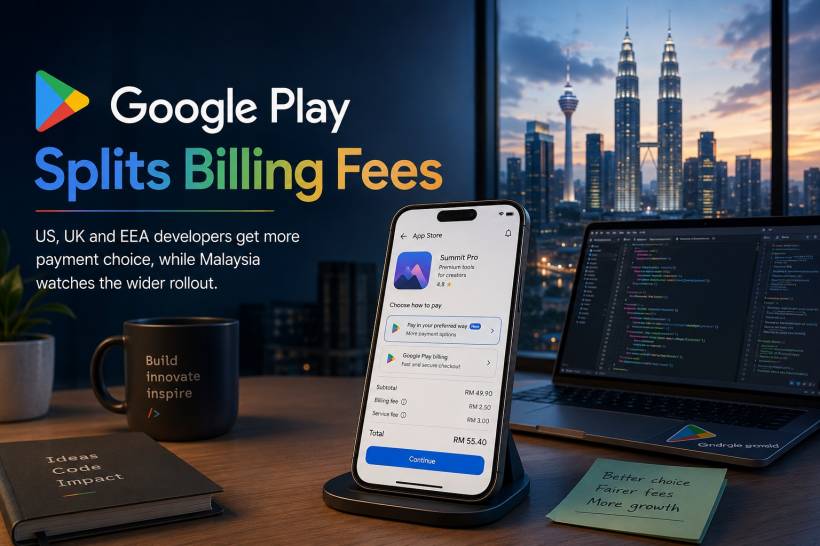
Google Play is changing the way it charges developers for digital purchases, separating its platform service fee from the fee for using Google Play Billing. The move gives developers in selected markets more freedom to offer alternative payment methods or guide users to an external website to complete purchases. It also introduces a more detailed pricing model based on where users are located, how they first installed an app, and whether the developer uses Google's billing system.
While the first rollout does not yet include Malaysia, the changes are still worth watching closely. Malaysian developers with users in the United States, United Kingdom, or European Economic Area may be affected earlier than expected, while developers serving mostly Malaysian users are likely to see the new framework later.
A New Google Play Fee Structure
Traditionally, Google Play's service fee and billing costs have been bundled into a simpler platform-charge model. Under the new approach, Google is separating them into two parts:
For developers in the US, UK, and EEA, Google Play Billing carries an additional 5% billing fee on applicable transactions. Developers using an alternative billing system or directing users to an eligible external web link will not pay that extra billing fee, although Google's core service fee still applies.
This is an important distinction. Alternative billing does not mean an app can avoid Google Play fees entirely. It simply changes how the platform's charges are structured.
More Payment Choice, But More Responsibility Too
The updated framework lets eligible developers offer users more ways to pay for in-app digital goods, subscriptions, and services.
Depending on the market and programme, developers may be able to:
However, with more flexibility comes more responsibility.
Developers handling payments outside Google Play may need to manage payment security, customer support, refunds, subscription management, purchase history, and dispute processes themselves. They must also follow payment-security requirements, including PCI-DSS obligations where relevant.
For small teams, this means the lower fee is only one part of the calculation. Building and operating a reliable payment flow can bring its own technical, legal, and support costs.
Why "New Installs" and "Existing Installs" Matter
One of the most complicated parts of Google's revised fee structure is how it separates users into "new installs" and "existing installs."
A new install refers to a user who installs an app for the first time, or first updates it through Google Play, after the new fee framework launches in their market.
An existing install refers to a user whose first installation or first Play update happened before the new model began in that market.
This matters because Google applies different service-fee rates depending on that category.
For standard non-subscription transactions, new installs receive a lower base service fee than existing installs. Google's goal appears to be encouraging new growth under the revised model while gradually transitioning older app-user relationships.
The New Rates for Early-Launch Markets
For the US, UK, and EEA, the standard model works broadly as follows:
Developers accepted into Google's updated Games Level Up or Apps Experience programmes may qualify for lower rates, including 15% for eligible new-install transactions and 20% for eligible existing-install transactions.
These programmes are aimed at developers that meet Google's evolving requirements around Android quality, user experience, device support, and platform integration.
What This Means for Malaysian Developers
For now, Malaysia is not part of the first rollout group.
Google has scheduled the updated fee model and broader billing choices for the rest of the world by 30 September 2027. Until then, the existing fee structure continues to apply to Malaysian users.
That means developers primarily serving Malaysia should not expect an immediate change to their Google Play billing arrangements on 30 June 2026.
However, Malaysian app developers should not ignore the update.
A Malaysian developer who sells subscriptions, premium app features, game items, or digital services to users in the US, UK, or EEA may need to understand the new rules much sooner. The relevant fee treatment depends on the user's market and the app's eligibility, not simply the country where the developer operates.
For local developers with an international audience, this could affect:
Malaysia's Current Position
Until the revised model reaches Malaysia, developers serving local users remain under Google Play's existing fee framework.
For most eligible developers, that generally means:
The future global rollout could change this structure, but Google has not yet published Malaysia-specific billing-fee details for the new model. In particular, the 5% billing fee announced for the US, UK, and EEA has not been confirmed for Malaysia.
So, Malaysian developers should avoid assuming that every detail from the early-launch markets will automatically apply locally.
A Gradual Global Rollout
Google is rolling out the changes in stages, likely because payment rules, consumer protection requirements, tax handling, and app-store regulations vary across markets.
The planned schedule is:
The updated Games Level Up and Apps Experience programmes are expected to become available in the US, UK, EEA, and Australia from 30 September 2026, then expand alongside the wider rollout.
Could This Lower Prices for Consumers?
Not automatically.
Developers may save on billing costs when using external payment options, but they also take on extra expenses and risk. Payment-provider fees, fraud controls, tax handling, refunds, chargebacks, support operations, and compliance work can all reduce any potential savings.
Some developers may pass savings to consumers through lower subscription prices or website-only offers. Others may use the difference to fund app development, marketing, content, or customer support.
For users, the result may be more payment options rather than immediately cheaper apps.
What Malaysian App Developers Should Do Now
Even though the local rollout is still some time away, this is a good moment for Malaysian developers to prepare.
They should consider:
For small developers, staying with Google Play Billing may remain the simplest option. For larger subscription businesses, game publishers, streaming services, education platforms, and digital-product companies, more payment flexibility could become strategically useful.
Final Thoughts
Google Play's new billing model is more than a fee reduction. It is a shift toward a more flexible, but more complex, app-commerce system.
For developers in the US, UK, and EEA, the changes begin very soon. For Malaysia, the wider rollout is currently planned for late 2027.
That gives Malaysian developers time to prepare, especially those with global audiences. The key question will not simply be whether alternative billing is cheaper. It will be whether the added control is worth the extra responsibility that comes with running more of the payment experience independently.











Comments 0