

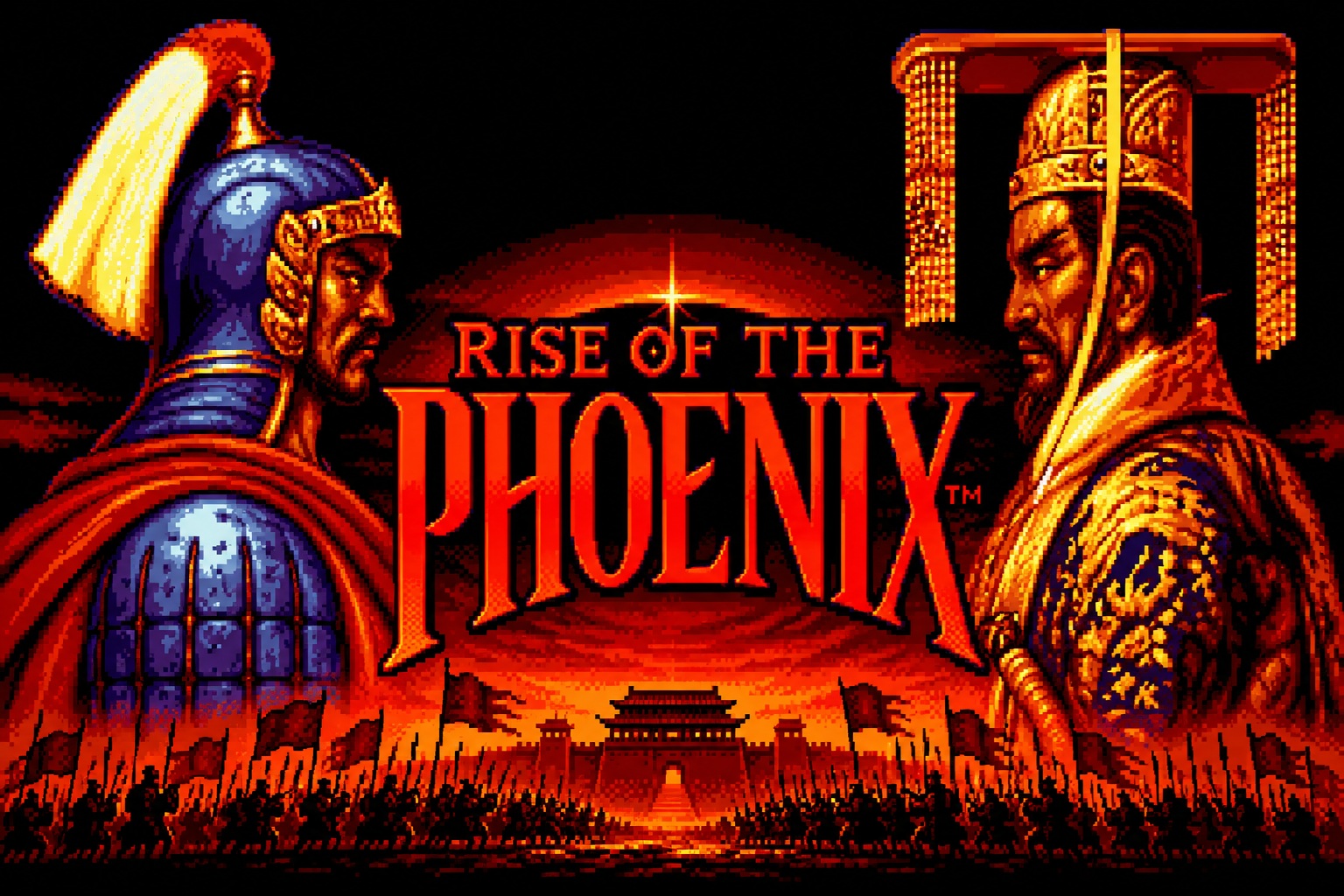
Rise of the Phoenix is a deep historical strategy game from Koei that places players in ancient China during the Chu–Han Contention, the turbulent period that followed the collapse of the Qin dynasty. Two powerful leaders stand at the centre of the conflict: Liu Bang of Han and Xiang Yu of Chu, each seeking to defeat the other and determine who will rule a newly unified China. Rather than focusing on a single battlefield, the game gives players control over cities, armies, officers, resources, diplomacy, taxation, development, and military campaigns spread across a large strategic map. Every month becomes another opportunity to strengthen a kingdom, weaken rivals, and prepare for the wars that will eventually decide the future of the country.
Like many classic Koei strategy games, Rise of the Phoenix rewards patience and long-term planning more than rapid reactions. Players need to develop productive cities, maintain military strength, recruit capable officers, manage relationships with neighbouring powers, move armies into useful positions, and decide when a military offensive is worth the risk. A poorly prepared attack can waste troops and resources, while excessive caution may allow the opposing kingdom to expand uncontested. The strongest campaigns are therefore built through a balance of economic management, diplomacy, officer development, intelligence, and carefully timed warfare.
Now playable online through Lemon Web Games, Rise of the Phoenix brings its historical campaign, turn-based strategy, city management, officer recruitment, diplomacy, field battles, sieges, and struggle between Liu Bang and Xiang Yu directly into the web browser. Players can choose a side, develop territory, organize armies, negotiate with other factions, and gradually push toward complete control of ancient China. Each decision contributes to a much larger campaign, making individual victories important without allowing a single battle to determine everything. For fans of Koei's classic historical simulations, Rise of the Phoenix remains a fascinating strategy game built around one of the most dramatic political struggles in Chinese history.
The Chu–Han Contention Provides a Powerful Historical Setting
Rise of the Phoenix takes place after the fall of the Qin dynasty, when multiple warlords struggled to control the territories left behind. The conflict eventually centred on Liu Bang and Xiang Yu, two leaders with very different personalities and approaches to warfare.
Xiang Yu emerged as one of the most formidable military commanders of the period, while Liu Bang gradually built a powerful coalition supported by capable advisers and generals. Their rivalry became the defining struggle of the Chu–Han Contention.
This historical foundation gives the campaign a natural sense of purpose. Players are not simply expanding across an anonymous map. Every city captured and alliance created contributes to the larger contest that will eventually determine which dynasty controls China.
Choose Between Liu Bang and Xiang Yu
The two central leaders encourage different strategic approaches. Liu Bang is generally suited to players who appreciate diplomacy, recruitment, and effective use of talented subordinates. His strength lies in building an organization capable of compensating for weaknesses through capable officers.
Xiang Yu offers a more aggressive alternative. His exceptional military ability makes direct warfare extremely attractive, allowing players to rely more heavily on battlefield strength and rapid conquest.
Neither leader eliminates the need for good management. Even a powerful commander can struggle if cities are neglected, armies are undersupplied, or officers are poorly positioned. The difference lies in which strengths the player can exploit most effectively.
Monthly Turns Create a Deliberate Pace
Rise of the Phoenix progresses through monthly turns rather than continuous real-time action. This gives players time to examine the political situation, review resources, check troop strength, and decide which actions deserve priority.
Each month presents limited opportunities, making every command meaningful. Developing a city may improve long-term income, while recruiting soldiers strengthens immediate military power. Moving an army could prepare an invasion but leave another region exposed.
The turn-based structure encourages planning several months ahead. Good players rarely think only about the current move. They consider how today's decision will affect the strategic position later in the year.
Cities Are the Foundation of Power
Territory in Rise of the Phoenix is valuable because cities provide the economic and military foundation needed to sustain expansion. A large army without productive cities will eventually become difficult to support.
Players can invest in development, strengthen local resources, improve taxation, and prepare cities to contribute more effectively to the kingdom. Well-managed territory produces the wealth required for recruitment and military operations.
This means conquest alone is not enough. Newly captured areas need attention before they become reliable assets. Expanding too quickly can create a large but fragile kingdom.
Economic Management Supports Every Campaign
Money influences almost every strategic system. Soldiers need to be raised, cities developed, officers supported, and military operations maintained.
Aggressive expansion can therefore become expensive. Capturing several cities may look impressive on the map, but the campaign can stall if there are not enough resources to defend and improve them.
A strong economy gives the player freedom. Wealthier kingdoms can recover from losses, reinforce important fronts, and react more effectively when an unexpected threat appears.
Taxation Creates an Important Trade-Off
Taxes provide essential revenue, but pushing the population too hard can create problems. Players need enough income to support the state without damaging the stability and productivity of their territory.
This creates another long-term decision. Maximum short-term income is not always the best option if it weakens the cities producing that wealth.
Balanced taxation allows the kingdom to continue growing while maintaining enough resources for future campaigns. The most successful rulers understand that economic strength cannot be separated from political stability.
Officers Make a Huge Difference
Rise of the Phoenix places significant emphasis on officers, generals, advisers, and other historical figures. These characters have different abilities that influence military, administrative, and strategic tasks.
A talented officer can greatly improve the effectiveness of an army or city. Assigning the correct person to the correct responsibility becomes an important part of campaign management.
This also makes recruitment valuable. Discovering or persuading a capable officer to join can strengthen the entire kingdom far more than simply adding another ordinary unit.
Recruitment Can Change the Balance of Power
Talented officers are not merely passive statistics. Bringing a skilled general or adviser into the kingdom can create entirely new strategic possibilities.
A strong commander may allow a weaker frontier to become an offensive base. A capable administrator can make an underperforming city far more useful.
Recruitment therefore becomes another form of competition. Every valuable officer gained by one side is someone the opposing kingdom can no longer use.
Diplomacy Offers Alternatives to Immediate War
Not every problem needs to be solved through direct invasion. Diplomatic actions allow players to influence relationships, build temporary cooperation, and manage the wider political landscape.
Alliances can protect a vulnerable border while the main army concentrates elsewhere. Negotiations may also buy time for economic recovery or military preparation.
Diplomacy is particularly useful when several powers remain active. Fighting everyone simultaneously is rarely efficient. Good players use political relationships to determine when and where wars occur.
Other Warlords Complicate the Struggle
Although Liu Bang and Xiang Yu dominate the historical conflict, the strategic map contains other leaders and territories that can influence the campaign.
These smaller powers create opportunities and dangers. A neighbouring warlord may become an ally, target, buffer state, or future rival depending on circumstances.
Their presence makes each campaign less predictable. Expanding toward one region may create a completely different political situation than focusing on another.
Army Management Requires Preparation
Military strength depends on more than simply ordering troops into enemy territory. Armies need capable commanders, sufficient numbers, useful positioning, and enough support to survive a prolonged campaign.
An army that appears powerful on paper can still fail if sent too far from friendly territory or committed against a heavily defended city without proper preparation.
Players therefore benefit from assembling forces carefully before launching major offensives. Sometimes several months of preparation are justified if they prevent a disastrous defeat.
Open-Field Battles Reward Tactical Thinking
When armies meet outside fortified cities, combat shifts toward tactical considerations. Positioning, numbers, commanders, and available strategies all influence the outcome.
Players need to understand when to attack aggressively and when preserving the army matters more than forcing an immediate victory. Losing an entire force can create vulnerabilities far beyond the battlefield itself.
This connection between tactical and strategic layers is one of the game's greatest strengths. A battlefield decision can reshape the campaign map for months afterward.
Castle Sieges Create Different Challenges
Capturing an enemy city often requires overcoming fortified positions. Siege warfare naturally feels different from open-field combat because defenders benefit from the security of their stronghold.
Attacking without adequate preparation can become extremely costly. A strong defensive position may absorb losses that would be unacceptable in an ordinary battle.
Sieges therefore reward patience. Weakening an opponent economically or isolating a city before attacking can sometimes be more effective than immediately committing the main army.
Ambushes Can Punish Careless Enemies
Rise of the Phoenix provides tactical options beyond straightforward attacks. Ambushes allow a prepared force to surprise an opponent and potentially gain an advantage before conventional fighting begins.
The effectiveness of such tactics depends on planning and the officers involved. A well-executed ambush can disrupt a stronger enemy and create opportunities for a smaller army.
These options give battles more personality than simply comparing troop totals. Command decisions and tactical preparation can matter enormously.
Night Raids Offer High-Risk Opportunities
Night attacks provide another way to disrupt enemy forces. Striking under cover of darkness can create surprise, but such operations naturally carry additional risk.
A successful raid may weaken the enemy before a larger engagement, destroy morale, or force the opposing commander into a worse position. Failure, however, can waste valuable troops.
The mechanic encourages players to consider unconventional tactics instead of assuming that every conflict should begin with a full frontal assault.
Flooding Can Turn Geography Into a Weapon
One of the more memorable strategic possibilities involves manipulating rivers and water to flood enemy positions. This transforms the environment itself into part of the military strategy.
Using such a tactic effectively can dramatically weaken enemy forces or disrupt defensive preparations. It also reflects the importance of geography in historical Chinese warfare.
The ability to use terrain in this way gives Rise of the Phoenix a distinctive tactical identity. The battlefield is not merely decorative; environmental conditions can become another weapon.
Different Officers Excel at Different Tasks
A brilliant battlefield commander may not necessarily be the best person to administer a city. Likewise, a talented political adviser may contribute little during direct combat.
Understanding these differences allows players to organize the kingdom more efficiently. Officers should be assigned according to their strengths rather than simply their fame.
This creates a satisfying management layer. Building the right leadership structure can be just as important as recruiting additional soldiers.
Liu Bang Rewards Strong Delegation
Liu Bang's greatest advantage comes from his ability to attract and utilize talented people. His historical strength was not simply personal combat ability but the quality of those who served under him.
Players following this route can build a flexible kingdom supported by capable officers handling different responsibilities. Strong delegation makes it possible to manage several regions effectively.
This style suits players who enjoy developing an organization rather than relying primarily on one overwhelming commander.
Xiang Yu Encourages Aggressive Expansion
Xiang Yu's exceptional military ability makes offensive warfare especially attractive. A strong commander can win battles that might otherwise require much larger forces.
This creates opportunities for rapid expansion if players maintain enough resources to support continued campaigning. Momentum becomes extremely valuable.
The danger is becoming too dependent on military strength. Even a brilliant general cannot be everywhere simultaneously. Economic and diplomatic weaknesses can still undermine an aggressive campaign.
Territory Needs to Be Defended After Conquest
Capturing a city is only the beginning. Newly gained territory can become vulnerable if the main army immediately leaves without establishing a strong defensive position.
Enemy counterattacks can erase months of progress, especially when valuable officers or troops have already moved elsewhere.
Players therefore need to think about defensive depth. A successful offensive creates new borders, and those borders need their own commanders, troops, and resources.
Overextension Can Destroy a Strong Kingdom
Rapid expansion looks impressive but can create serious strategic problems. More territory means more borders to defend, more cities to manage, and longer distances between important armies.
An opponent may deliberately avoid the strongest army and attack somewhere else instead. If reinforcements cannot arrive quickly enough, distant cities can fall one after another.
Maintaining a compact and defensible realm can sometimes be more valuable than controlling a larger but unstable collection of territories.
Intelligence Helps Prevent Surprises
Knowing the condition of neighbouring regions can influence every major decision. Information about troop strength, officers, and political relationships allows players to identify weak targets and avoid disastrous attacks.
Without adequate intelligence, an apparently vulnerable city may contain a much stronger army than expected. Preparing before committing forces reduces unnecessary risk.
Strategic information becomes especially valuable once several fronts are active. The player needs to understand not only what is happening locally but how the entire map is changing.
Two-Player Support Adds Political Tension
Rise of the Phoenix also supports two-player competition, allowing separate players to control opposing factions. This dramatically changes the experience because human opponents are less predictable than computer-controlled rivals.
Diplomacy becomes more psychological, military movements can contain deliberate deception, and apparent weaknesses may actually be traps.
The slow strategic structure works particularly well with human competition. Every turn becomes another opportunity to anticipate what the opposing player intends to do next.
Historical Officers Give the Campaign Personality
The game includes numerous figures associated with the period, giving the strategic systems a stronger historical identity. Famous generals and advisers are more memorable than anonymous units.
Players who become familiar with individual officers begin recognising which characters are especially valuable for particular responsibilities. Recruitment and loyalty then become personal strategic concerns.
This is a hallmark of Koei's historical games. The campaign is not only about territories and armies but also about the people responsible for controlling them.
The Interface Reflects Classic Koei Strategy Design
Rise of the Phoenix uses maps, menus, statistics, officer screens, and command systems typical of Koei's historical simulations. New players may initially encounter a significant amount of information.
Once the relationship between the systems becomes clear, however, the interface allows detailed control over nearly every aspect of the kingdom. Each menu contributes directly to the strategic campaign.
The presentation may feel dense compared with modern streamlined strategy games, but that complexity is part of the appeal. Rise of the Phoenix expects players to behave more like rulers than battlefield heroes.
Patience Is More Valuable Than Constant War
One of the easiest mistakes is assuming that every turn should contain another attack. Sometimes the strongest move is spending several months improving cities, rebuilding armies, and waiting for rivals to weaken themselves.
A peaceful period can create the economic strength required for a decisive future offensive. Allowing enemy factions to fight each other may also produce opportunities that direct intervention would have prevented.
Knowing when not to fight separates careful strategy from simple aggression. The campaign rewards rulers who recognize when preparation is more important than immediate conquest.
Victory Requires More Than Winning Battles
A player can perform extremely well in individual battles and still lose the wider campaign. Poor finances, weak diplomacy, badly managed cities, and excessive expansion can eventually overcome even impressive battlefield success.
Likewise, careful administration can create such a strong foundation that later wars become much easier. Economic and political preparation often determines how much military force can ultimately be deployed.
Rise of the Phoenix therefore treats warfare as one part of governing rather than the entire game. Complete victory comes from coordinating all available systems.
Playing Rise of the Phoenix Online Today
Through Lemon Web Games, Rise of the Phoenix can now be played directly in your web browser with no downloads or setup required. Features of the web-based version include:
New players should avoid trying to conquer too much territory immediately. Build a reliable economy, recruit useful officers, and make sure important cities can defend themselves before committing to a major offensive. A smaller kingdom with strong administration is often more dangerous than a larger one stretched across too many borders.
It is equally important to study officer abilities. Assign talented commanders to important military campaigns while using stronger administrators to develop valuable cities. Getting more value from existing officers can often be more effective than simply recruiting additional troops.
Who Should Play Rise of the Phoenix
Rise of the Phoenix is particularly suitable for players who enjoy campaigns where every system contributes to long-term success. Economy, officers, diplomacy, territory, and armies all influence one another, making careless decisions difficult to isolate.
It should also appeal to players familiar with Koei's Romance of the Three Kingdoms series. The historical period is different, but the emphasis on rulers, officers, political management, and strategic warfare will feel immediately familiar.
Play Rise of the Phoenix Online Now
Rise of the Phoenix places one of ancient China's most important struggles directly under the player's control. Choose Liu Bang or Xiang Yu, develop cities, collect taxes, recruit talented officers, build armies, negotiate with rivals, and decide exactly when diplomacy should give way to war.
Through Lemon Web Games, players can experience this classic historical strategy game directly in a modern browser and attempt to reshape the outcome of the Chu–Han Contention. Every city captured brings unification closer, but every new frontier creates another responsibility. Winning China requires far more than simply winning the next battle.
Final Thoughts
Rise of the Phoenix remains compelling because it treats historical conquest as a combination of leadership, administration, diplomacy, and warfare. Strong armies matter, but those armies depend on productive cities and capable officers. Victories matter, but poorly defended territory can disappear just as quickly as it was captured. Nearly every system connects back to the larger objective of creating a kingdom powerful enough to survive the struggle for China.
The contrast between Liu Bang and Xiang Yu also gives the campaign strong replay value. One encourages players to exploit capable subordinates, political relationships, and organizational strength, while the other makes aggressive military action particularly attractive. Different officers, alliances, and routes of expansion can further change how each campaign develops.
Through Lemon Web Games, Rise of the Phoenix can now be experienced directly in the browser as one of Koei's distinctive historical strategy games. Its interface and pacing reflect the deliberate style of classic 16-bit strategy, but the underlying decisions remain deeply engaging. For players who enjoy building kingdoms carefully, commanding historical officers, and shaping the outcome of ancient conflicts one month at a time, the struggle between Han and Chu remains well worth revisiting.











Comments 0