

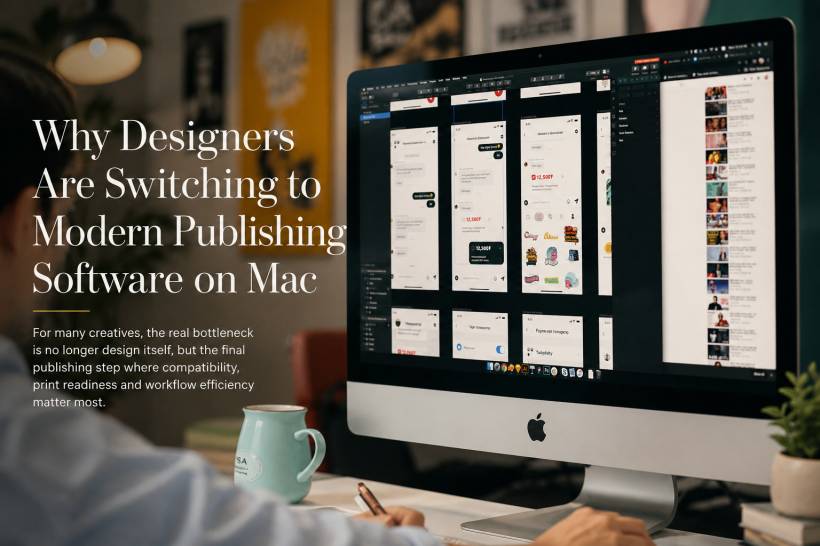
Mac users have never lacked powerful creative tools. From illustration and photo editing to interface design and prototyping, the platform has long been associated with professional creative work. The frustration often begins after the design itself is finished.
Turning completed artwork into a polished brochure, catalogue, magazine, report or print-ready document can still involve awkward file conversions, inconsistent formatting and repeated checks before the final material is ready to distribute. This final publishing stage is where many otherwise smooth creative workflows begin to slow down.
The Publishing Problem That Often Gets Overlooked
Most creative software discussions focus on the exciting parts of the process: designing layouts, creating illustrations, adjusting images and developing visual concepts.
Far less attention is given to what happens at the end.
Before a document can be sent to a printer, shared with a client or published digitally, designers must manage details such as:
None of these tasks is especially glamorous, but mistakes at this stage can lead to expensive reprints, incorrect colours, missing fonts or layouts that shift when opened by another person.
For years, many Mac-based designers have relied on combinations of plugins, conversion tools and manual workarounds to bridge this gap. The result is often more files, more checking and more opportunities for something to go wrong.
Why Legacy Publishing Tools Can Feel Out of Place on macOS
Older desktop-publishing applications were often designed around workflows and operating systems that looked very different from the modern Mac environment.
Even when those programs technically run on macOS, they may not feel fully integrated with it. Designers can encounter differences in file handling, font behaviour, interface conventions and colour management.
The issue is not always that the software lacks features. Some legacy programs remain extremely capable. The problem is that they may require the user to adapt their working habits around the application instead of fitting naturally into the wider Mac workflow.
That distinction matters.
A designer may already be using macOS-native tools for image editing, illustration, cloud storage and collaboration. Introducing a publishing application that handles files, fonts or exports differently can create unnecessary friction at every handoff.
Modern alternatives are increasingly being designed with the Mac ecosystem in mind from the beginning. They tend to follow familiar interface patterns, work more naturally with system-level font management and provide better support for Apple's display and colour technologies.
Modern Software Is About More Than a Newer Interface
The word "modern" should not simply mean that an application has a recent version number or a redesigned toolbar.
A genuinely modern publishing tool should reflect how designers work today.
That includes support for high-resolution displays, flexible cloud storage, shared assets, common file formats and faster movement between applications. It should also reduce the number of times a designer needs to stop and convert, flatten or rebuild something.
Accessibility is becoming another important consideration.
Some creative applications are beginning to introduce improved keyboard navigation, voice controls and interface options that support users with different accessibility needs. For studios working with diverse teams, these capabilities can influence which tools are practical for long-term adoption.
The most meaningful improvements are often not individual headline features. They are the small architectural decisions that make the overall workflow feel smoother.
Workflow Matters More Than the Length of the Feature List
Creative professionals often choose Macs because the operating environment tends to stay out of the way of the work.
The same principle applies to publishing software.
A tool does not become valuable simply because it has hundreds of features. It earns its place when it reduces interruptions and removes repetitive steps.
For example, a publishing application that can open files from existing design tools, preserve typography correctly and export a print-ready PDF without additional plugins may save more time than a larger program filled with functions the designer rarely uses.
The biggest improvements often come from reducing handoff costs.
When artwork moves between applications without losing formatting, colour information or linked assets, the designer can remain focused on the project instead of repeatedly troubleshooting compatibility issues.
Native Mac Integration Can Make a Noticeable Difference
Software built specifically for macOS can take advantage of features that cross-platform or Windows-first applications may handle less naturally.
These advantages can include:
Individually, these may appear to be small conveniences. Across a full working day, however, they can significantly reduce friction.
Performance on Apple silicon has also become a major consideration. Applications optimised for current Mac processors can launch faster, handle complex pages more smoothly and use system resources more efficiently than software still relying heavily on older architecture or translation layers.
What Designers Should Look for Before Switching
Moving away from familiar software should not be done simply because a newer option looks more attractive.
A publishing tool needs to prove that it can handle real production requirements.
One of the first things to examine is its PDF export capability. Professional printing often requires more than simply selecting "Save as PDF." The application should support proper bleed settings, crop marks, embedded fonts and appropriate colour output.
Preflight checking is also essential.
A useful preflight system can identify missing images, low-resolution assets, unsupported colour modes, overflowing text and fonts that may not export correctly. Catching these problems before sending the file to a printer can prevent delays and additional costs.
The application should also support the common formats used by clients, print vendors and other designers. A tool that works well only within its own ecosystem may create new problems later.
Avoid Trading One Form of Lock-In for Another
Proprietary file formats can become a serious concern when changing publishing platforms.
Designers should consider whether their work can be exported into widely supported formats and whether important assets remain accessible if the software is no longer available in the future.
A good publishing application should not force users to remain dependent on a single vendor just to open their own projects.
At minimum, completed work should be exportable into dependable formats such as PDF, while images, text and other assets should remain recoverable without complicated conversions.
Long-term access matters especially for agencies and businesses that may need to update a catalogue, report or marketing document several years after it was originally produced.
Variable Data and Repetitive Layouts Need Proper Support
Some publishing tasks involve more than creating a single static document.
Product catalogues, certificates, event materials, personalised mailers and business reports may contain information that changes across dozens or hundreds of pages.
Modern publishing software should be able to handle variable data without requiring every page to be edited manually.
The layout should remain stable when names, prices, descriptions or other information change in length. It should also be possible to connect structured data to a template without breaking the design.
For studios producing high-volume materials, reliable variable-data handling can save hours of repetitive work and reduce the likelihood of human error.
Collaboration Has Become Part of the Publishing Process
Publishing was once treated mainly as a final production task carried out by one specialist.
Today, documents often pass through designers, writers, marketing teams, clients and printers before they are approved.
Modern software should support this collaborative reality.
Useful features may include shared document access, version tracking, comments, linked assets and simple ways to package a project for another user.
Even when real-time collaboration is not available, the software should make it easy to collect everything needed for handover. A printer or colleague should not have to search through multiple folders to locate missing fonts or images.
Print and Digital Outputs Now Need to Coexist
Designers are increasingly expected to create content for both print and digital distribution.
A brochure may be printed physically, shared as a downloadable PDF and displayed on a website. A report may need one version for high-quality printing and another compressed version for email.
Modern publishing tools should make it easier to create these different outputs from the same source document.
The goal is not to produce identical files for every platform, but to avoid rebuilding the entire layout each time the delivery method changes.
Responsive design is still handled differently from traditional page publishing, but applications that support flexible layouts, interactive PDFs and multiple export presets can reduce duplicated effort.
Why Designers Are Finally Willing to Leave Familiar Tools
Creative professionals are often reluctant to change software because familiarity has real value.
A designer who has spent years learning shortcuts, templates and production methods can work extremely quickly inside an established application. Switching means investing time in training, rebuilding resources and adjusting old habits.
The fact that more designers are considering alternatives suggests that the benefits are beginning to outweigh those costs.
They are not necessarily chasing novelty. Many are simply trying to eliminate a mismatch that has existed for years between their preferred creative platform and their publishing software.
As Mac-focused options improve, designers no longer have to choose between powerful publishing features and a workflow that feels native to their computer.
Final Thoughts
The move towards modern publishing software on Mac is less about abandoning the past and more about removing unnecessary friction from the final stage of creative work.
Designers already have capable tools for producing illustrations, photographs and layouts. What they increasingly expect is a publishing application that connects those elements without introducing extra conversions, compatibility problems or manual corrections.
The best option will not always be the application with the longest feature list. It will be the one that fits naturally into the existing workflow, produces dependable print and digital files, supports common formats and keeps the designer in control of their work.
The conversation is no longer simply about which publishing programs are available for Mac. It is about which ones were designed to work properly within the Mac ecosystem—and that shift is giving creative professionals far better choices.











Comments 0