

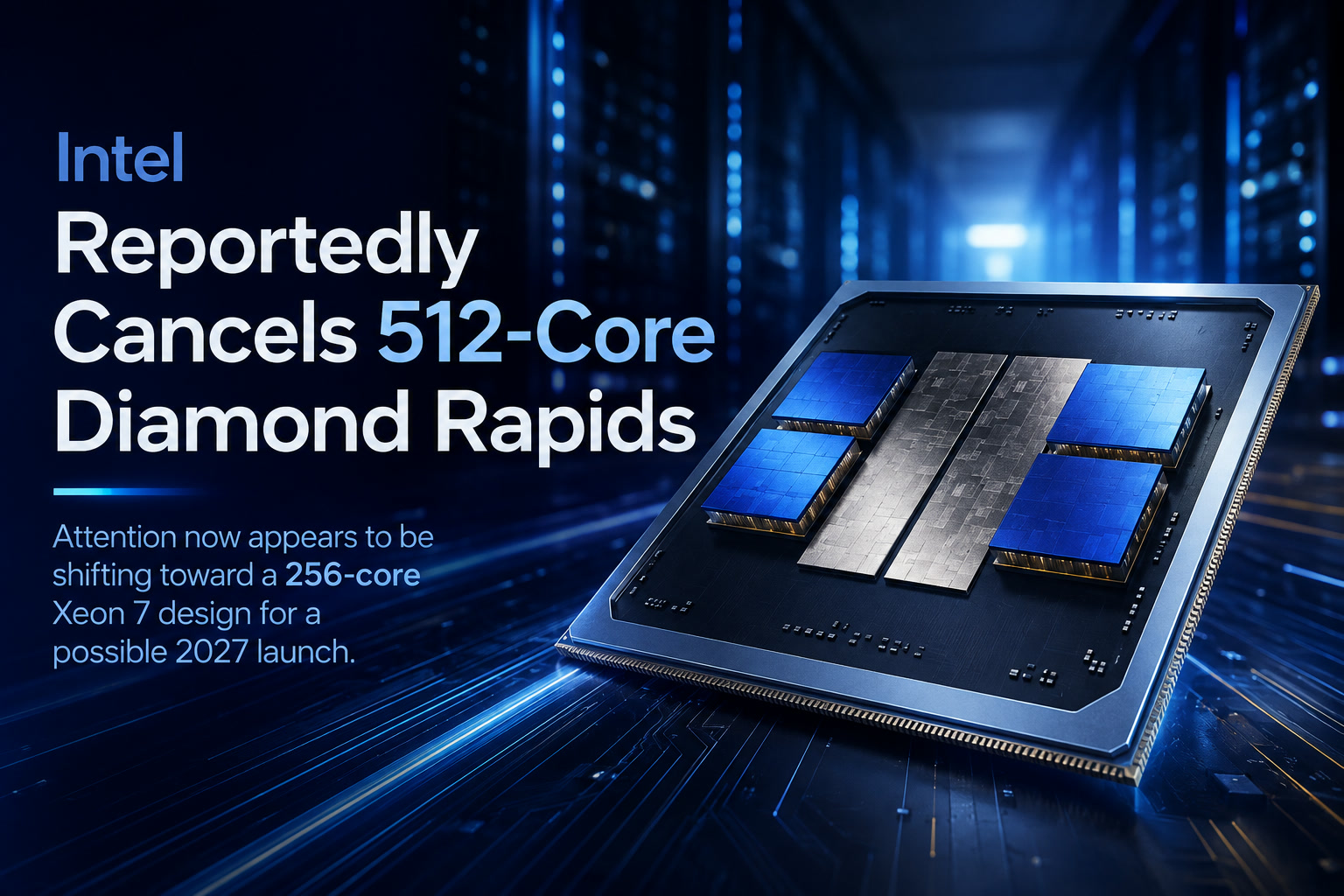
Intel may be scaling back one of the most ambitious processors planned for its upcoming Diamond Rapids Xeon generation. According to new reports, the company has reportedly cancelled a massive 512-core Xeon 7 processor that was expected to rely entirely on efficiency-focused cores.
Instead, Intel is believed to be redirecting its efforts toward a 256-core Diamond Rapids processor built around performance cores, potentially setting up a much more direct confrontation with AMD's high-core-count EPYC server lineup.
If the information proves accurate, it would represent a significant change in Intel's strategy for the next generation of data-center processors.
The 512-Core Xeon May Never Make It Beyond the Drawing Board
Rumours surrounding a 512-core Diamond Rapids processor have been circulating for some time, with earlier reports suggesting development was progressing as planned.
As recently as April, the enormous server processor was reportedly still part of Intel's roadmap.
The latest information paints a very different picture.
According to hardware leaker Jaykihn, Intel has apparently decided to cancel the 512-core configuration while it was still in the definition stage, meaning the processor had not yet progressed into full-scale production development.
That distinction is important. Intel hasn't necessarily cancelled a finished chip that was about to enter factories; rather, the company may have decided that pursuing such an extreme configuration was no longer worthwhile before committing significantly more engineering resources to it.
And with 512 CPU cores on a single server processor, there were certainly plenty of engineering challenges to overcome.
512 Efficiency Cores Sound Impressive, but There Are Trade-Offs
The cancelled processor was reportedly designed around 512 E-cores, prioritising extremely high core density rather than maximum performance from each individual core.
That sort of architecture makes sense for heavily parallel workloads.
Cloud services, web hosting, microservices, containerised environments and other server applications can sometimes benefit tremendously from having hundreds of relatively efficient CPU cores available simultaneously.
The problem is that doubling core counts isn't free.
More cores require additional silicon, cache resources, memory bandwidth, interconnect capacity and power delivery. Intel also has to consider how efficiently all those cores can communicate while keeping thermal and power consumption within practical server limits.
At some point, simply adding additional cores produces diminishing returns.
Intel may therefore have decided that a 512-core design would be unnecessarily complex compared with concentrting resources on a smaller number of significantly more powerful cores.
The New Target Could Be a 256-Core All-P-Core Xeon
The more interesting part of the report is what Intel may be building instead.
Rather than pushing ahead with 512 efficiency cores, Intel is reportedly focusing on a 256-core Diamond Rapids Xeon 7 processor using only P-cores.
That would completely change the character of the CPU.
Instead of chasing maximum core density, an all-P-core configuration would place greater emphasis on per-core performance, instruction throughput and performance in workloads where individual CPU cores need considerably more processing capability.
For enterprise customers, that could arguably be more useful than simply having hundreds of smaller cores available.
It would also put Intel into much more direct competition with AMD.
Intel and AMD Could End Up Fighting at 256 Cores
The shift toward a 256-core Diamond Rapids processor is particularly interesting because AMD is also pushing its EPYC processors toward extremely high core counts.
AMD's EPYC 9006 "Venice" family is expected to include configurations reaching 256 Zen 6 cores, placing both companies within the same headline core-count territory.
Of course, comparing server processors based purely on core count doesn't tell the entire story.
Architectural efficiency, clock speeds, memory bandwidth, cache design, interconnect performance, accelerator support and power consumption can all have enormous effects on real-world server performance.
But from a marketing perspective, having Intel and AMD both competing around the 256-core mark would certainly make the next generation of enterprise CPUs particularly interesting.
Instead of one company simply advertising twice as many cores as the other, the competition could increasingly come down to how effectively those cores actually perform.
Diamond Rapids Represents a Major Architectural Step for Intel
Diamond Rapids is expected to become an important generation for Intel's Xeon platform.
The processor family is reportedly designed around multiple compute tiles, which Intel refers to as Core Building Blocks, or CBBs.
Rather than creating one gigantic piece of silicon containing every CPU core, the processor can be constructed from several compute blocks connected together within the same package.
This modular approach has become increasingly important for modern high-end processors.
Building extremely large monolithic chips becomes difficult and expensive because manufacturing yields generally decrease as individual dies become larger. Breaking the CPU into several smaller components allows chipmakers to combine multiple pieces of silicon into one processor while potentially improving manufacturing flexibility.
It is an approach already seen throughout the industry, particularly within AMD's chiplet-based EPYC processors.
Intel's 18A Process Will Be Crucial
Diamond Rapids is also expected to take advantage of Intel's advanced 18A-family manufacturing technology, making the platform particularly important for the company's foundry ambitions.
Intel has been investing heavily in regaining process leadership, and its next-generation manufacturing nodes are expected to play a major role in that effort.
For enormous server processors, improvements in transistor efficiency become especially important.
Even modest efficiency gains multiplied across hundreds of CPU cores can translate into substantial reductions in electricity consumption and heat generation.
That matters enormously inside data centres, where power and cooling costs can become just as important as the price of the hardware itself.
Reports surrounding the underlying process technology have suggested improvements in both performance and power efficiency compared with earlier generations, although final Diamond Rapids performance will ultimately depend on much more than manufacturing technology alone.
Data Centres Care About More Than Just Core Count
The apparent cancellation of the 512-core model may also reflect how server customers actually choose processors.
A chip with 512 cores sounds extraordinary on a specification sheet, but data-centre operators rarely select processors based on core count alone.
They also have to consider performance per watt, memory capacity, memory bandwidth, software licensing, virtualisation performance and total cost of ownership.
Software licensing can be particularly important.
Some enterprise applications are licensed according to processor sockets or CPU cores. In those environments, doubling the number of cores doesn't necessarily mean the customer gets twice as much value.
A processor with fewer but faster cores could therefore make considerably more financial sense for certain workloads.
That could make a powerful 256-core P-core Xeon more commercially attractive than an enormous 512-core E-core design.
AMD's EPYC Momentum Adds Even More Pressure
Intel also isn't developing Diamond Rapids in isolation.
AMD has spent several generations aggressively expanding its position in the enterprise and data-centre CPU market, with EPYC processors becoming increasingly competitive in core density, efficiency and performance.
The upcoming battle between Diamond Rapids and AMD's newer EPYC platforms therefore won't simply be about who can build the processor with the biggest number printed on the specification sheet.
Intel needs a platform that is competitive across a much wider range of metrics.
That includes performance per socket, memory throughput, power efficiency, platform features and workloads ranging from conventional enterprise databases to cloud computing and increasingly AI-related infrastructure.
A 256-core high-performance design may ultimately give Intel more flexibility across those workloads.
A 2027 Arrival Is Currently Expected
Intel hasn't officially announced a launch date for Diamond Rapids.
Current speculation points toward a 2027 launch window, although server processor roadmaps can change considerably before products actually reach customers.
That would give Intel additional time to refine both the architecture and manufacturing process before Diamond Rapids enters what is likely to be an extremely competitive server CPU market.
By then, raw CPU core counts may not even be the biggest battleground.
Modern data centres are increasingly combining CPUs with GPUs, AI accelerators and other specialised processors, meaning overall platform efficiency is becoming increasingly important.
Final Thoughts
Losing a 512-core Xeon might initially sound like Intel is taking a step backwards, but the reality could be considerably more nuanced.
A processor with 512 E-cores would have been an extraordinary engineering achievement, but an equally important question is whether customers actually need that many cores within a single CPU package.
Redirecting those resources toward a 256-core processor using higher-performance cores could ultimately result in a more balanced and competitive product.
It would also put Intel and AMD into an intriguing position where both companies could offer server processors with similar headline core counts, leaving architecture, efficiency and real-world performance to determine the winner.
For now, however, the reported cancellation remains unofficial. Until Intel reveals the final Diamond Rapids lineup, the 512-core monster will remain one of those fascinating processors that may have existed on a roadmap, but never quite made it into a server rack.











Comments 0