

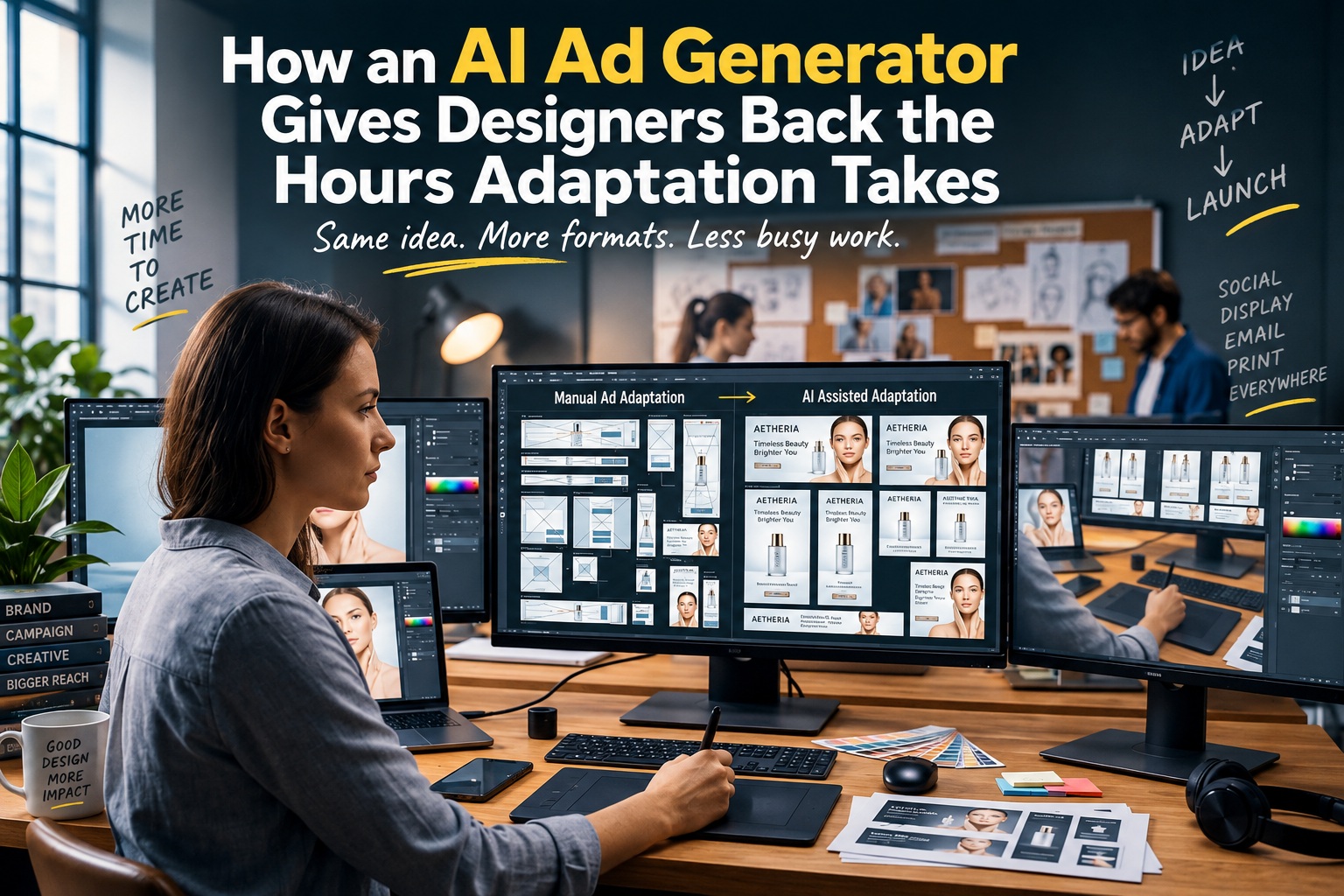
Ask most commercial designers where their week actually goes and the answer is rarely "coming up with ideas." The concept might arrive during a morning workshop, while sketching over coffee, or even on the commute to the studio. Once the creative direction, type treatment, imagery and hierarchy have been agreed, however, a very different kind of work begins: adapting that one approved idea into every size, placement, market and channel the campaign requires.
That is where the hours disappear. The hero artwork becomes a square social post, a vertical Story, a leaderboard banner, an email header, a skyscraper ad, an out-of-home format and several regional variations. Legal asks for another sentence, the price changes two days before launch, and one market needs copy that reads right-to-left. None of this feels like concept development, yet it can easily consume more time than creating the original idea.
This is also where AI ad-generation tools make the strongest case for themselves. Their value is not necessarily in replacing the designer who creates the campaign idea. It is in taking an approved creative direction and helping carry it across the dozens of executions that come afterward.
The Concept Is One Decision; Adaptation Is Dozens
It is easy for someone outside a design team to look at a campaign adaptation and assume the job is simply resizing an existing layout. In reality, changing dimensions usually forces a chain of new decisions. A square composition that feels balanced can become cramped when squeezed into a narrow mobile banner, while a wide landscape image may lose its strongest focal point when turned into a vertical Story.
Hierarchy becomes the real challenge. A large poster has room for a headline, supporting copy, image, logo and call to action to coexist comfortably. A small banner may only have enough visual space for one strong message, which means the designer has to decide what survives and what disappears. Copy may need rewriting, the image may need a completely different crop, and typography that worked beautifully at large scale may suddenly become unreadable at thumbnail size.
Those choices cannot always be solved once at the beginning of the project because every placement creates a different constraint. A campaign running across social, display, email and outdoor media can easily require 20 or 30 outputs, each of which still needs someone to look at it and decide whether the original idea has survived the transition.
That is why adaptation is so time-consuming. It looks repetitive from the outside, but internally it is a sequence of small design judgements repeated at scale.
Why Templates Only Solve Part of the Problem
Most studios already have systems for reducing repetitive production work. Linked artboards, master templates, reusable components and design systems can make adaptation dramatically faster when the relationship between elements remains predictable. They work particularly well for things such as weekly social graphics, product cards or recurring promotional formats where the same structure is reused again and again.
Campaign work is less cooperative. The problem is that a campaign is usually one idea expressed differently rather than one layout copied repeatedly. The image that carries the square version may be useless in a skyscraper banner, while the headline that looks elegant over two lines may become four awkward lines in a narrow format. At some point, the template starts fighting the creative rather than supporting it.
This is where an AI Ad Generator can be more useful than a rigid master file. Instead of treating the previous layout as geometry that must be preserved, the system can work from the broader creative intent and generate a new execution suited to the next format. That is closer to how a designer approaches adaptation manually: preserve the idea, not necessarily every pixel relationship.
The distinction matters because the goal is not simply to make everything fit. The goal is to make every format still feel as though somebody designed it intentionally.
The Craft Still Lives in the Concept
There is a tendency for generative AI marketing to imply that the tool can take over the entire creative process, but that is not where its most convincing value lies. The concept remains the difficult part: deciding what the campaign is actually saying, selecting the image that carries the idea, determining the relationship between copy and visual, choosing typography and understanding why someone should pay attention in the first place.
Those are not production tasks. They are decisions about meaning, tone and relevance, and they still require a designer who understands the brand and the audience. Typography alone is more than selecting a font that technically fits; the choice communicates personality, authority, energy and cultural context before the viewer even reads the words.
Hierarchy is equally important. When a format only has room for one visual message, someone has to decide which part of the campaign is essential enough to survive. That decision is design work because it requires understanding why the original composition worked.
What AI can reasonably take over is the mechanical expression of those already settled decisions. If the creative direction has been properly established, there is little reason a senior designer should spend two full days manually rebuilding the same idea across another 25 placements unless those formats genuinely demand new judgement.
Where an AI Ad Generator Becomes Useful
The most obvious use case is producing format variants after the hero execution has been approved. A designer can establish the campaign properly once, then use the AI system to generate versions for the different placements called for in the media plan. The designer still reviews the work, but they are no longer starting from an empty artboard every time.
Market and seasonal variations are another natural fit. The structure and creative direction may remain intact while the product, date, location, language, or visual subject changes. Instead of reopening dozens of master files and manually rebuilding every asset, the campaign treatment can be applied to the new content much more quickly.
Alternate imagery can be particularly valuable. Campaigns often need different people, products or environments while preserving the same general design language. Historically, the number of variants was constrained by what could be photographed, licensed or manually composited within the production budget. Generative tools can expand those options, provided brand, legal and authenticity requirements are properly managed.
Then there are the inevitable late changes. A disclaimer gets longer, legal rewrites one sentence, a promotion date moves or the client changes the price on Friday afternoon. Updating a campaign across 30 assets is exactly the sort of production work where automation has a practical rather than theoretical advantage.
Where Higgsfield Fits Into This Workflow
Higgsfield approaches the problem as a broader AI creative environment rather than a single-purpose generation tool. In an adaptation workflow, the useful part is the ability to establish a creative treatment and then reuse that direction across later outputs rather than recreating the look from scratch every time.
A designer can concentrate on getting the hero execution right first, including the visual tone, composition and brand expression. Once that direction is settled, the same treatment can become the foundation for the rest of the campaign. This is similar to what designers have always wanted from linked templates, except the system is working more from creative intent than from fixed geometry.
Project organisation and version history also matter more than they initially appear. Real campaigns accumulate approved assets, rejected experiments, client revisions, country-specific versions and last-minute amendments. Being able to keep those variations inside the same project makes it much easier to find the right version months later when someone suddenly asks for the German adaptation from the previous campaign.
The fact that the platform operates through a browser also lowers some of the practical friction around evaluation. A team can test whether the workflow actually saves time before committing to a larger change in production process, which is far more useful than judging the technology from a polished product demo.
Designers Are Right to Be Sceptical
Designers have good reasons to be cautious about generative tools. The industry has repeatedly made extravagant claims about replacing creative work, while discussions around training data, copyright, authorship and the value of human craft remain unresolved. That scepticism should not be dismissed simply because automation has become fashionable.
A more useful claim is much narrower: AI does not need to replace concept development to be valuable. Commercial designers already spend enormous amounts of time on production work that exists only because somebody has to perform it. If software can reduce the hours spent rebuilding approved ideas across placements, that does not make the concept less valuable. It potentially creates more room for the part of the job that actually requires a designer.
A studio where a senior designer spends most of Thursday and Friday resizing assets has a resource problem. Those are expensive hours being spent on work that contributes relatively little new creative thinking. Recovering even part of that time can allow the team to explore another concept, improve the hero execution, test more ideas or simply reduce the constant production pressure that makes commercial design feel mechanical.
The important part is keeping responsibility where it belongs. AI-generated adaptations still need human approval because a malformed crop, incorrect legal line or poorly positioned logo is ultimately the studio's problem, regardless of which tool produced it.
What Still Needs a Designer
Typography should remain deliberate, particularly when brand guidelines or contractual requirements specify exact wording, spacing or hierarchy. A generated approximation is not good enough when the type itself is part of the identity. Brand consistency also requires judgement because a system can reproduce surface characteristics without necessarily understanding why certain choices were made.
Legal and regulated content obviously needs even more care. Any campaign containing mandatory disclaimers, financial information, product claims or jurisdiction-specific language should be checked intentionally rather than treated as another generated element. Automation can speed up the layout, but accountability cannot be automated away.
Most importantly, designers still need to review every output. Generating 30 assets in minutes simply changes the nature of the work from constructing every version to evaluating them. The designer becomes more of an editor and creative director across the adaptation set, identifying the handful of placements where the hierarchy genuinely needs to change.
That may actually be a healthier use of design time. Instead of repeatedly performing the same crop, the designer concentrates attention where the system cannot confidently make the right decision.
What Happens to Junior Designers?
There is a legitimate concern that adaptation has historically been part of how junior designers learn. Rebuilding campaigns across different formats teaches hierarchy, spacing, legibility and the uncomfortable reality that a composition that works at one size can collapse completely at another. Removing all of that work without replacing the learning opportunity would have consequences.
The better outcome is not eliminating junior involvement but changing it. Instead of manually producing all 30 versions, a junior designer can review a much larger set of adaptations and explain why particular ones fail. They still learn about hierarchy, cropping and legibility, but through evaluation across more varied examples rather than repeating the same mechanical task.
That can become an even stronger learning environment if senior designers are involved in the review. Asking a junior to explain why a particular output feels wrong forces them to articulate design judgement rather than simply follow production instructions.
The danger comes when AI is treated purely as a headcount reduction exercise. If the hours saved are reinvested into giving junior designers earlier exposure to concept development, art direction and critique, automation can actually improve the apprenticeship rather than destroy it.
A Practical Campaign Workflow
A sensible workflow begins exactly where commercial design already begins: with ideas. The team researches, sketches, explores references, develops routes and presents the strongest options to the client. Nothing particularly needs to change there.
Once the direction is approved, the hero execution is built properly by a designer with full attention. This is where the campaign language is established, and rushing that stage simply creates bad automation later. If the foundational asset is weak, generating it efficiently across 30 formats only produces 30 weak assets faster.
The approved treatment can then be carried into an AI Ad Generator to produce the required placement set. Designers review the results and intervene where the format requires a genuinely different hierarchy, crop or copy treatment. Market variants and future amendments can then use the same established direction rather than returning to the original production process each time.
That workflow keeps design decisions human while reducing the amount of repetitive labour required to express those decisions everywhere else.
Final Thoughts
The longest part of many commercial design projects is not the concept. It is everything that happens after the concept has already been approved. Modern campaigns demand so many sizes, placements, markets and revisions that production can easily consume the majority of a designer's time without adding much new creative value.
AI Ad Generators are most useful when they are honest about that problem. They do not need to invent the campaign, choose the brand's voice or decide which message matters most. They simply need to become good at carrying an approved creative direction across the enormous number of executions modern advertising now requires.
For platforms such as Higgsfield, that may be the more interesting opportunity. The value is not necessarily replacing the person who had the idea, but reducing the time that person spends rebuilding the idea for the twenty-ninth time.
The concept was always the part of the job that needed a designer most. If automation can return more of the working week to that part, the real benefit may not be producing more advertising. It may be giving designers more time to actually design.











Comments 0