

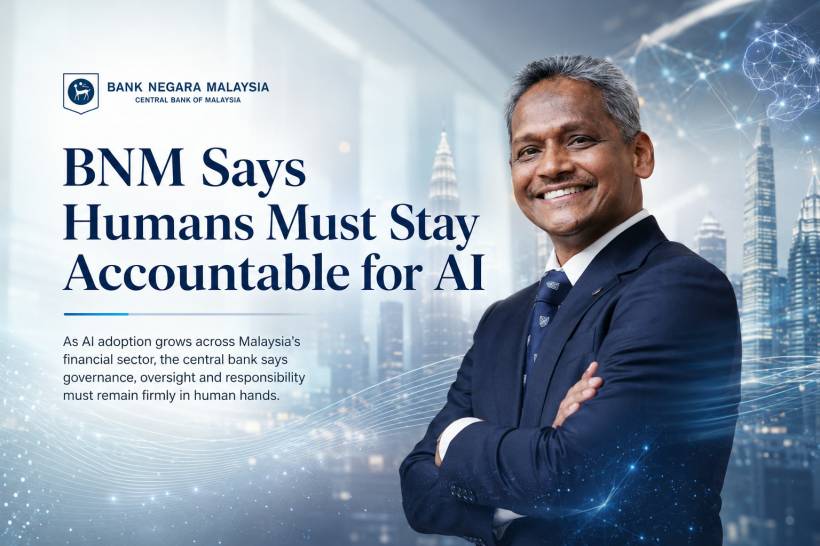
Artificial intelligence is no longer a future concept for Malaysia's financial sector. It is already being used by banks and financial service providers to detect fraud, assess credit and insurance risk, support compliance, improve customer service, and strengthen internal operations.
According to Bank Negara Malaysia Governor Abdul Rasheed Ghaffour, more than 70% of Malaysian financial service providers have already implemented at least one AI application. That shows how quickly AI is becoming part of day-to-day financial services, even if many customers may not always see it directly.
But with that progress comes a bigger question: when an AI system influences a financial decision, who is responsible for the outcome?
For BNM, the answer is clear. AI can support decisions, but accountability must remain with people.
AI Is Moving Beyond Back-Office Efficiency
So far, much of AI adoption in financial institutions has focused on improving internal efficiency. That includes automating repetitive processes, improving risk detection, speeding up analysis, and helping teams manage large volumes of data more effectively.
These are useful gains, but Abdul Rasheed urged financial institutions to think bigger. Instead of using AI only to benefit individual organisations, banks should also explore how it can help solve wider industry problems.
That includes scams, fraud, cyber threats, financial crime, and customer protection. These are not issues one bank can solve alone. They require cooperation across the financial ecosystem, including BNM, the Royal Malaysia Police, financial institutions, PayNet, and other industry partners.
His message was that trust in finance does not come from one institution acting alone. It comes from the whole ecosystem working together.
AI Governance Must Reach the Boardroom
A major point from BNM's message is that AI should not be treated purely as a technology project. It is now a governance issue.
As AI models become more advanced, financial institutions must be able to explain how decisions are made, challenge AI-generated outputs, and take responsibility when those systems affect customers or business outcomes.
This means boards and senior management can no longer leave AI entirely to technical teams. They need to understand where AI is being used, what value it creates, what risks it introduces, and how those risks fit within the institution's overall risk appetite.
In banking, this is especially important because AI may influence sensitive areas such as loan approvals, fraud alerts, insurance assessment, compliance monitoring, and customer treatment. A wrong or poorly explained AI decision can affect someone's access to credit, financial reputation, or ability to resolve a problem.
Algorithms Cannot Carry Responsibility
One of the strongest messages is that institutions cannot simply blame the system when something goes wrong.
Even if an algorithm supports a decision, the financial institution must still be able to stand behind the outcome. That means human teams must understand enough about the model to explain its purpose, challenge questionable results, and correct problems when needed.
Risk, compliance, and internal audit teams will also need to evolve. Their role should not only be to check whether controls exist, but also to ask deeper questions: Can the institution explain AI-driven outcomes? Are decisions fair? Are customers protected? Is there proper human oversight? Are the risks being monitored continuously?
This is where AI governance becomes more than documentation. It becomes part of responsible financial management.
The Workforce Must Be Prepared for AI
BNM also highlighted the need to invest in people. AI will change job roles, workflows, and the skills expected from financial professionals.
This does not only mean training employees to use AI tools. It also means building AI literacy, ethical judgement, governance awareness, and the ability to question AI outputs responsibly.
AICB's Future Skills Framework was mentioned as part of this effort, with the goal of helping banking professionals prepare for a financial sector where AI becomes more common.
This is important because AI adoption without workforce readiness can create a dangerous gap. Institutions may deploy advanced tools, but if employees do not understand how to supervise, interpret, or challenge them, the risk increases.
Innovation Must Still Protect Trust
BNM's position appears to be balanced. It is not discouraging AI adoption. Instead, it wants innovation to happen responsibly.
That includes early engagement with the industry, clearer regulatory expectations, responsible experimentation, and shared infrastructure where appropriate. The aim is to allow financial institutions to innovate while still protecting the public interest.
In finance, trust is everything. Customers need to believe that their money is safe, their data is protected, and decisions affecting them are made fairly. If AI improves speed but weakens trust, the sector has not truly progressed.
Open Finance and Tokenisation Are Also Part of the Bigger Picture
BNM is also moving ahead with other major financial sector initiatives. One of them is the Open Finance framework, which is expected to support secure, consent-based data sharing through phased implementation from 2027.
If implemented well, Open Finance could allow customers to share financial data safely between approved providers, potentially improving access to personalised services, better financial planning, and more competitive products.
BNM is also progressing with asset tokenisation pilots through the Digital Assets Innovation Hub. Tokenisation could eventually support new ways of representing and transferring assets digitally, although its real value will depend on practical use cases, proper safeguards, and public trust.
The Governor made an important point here: these technologies are tools, not the final goal. Their success should be measured by whether they improve lives, strengthen resilience, expand opportunity, and deepen trust.
Final Thoughts
BNM's message to the financial sector is timely. AI can make banking faster, smarter, and more responsive, but it must not become a black box that no one can explain.
As more Malaysian financial institutions adopt AI, accountability needs to remain firmly with boards, senior management, risk teams, compliance teams, and the people responsible for customer outcomes.
The future of finance will not be defined only by how advanced the technology becomes. It will be defined by whether that technology is used responsibly, whether customers are protected, and whether trust in the financial system becomes stronger rather than weaker.











Comments 0