

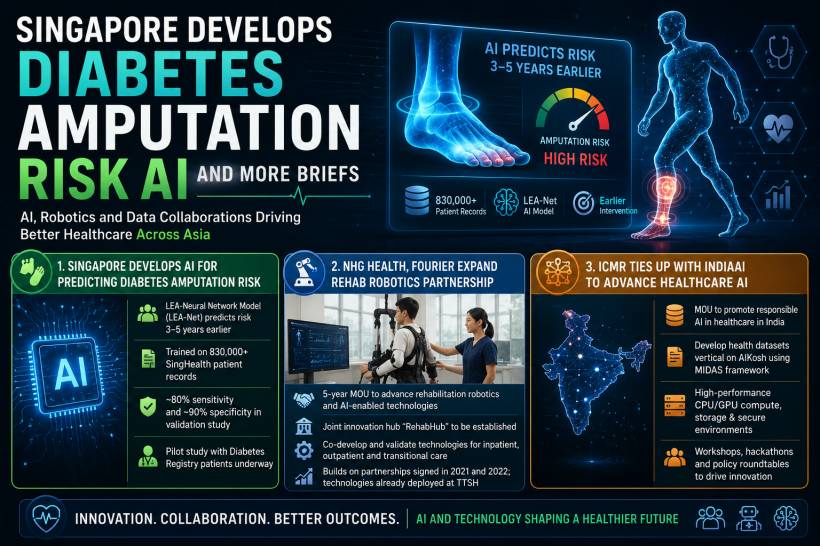
Artificial intelligence is continuing to move deeper into healthcare, not only as a tool for diagnosis, but also as a way to identify risks before serious complications happen. One recent example comes from Singapore, where researchers have developed an AI model designed to predict the risk of lower extremity amputation among patients with diabetes years before severe foot ulcers or infections appear.
This is an important development because diabetes-related foot complications can become serious very quickly if they are not detected and managed early. By the time ulcers, infections, or circulation problems become obvious, some patients may already be at high risk of major intervention. A predictive model could help healthcare teams identify vulnerable patients earlier and guide them toward closer monitoring, preventive care, and timely specialist referral.
LEA-Net Aims To Identify High-Risk Diabetes Patients Earlier
The AI model, known as the LEA-Neural Network Model or LEA-Net, was developed by Singapore General Hospital, SingHealth, and the Ministry of Health Office for Healthcare Transformation. Its main purpose is to estimate a patient's risk of lower extremity amputation around three to five years before serious complications such as foot ulcers and infections develop.
The model was built using anonymised data from more than 830,000 SingHealth patient records. This included information such as patient demographics, clinical conditions, and medical test results. By analysing these data patterns, LEA-Net can classify patients into lower-risk and higher-risk groups.
The practical value of this is clear. If a patient is flagged as high-risk early enough, clinicians may be able to refer them for preventive care, closer foot screening, vascular assessment, diabetes control review, wound prevention education, or other interventions before the condition worsens.
Strong Early Validation Results
According to the reported validation study, the model achieved nearly 80% sensitivity and close to 90% specificity using 250,000 patient records. In simple terms, sensitivity refers to how well the model identifies patients who may truly be at risk, while specificity refers to how well it avoids incorrectly flagging those who are not high-risk.
These are promising figures for a predictive healthcare tool, although further validation is still important before wider clinical use. AI models in healthcare need to be carefully tested in real-world environments because patient populations, clinical workflows, and data quality can vary.
The research team is now looking to further validate LEA-Net through a pilot study involving patients from SingHealth's Diabetes Registry. That next step will be important in determining how well the model performs outside retrospective data analysis and whether it can support practical clinical decision-making.
Why This Matters For Diabetes Care
Diabetes management is not only about controlling blood sugar. It also involves preventing long-term complications involving the heart, kidneys, eyes, nerves, and limbs. Foot complications are especially concerning because nerve damage, poor circulation, delayed wound healing, and infection can combine into a serious problem.
A tool like LEA-Net could shift care from reactive treatment to earlier prevention. Instead of waiting for a visible wound or infection, clinicians may be able to identify patients who need more attention before serious symptoms appear.
That does not mean AI replaces doctors, nurses, podiatrists, or diabetes educators. Rather, it gives healthcare teams another layer of risk insight, helping them prioritise patients who may benefit most from early intervention.
NHG Health And Fourier Rehab Expand Robotics Collaboration
In another healthcare technology development, NHG Health and Fourier Rehab have signed a five-year memorandum of understanding to deepen their collaboration in rehabilitation robotics and AI-enabled technologies.
The expanded partnership will include the creation of a joint rehabilitation innovation hub called RehabHub. Through this platform, both organisations plan to co-develop, test, and validate rehabilitation and assistive robotic technologies across inpatient, outpatient, and transitional care settings.
This builds on earlier collaboration between the two parties. Their first memorandum of understanding was signed in 2021, followed by a Master Research Collaboration agreement a year later. Under those arrangements, selected Fourier rehabilitation technologies were deployed and evaluated at Tan Tock Seng Hospital.
Rehabilitation Technology Is Becoming More Important
Rehabilitation robotics is becoming increasingly relevant as healthcare systems face ageing populations, rising chronic disease burden, and growing demand for therapy services. Robotic systems can support repetitive movement training, assist patients with mobility recovery, and help therapists monitor progress more consistently.
AI-enabled rehabilitation tools may also make therapy more personalised. For example, systems can potentially adjust difficulty levels, measure patient performance, and provide data that helps clinicians refine treatment plans.
The RehabHub initiative suggests that NHG Health and Fourier Rehab are not only looking at adopting ready-made devices, but also validating technologies in real care settings. That is important because rehabilitation tools must work not just in a lab, but also in hospitals, clinics, and transitional care environments where patient needs can be complex.
ICMR And IndiaAI To Advance Responsible AI In Healthcare
India is also moving ahead with healthcare AI development. The Indian Council of Medical Research has signed a memorandum of understanding with the IndiaAI Mission under the Ministry of Electronics and Information Technology to support responsible AI use in healthcare.
A key part of this collaboration involves the development and operationalisation of health datasets on AIKosh using the MIDAS framework. This includes using the MIDAS Rubric to assess dataset quality, along with the provision of anonymised datasets, metadata, documentation, and annotation guidelines by ICMR, the Indian Institute of Science, and supported investigators.
This focus on datasets is important because AI models are only as reliable as the data used to train and evaluate them. Poorly documented, biased, incomplete, or low-quality datasets can lead to unreliable AI tools, especially in sensitive areas such as healthcare.
Building A Safer AI Healthcare Ecosystem
The ICMR and IndiaAI collaboration also includes access to high-performance CPU and GPU computing resources, storage, and secure sandboxed environments for authorised users. This kind of infrastructure can help researchers work with healthcare data more safely while supporting model development and testing.
The partnership will also involve workshops, hackathons, and policy roundtables. These activities are useful because responsible healthcare AI requires more than technical development. It also needs governance, ethics, privacy controls, clinical validation, and clear policy direction.
As more countries explore AI in healthcare, the challenge is no longer just about building powerful models. It is also about ensuring that these systems are safe, explainable, properly validated, and used in ways that protect patients.
Final Thoughts
These developments show how quickly AI and robotics are becoming part of modern healthcare across Asia. Singapore's LEA-Net model highlights the potential of AI to identify diabetes-related amputation risk earlier, giving clinicians more time to act before complications become severe. NHG Health and Fourier Rehab's expanded partnership shows how robotics and AI can support rehabilitation services in more practical care settings. Meanwhile, ICMR's collaboration with IndiaAI reflects the growing importance of responsible data infrastructure for healthcare AI.
The common thread across all three updates is prevention, support, and better decision-making. Whether it is predicting risk, assisting rehabilitation, or building trusted healthcare datasets, AI is increasingly being shaped as a tool to strengthen clinical care rather than replace it. The real value will come when these technologies are carefully validated, responsibly implemented, and integrated into healthcare systems in a way that genuinely benefits patients.











Comments 0