

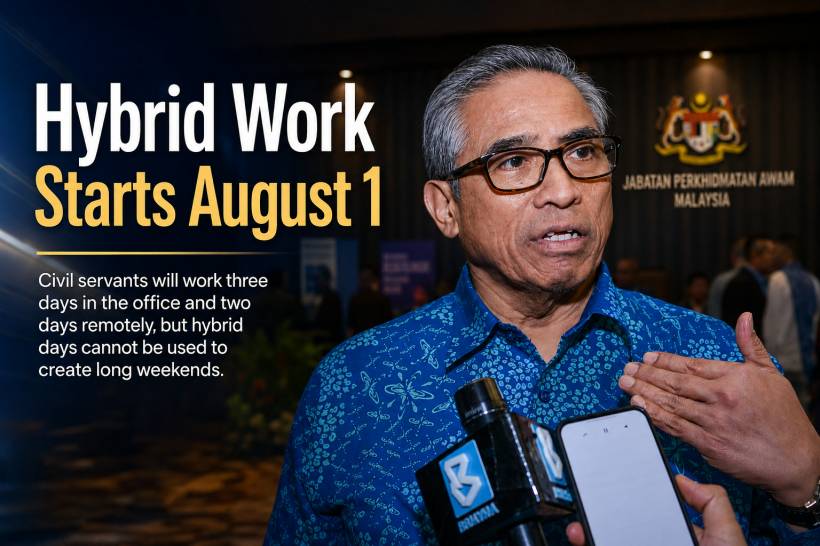
Malaysia's civil servants will move into a more structured hybrid working arrangement beginning August 1, following several months of a nationwide Work From Home initiative that reportedly reduced fuel consumption and government spending on petrol subsidies.
Under the new Hybrid Working Day, or HWD policy, eligible civil servants will work three days in the office and two days remotely each week. However, the flexibility comes with an important restriction: remote-working days cannot be placed next to the weekend simply to create a longer break.
The revised arrangement is intended to retain the cost and productivity benefits of flexible work while introducing clearer rules across the public sector.
Three Days in the Office, Two Days Remote
The HWD policy introduces a straightforward weekly formula.
Civil servants covered by the arrangement will be expected to report physically to the office for three days, with the remaining two working days completed from home or another approved location.
The structure gives employees some flexibility while ensuring government offices continue to maintain a regular on-site presence.
It also represents a shift away from treating remote work as a temporary response. Instead, hybrid work is being incorporated into a more formal working model with defined expectations and safeguards against misuse.
The exact implementation may still depend on operational requirements, job responsibilities and the needs of individual ministries or agencies. Not every public-sector role can be performed remotely, particularly those involving counter services, enforcement duties, healthcare, security or direct public engagement.
No Using Hybrid Days to Create a Long Weekend
The government has made it clear that the new flexibility cannot be used to extend weekends.
Chief Secretary to the Government Tan Sri Shamsul Azri Abu Bakar explained that civil servants whose regular rest days fall on Saturday and Sunday would not be permitted to select both Friday and Monday as their remote-working days.
That would effectively create four consecutive days away from the office, even though Friday and Monday would technically remain working days.
The restriction is intended to prevent the hybrid arrangement from being treated as an unofficial long-weekend entitlement.
In practical terms, employees may need to spread their remote days across the middle of the week or arrange them according to departmental schedules and supervisory approval.
This also helps ensure that offices are not left unusually quiet at the beginning and end of each week, when public demand and administrative activity may still remain high.
WFH Initiative Reportedly Saved More Than RM7.3 Million
The decision to formalise hybrid work follows the government's assessment of the Work From Home initiative introduced nationwide in mid-April.
Over approximately three months, the programme reportedly saved the government RM7,309,084 in petrol subsidy expenditure.
The reduced need for daily commuting was also associated with a decline of 4,046,448 litres in fuel consumption.
These figures illustrate how working arrangements can have effects beyond employee convenience. Fewer commuting journeys may reduce fuel demand, traffic congestion and the cost of subsidised petrol.
However, the long-term success of hybrid work will depend on whether these savings can be maintained without weakening public-service delivery.
Cost reduction is only meaningful if citizens can still access services efficiently and government departments continue meeting their operational responsibilities.
Around 659,000 Civil Servants Benefited
A cumulative total of approximately 659,000 civil servants reportedly benefited from the earlier Work From Home initiative.
That scale makes the programme one of the more significant changes to public-sector working practices in recent years.
For employees, remote work can reduce commuting time, transport costs and the stress associated with travelling through congested areas. It may also give staff greater flexibility in managing focused administrative work that does not require a physical office presence.
For employers, the model may support business continuity during transport disruptions, severe weather, building issues or other situations that prevent staff from reaching their normal workplaces.
At the same time, large-scale hybrid work requires clear management. Departments must know who is working remotely, how performance will be measured and how public enquiries will be handled when certain employees are not physically present.
Productivity Remains a Central Requirement
The government's decision is not based solely on reducing fuel usage.
The revised policy is also intended to sustain productivity while offering controlled flexibility.
This means hybrid work cannot simply be measured by whether employees are logged in or reachable online. Departments will need to focus on completed tasks, service response times, document processing, project delivery and other practical outcomes.
Managers may also need to become more consistent in setting expectations.
Remote employees should know what work must be completed, when they are expected to be available and which meetings require physical attendance. Supervisors, in turn, should avoid creating unnecessary check-ins that make remote work less efficient than working in the office.
A hybrid arrangement works best when responsibility is based on outcomes rather than constant observation.
Public Services Must Remain Accessible
One of the biggest considerations is maintaining service availability for the public.
Government departments handle licensing, documentation, approvals, benefits, enforcement and numerous other essential services. Any hybrid model must therefore be designed around the needs of citizens rather than staff convenience alone.
Departments may need to stagger remote days so enough employees remain on-site throughout the week.
Frontline counters, call centres and time-sensitive administrative functions should continue operating without interruption. Where services are available online, departments should also ensure their digital systems can handle increased usage.
The policy may work particularly well for back-office activities, planning, reporting, data analysis and administrative duties that can be completed securely from outside the office.
Cybersecurity and Data Protection Will Matter More
As remote work becomes a regular part of government operations, cybersecurity will become increasingly important.
Civil servants may be accessing government systems, internal records and official communications from home networks or alternative locations. Those connections must be properly secured to prevent unauthorised access or data leakage.
Agencies may need to strengthen the use of approved devices, virtual private networks, multi-factor authentication and secure document-sharing platforms.
Staff should also be reminded not to use personal email accounts, unapproved cloud storage or public computers for government work.
Hybrid work may reduce commuting costs, but a single security breach involving sensitive government information could create significantly greater financial and operational consequences.
A More Formal Approach Than the Earlier WFH Arrangement
The introduction of HWD suggests the government is moving from a temporary flexible-work initiative towards a more clearly governed system.
The three-office-day and two-remote-day structure gives departments a common baseline while still allowing flexibility within that framework.
The restriction around Fridays and Mondays also shows that the government wants the arrangement to remain work-focused rather than becoming an informal leave extension.
The real test will be how consistently the policy is applied.
If different departments interpret the rules very differently, employees may see the arrangement as unfair. Clear guidance on eligibility, scheduling, performance expectations and exceptions will therefore be important.
Integrity and Governance Remain Part of the Wider Agenda
The hybrid-work announcement was made during the UNGGUL Certification Presentation Ceremony for the Integrity and Governance Management System, also known as SPINE, as well as the Malaysia Institute of Integrity Appreciation Ceremony.
Shamsul Azri, who also chairs the Malaysia Institute of Integrity, said 37 public-sector organisations have received UNGGUL SPINE Certification.
The recipients include ministries and government agencies recognised for their efforts to strengthen integrity, governance and anti-corruption practices.
Although this is separate from the hybrid-working policy, the two issues are connected by a broader question of accountability.
Flexible work depends heavily on trust, but that trust must be supported by clear governance, measurable performance and consistent enforcement of policy.
Employees should receive genuine flexibility, while departments must retain confidence that responsibilities are being fulfilled regardless of where the work is performed.
What Civil Servants Can Expect From August 1
From August 1, eligible civil servants can expect a more structured hybrid schedule rather than an entirely open-ended Work From Home arrangement.
The standard model will involve three office days and two remote days each week.
Remote days will need to be arranged in a way that does not directly extend the weekend, and departmental requirements are likely to remain the deciding factor.
Employees should therefore not assume that everyone will automatically receive the same two remote days. Scheduling may need to be staggered to ensure enough staff remain available in the office.
Roles that depend heavily on physical presence may also receive limited or no remote-work flexibility.
Final Thoughts
Malaysia's move towards structured hybrid work reflects a wider recognition that public-sector duties do not always need to be completed from a traditional office five days a week.
The earlier Work From Home programme reportedly reduced fuel consumption by more than four million litres, saved over RM7.3 million in petrol subsidies and benefited hundreds of thousands of civil servants.
The new HWD policy attempts to preserve those gains while preventing the flexibility from becoming a shortcut to longer weekends.
Its success will ultimately depend on implementation. Departments must maintain public access, protect government data, measure real productivity and apply the rules fairly.
If managed carefully, the three-day office and two-day remote structure could become a sustainable model that reduces commuting costs without weakening accountability or service quality.











Comments 0