

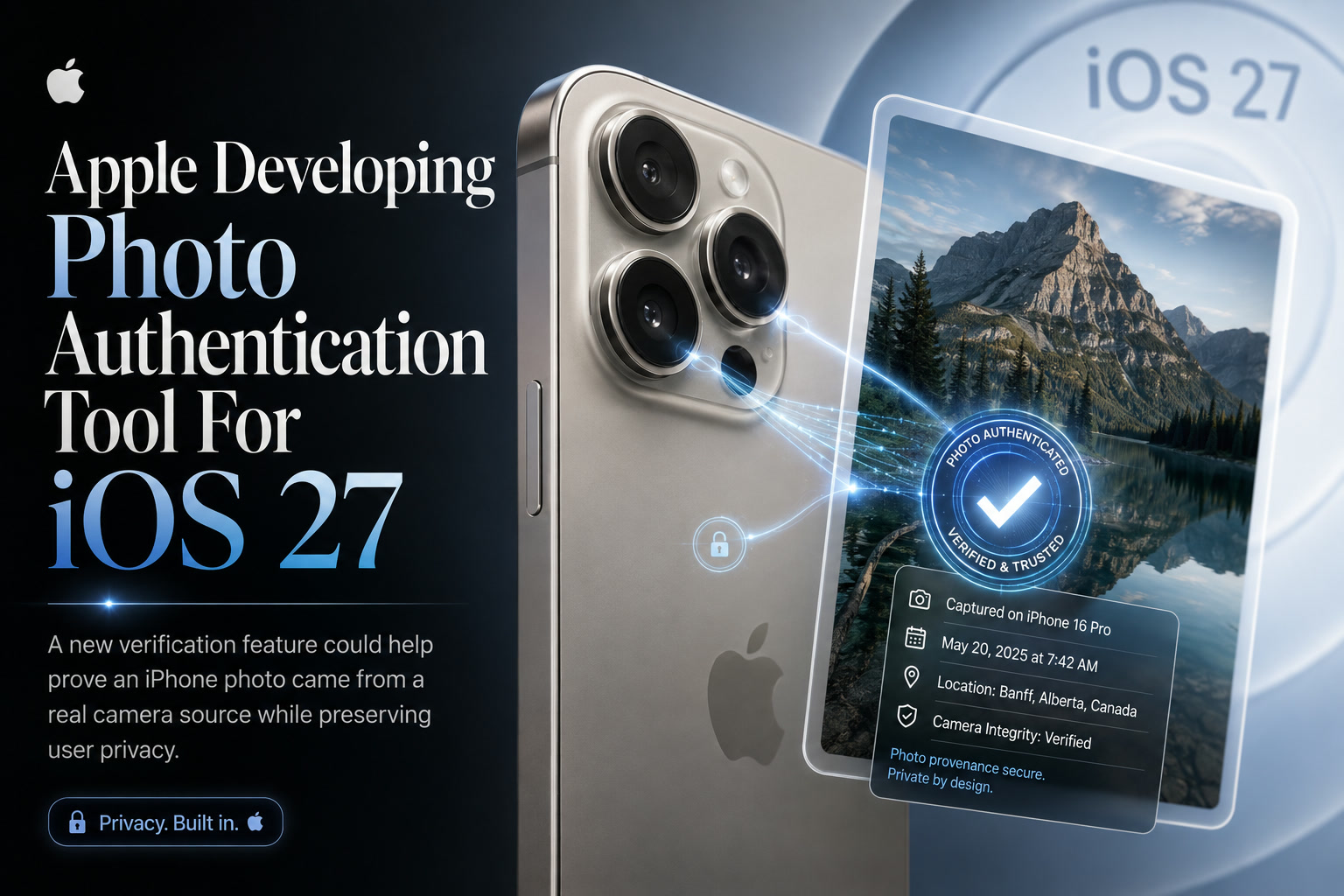
Apple appears to be preparing a new way for iPhone users to prove that a photo genuinely came from a real device rather than being generated, heavily manipulated, or passed through an unknown editing process.
References discovered in iOS 27 beta 5 reportedly point to a feature called Apple Reference Image, which could become part of Apple's broader effort to deal with the growing challenge of distinguishing authentic photography from AI-generated content.
If the feature works as currently described, it could give iPhone users something increasingly valuable in the AI era: a way to verify the origin of a photograph without simply asking everyone to trust that it is real.
Why Photo Authentication Is Becoming More Important
The timing of such a feature would make plenty of sense.
Generative AI tools are becoming increasingly capable of producing images that look convincingly photographic. At the same time, photo-editing software can now alter people, backgrounds, objects and lighting with very little effort.
That creates a growing problem.
When almost anyone can generate or manipulate a realistic-looking image, simply seeing a photograph is no longer enough to establish that something actually happened.
For everyday users this may not matter much, but it becomes far more important for areas such as journalism, insurance claims, legal evidence, business documentation, incident reporting and online verification.
Apple's proposed system appears designed to address that problem by recording information directly at the moment a photograph is captured.
Apple Reference Image Appears in iOS 27 Beta Code
According to code references reportedly discovered in iOS 27 beta 5, Apple is working on a system referred to internally as Apple Reference Image.
The feature would apparently not be enabled automatically.
Instead, users would need to activate something called Reference Mode through the iPhone's camera settings.
Once enabled, photographs captured using that mode would contain additional provenance information.
In simple terms, provenance is a record describing where a digital file came from and how it was created.
For photographs, that could include information about the camera hardware, capture process and other details that help establish that the image originated from a genuine iPhone camera.
Taking a Photo Wouldn't Automatically Make It Verified
One interesting part of the reported implementation is that simply using Reference Mode wouldn't automatically authenticate every photograph.
Instead, the image would first be captured together with the necessary provenance information.
The user could then choose to verify the photograph.
That extra verification stage could allow Apple to perform additional checks before attaching authentication information to the image.
This approach may also prevent every photograph taken by an iPhone from automatically becoming part of an authentication system when the owner has no need for it.
For most casual photography, users may never need Reference Mode at all.
But when proof of authenticity matters, it could become extremely useful.
The iPhone's Camera Hardware Could Become Part of the Verification
The reported system goes beyond simply recording that a photograph was taken using the Camera app.
Authentication could also involve information associated with the iPhone's camera sensor and other hardware identifiers.
That could make the verification system considerably more difficult to fake.
Instead of trusting only software metadata—which can often be changed—Apple could potentially verify whether the image came from a recognised physical camera sensor associated with a legitimate device.
A unique identifier could then be attached to the authenticated photograph.
That creates something closer to a digital chain of custody.
Rather than saying, "This file claims it came from an iPhone," the system could potentially say, "This photograph was captured through verified hardware and has remained consistent with the authentication information attached to it."
Compromised Camera Sensors Could Lose Authentication
Another particularly interesting detail involves what happens if Apple detects that a camera sensor has been compromised.
According to the report, Apple could refuse to authenticate new photographs originating from that sensor.
More importantly, the company could potentially revoke previous authentication credentials associated with the compromised hardware.
That would be a powerful security measure.
Imagine someone finding a way to manipulate a camera module so that fabricated images could be presented as genuine photographs.
Rather than allowing that compromised sensor to continue generating trusted images indefinitely, Apple's system could invalidate its authentication capability.
This could make hardware-backed image verification significantly more difficult to exploit than traditional metadata.
Privacy Will Be a Major Part of the Conversation
Naturally, any feature that sends information about photographs to Apple will immediately raise privacy questions.
Reports surrounding Apple Reference Image suggest that the company is attempting to minimise the amount of information sent during verification.
The system may transmit selected metadata and camera hardware information to Apple's Private Cloud Compute infrastructure so that the photograph can be authenticated.
There has been some uncertainty in early descriptions over precisely how much image data is transmitted during different stages of the process, but the overall design appears intended to avoid unnecessarily uploading a user's entire photo library.
That distinction will be extremely important if Apple formally introduces the feature.
Users will want to know exactly what leaves the device, how long verification information is retained and whether Apple itself can reconstruct or view the underlying photograph.
Private Cloud Compute Could Play an Important Role
Apple's Private Cloud Compute architecture has become increasingly central to the company's approach to AI services.
Rather than simply sending user data to conventional cloud servers, Apple has been designing systems intended to provide stronger privacy protections for processing that cannot be completed entirely on-device.
Photo authentication could be another natural use for that infrastructure.
Some checks may happen locally on the iPhone, while more complicated verification tasks could require Apple's servers to confirm hardware identities or cryptographic information.
If implemented correctly, this would allow Apple to provide central verification without turning authenticated photography into a system where the company permanently stores every verified image.
Authentication Could Travel With the Photo
Another important aspect of the feature is that authentication information could apparently remain attached when a photograph is shared.
That means someone receiving an authenticated image on another device may be able to check whether the image still carries valid verification.
This could be one of the most practically useful parts of the system.
Imagine receiving a photograph showing damage to equipment, an accident scene, a product shipment or some other event where authenticity matters.
Instead of relying entirely on the sender's word, the receiving device could potentially confirm that the photograph was captured using verified hardware and that its authentication data remains intact.
The value isn't necessarily proving that everything shown in the photograph is true.
Rather, it helps establish where the image came from and whether the underlying file has maintained its verified status.
Editing a Photo Could Change Its Authentication Status
This is where things become particularly interesting.
A verified photograph that is subsequently edited may no longer be identical to the original authenticated image.
Apple therefore appears to be considering different states for photographs depending on whether they are:
The amount of provenance information preserved could also depend on how the photograph is transferred between devices.
Sending an image through AirDrop, exporting it as a file, uploading it through social media or compressing it through a messaging application can all modify image metadata differently.
Apple will therefore need a way of determining which parts of the authentication data survive each method.
A Full-Data Transfer Option Could Help Preserve Verification
The company is also reportedly working on a way to transfer photographs while preserving all associated authentication information.
That could become particularly useful for professional workflows.
A journalist, for example, might capture an authenticated photograph on an iPhone and transfer the original file to an editor while maintaining the complete provenance record.
Similarly, businesses could use authenticated images for audits, inspections or documentation.
The ability to deliberately preserve all verification data could prevent important information from being stripped during normal file transfers.
This Could Become Apple's Answer to AI-Generated Images
The broader significance of Apple Reference Image isn't really about photography alone.
It is about digital trust.
AI image generation is improving so quickly that detecting fake images purely by analysing the pixels is becoming increasingly unreliable.
Instead of trying to determine whether an image "looks AI-generated," a stronger approach may be to verify the authenticity of genuine images at the moment they are created.
That is a very different strategy.
Rather than asking:
The system asks:
That difference could become extremely important over the next several years.
It Could Also Complement Existing Content Credentials
The technology industry has already been moving toward provenance standards that attach information about how digital media was created and modified.
Apple's approach could potentially fit into that broader ecosystem by providing hardware-backed evidence from the capture device itself.
If authentication information becomes interoperable across platforms, a photograph captured on an iPhone could potentially retain trustworthy provenance information even after being viewed on computers, websites or non-Apple devices.
That would make the feature considerably more useful than something that only works inside Apple's own ecosystem.
Exactly how open Apple intends to make the system remains to be seen.
Not Every Photo Needs to Be Authenticated
It is also worth emphasising that this doesn't need to become something users think about every time they take a selfie or photograph their lunch.
Keeping Reference Mode optional would allow Apple to position it as a specialised tool.
Most people could continue using the Camera app exactly as they do today.
When authenticity matters, however, they could intentionally switch on Reference Mode before taking the photograph.
That makes the feature less intrusive while still giving users access to stronger verification when needed.
Potential Uses Go Far Beyond Social Media
While fake images on social media are the most obvious example, authenticated photography could have much broader applications.
Insurance companies could request authenticated photographs when processing damage claims.
Businesses could use them during equipment inspections.
Hospitals and healthcare organisations could potentially use verified images for certain documentation workflows, assuming appropriate privacy controls were in place.
Law enforcement, journalists, property inspectors and logistics companies could all find similar uses.
Even ordinary users selling expensive items online might eventually use authenticated photos to prove that a product genuinely existed in a certain condition when the image was captured.
The feature could therefore become much more than an anti-AI gimmick.
There Are Still Plenty of Questions
Because Apple Reference Image has not yet been formally announced as a finished consumer feature, plenty of details remain unclear.
It is not yet known which iPhone models would support the system, whether certain camera hardware would be required or whether the feature would be available globally.
There are also questions about how authentication survives editing, whether third-party camera applications can participate and how verification would work outside Apple's ecosystem.
Another major question is whether websites and social platforms will eventually be able to display an authentication indicator when receiving a verified photograph.
Without broader industry support, much of the value could remain confined to Apple devices.
Final Thoughts
Apple potentially adding hardware-backed photo authentication to iOS 27 feels like a very logical response to the rapid growth of generative AI.
As creating convincing fake photographs becomes easier, proving that genuine images are genuine will become increasingly valuable.
The reported Apple Reference Image system takes an interesting approach by focusing on provenance, camera hardware and verification rather than trying to analyse whether a picture simply looks fake.
If Apple can make the system secure, privacy-conscious and easy to verify across different devices, it could become one of the more important camera features introduced in the AI era.
The challenge won't just be producing better photographs anymore.
Increasingly, it may also be about proving where those photographs actually came from.











Comments 0