

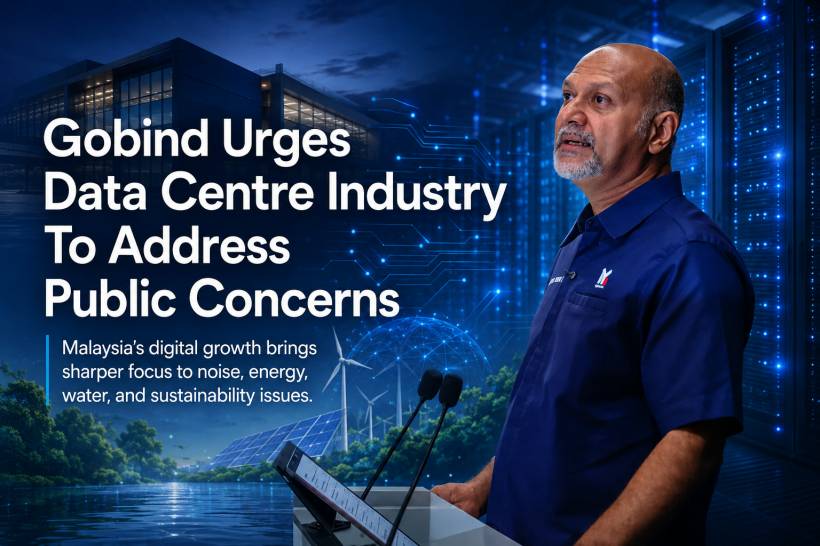
Malaysia's data centre industry is growing quickly, especially as the country positions itself for wider AI adoption and a stronger role in Southeast Asia's digital economy. However, as more large-scale digital infrastructure projects are being developed, public concerns are also becoming harder to ignore.
Digital Minister Gobind Singh Deo has urged data centre operators to take these concerns seriously, particularly when it comes to energy usage, water consumption, and noise pollution. His comments came during the launch of NEXTDC's KL1 Kuala Lumpur data centre in Petaling Jaya, where he acknowledged that communities living near such facilities are increasingly asking valid questions about how these projects may affect their surroundings.
Public Concerns Cannot Be Brushed Aside
According to Gobind, it is realistic for people to ask whether there is enough energy and water to support large data centre operations. These facilities require significant infrastructure, and when they are built near residential or commercial areas, concerns about noise and environmental impact naturally come into the discussion.
His point was not that data centres should be rejected, but that the industry must communicate better. Large infrastructure projects often create uncertainty among nearby residents, especially when people do not fully understand how the facilities operate or what safeguards are in place.
Gobind urged industry players to manage these conversations more openly. Instead of waiting for complaints to grow, data centre operators should explain what is happening, acknowledge public worries, and make it clear what measures are being taken to reduce disruption. This kind of communication matters because trust is not built only through technology or investment figures. It also depends on how well companies engage with the communities around them.
Why The Issue Is Becoming More Sensitive
The minister's remarks come at a time when data centre developments in Malaysia are receiving closer public attention. In Johor, a large-scale hyperscale AI data centre project in Gelang Patah recently drew backlash from nearby residents over environmental and quality-of-life concerns.
Residents reportedly protested against the development, raising issues such as dust pollution, possible water supply pressure, and construction-related disturbances. The incident stood out because it was described as one of Malaysia's first public protests against a data centre project.
This shows that the public is no longer viewing data centres as invisible back-end technology facilities. As AI, cloud computing, and digital services expand, the physical infrastructure behind them becomes more visible. People may use digital services every day, but they are also beginning to question the real-world cost of supporting those services, especially when major facilities are built close to where they live.
NEXTDC KL1 And Malaysia's AI Infrastructure Ambitions
The launch of NEXTDC's KL1 is still a major milestone for Malaysia's digital infrastructure landscape. The facility marks the Australian company's first international data centre and represents a long-term investment of around AUD 1 billion, or approximately RM2.8 billion, into Malaysia.
Located in the Klang Valley, KL1 is designed to support AI and high-performance computing workloads. The facility is expected to offer up to 65MW of IT capacity and is targeting Uptime Institute Tier IV certification. If achieved, it would become the first Tier IV-certified facility of its kind in Peninsular Malaysia.
This is significant because AI workloads require powerful, reliable, and scalable infrastructure. As businesses, governments, and technology providers adopt more AI-driven tools, demand for data processing, storage, and cloud capacity will continue to grow. Facilities like KL1 are part of the foundation needed to support that demand.
Gobind described the project as an important step toward Malaysia's AI Nation 2030 ambitions. From a national development perspective, data centres are no longer just technical buildings. They are becoming part of the country's digital backbone, supporting cloud services, enterprise systems, AI platforms, and regional digital connectivity.
Balancing Growth With Responsibility
While the economic and technological benefits are clear, the challenge is ensuring that data centre growth does not come at the expense of public confidence. Energy use, water demand, cooling systems, and operational noise are all issues that require proper planning and transparent communication.
Modern data centres are far more advanced than many people may realise, but public perception still matters. If communities only see them as massive buildings consuming electricity and water, resistance can grow quickly. This is why operators need to explain how they manage energy efficiency, cooling, backup systems, noise control, and sustainability commitments.
For Malaysia, this balance is especially important. The country wants to attract digital infrastructure investment, but it must also ensure that growth is well-regulated and socially acceptable. Without that balance, even technically successful projects may face public pushback.
NEXTDC Says Sustainability Is Part Of Its Strategy
At the KL1 launch, NEXTDC executives also addressed concerns around sustainability and community impact. CEO and managing director Craig Scroggie said sustainability is built into the company's infrastructure strategy, rather than being treated as an afterthought.
This is an important distinction because sustainability in data centres cannot be something added only after a facility is already operating. It needs to be considered from the design stage, including power efficiency, cooling systems, water usage, equipment layout, and long-term operational monitoring.
NEXTDC's group chief development officer Simon Cooper also said the company is prepared to respond if nearby residents raise issues such as excessive nighttime noise. He noted that if complaints are made to the council and forwarded to the company, the operator would need to measure noise levels and fix anything that has changed or gone beyond acceptable limits.
That kind of response framework is important because it gives the public a channel for accountability. For nearby residents, knowing that complaints can be measured, reviewed, and acted upon can help reduce uncertainty.
Selangor Also Emphasises Public Awareness
Selangor Menteri Besar Datuk Seri Amirudin Shari also highlighted the need for better public understanding of modern data centres. According to him, many people still view these facilities mainly as buildings that consume large amounts of electricity and water.
That perception is understandable, but it may not give the full picture. A modern data centre can include advanced cooling systems, efficiency controls, sustainability targets, and compliance requirements. However, if this information is not communicated clearly, the public may only focus on the potential downsides.
Amirudin also assured that the Selangor state government has measures in place to ensure operators comply with sustainability requirements. This is a key part of the bigger discussion because public confidence depends not only on what companies promise, but also on whether governments are seen to be actively monitoring and enforcing standards.
Why This Matters For Malaysia's Digital Future
Malaysia's ambition to become a stronger AI and digital infrastructure hub will depend on more than just attracting investment. It will also depend on how well the country manages the social and environmental impact of that growth.
Data centres are essential for AI, cloud services, business continuity, digital government systems, and online platforms. However, they are also physical infrastructure with real resource needs. As more facilities are built, the industry will need to prove that it can operate responsibly, communicate clearly, and respond quickly when concerns arise.
This is where Gobind's message becomes important. The industry cannot assume that public acceptance will come automatically. Communities want to understand what is being built, how it affects them, and what protections are in place. If operators engage early and transparently, it can reduce misunderstanding and build stronger support for future projects.
Final Thoughts
Gobind Singh Deo's call for the data centre industry to address public concerns is a timely reminder that digital progress must also be socially responsible. Malaysia's growing data centre sector has the potential to support AI adoption, cloud services, and regional digital growth, but that progress must be matched with proper communication, sustainability planning, and community engagement.
The launch of NEXTDC's KL1 shows that Malaysia is becoming a serious destination for high-performance digital infrastructure. At the same time, recent public concerns in Johor show that communities are paying attention to how these projects affect their daily lives.
For the industry, the message is clear. Building data centres is no longer just about power capacity, certifications, and investment value. It is also about trust, transparency, and proving that digital infrastructure can grow without ignoring the people and communities around it.











Comments 0