

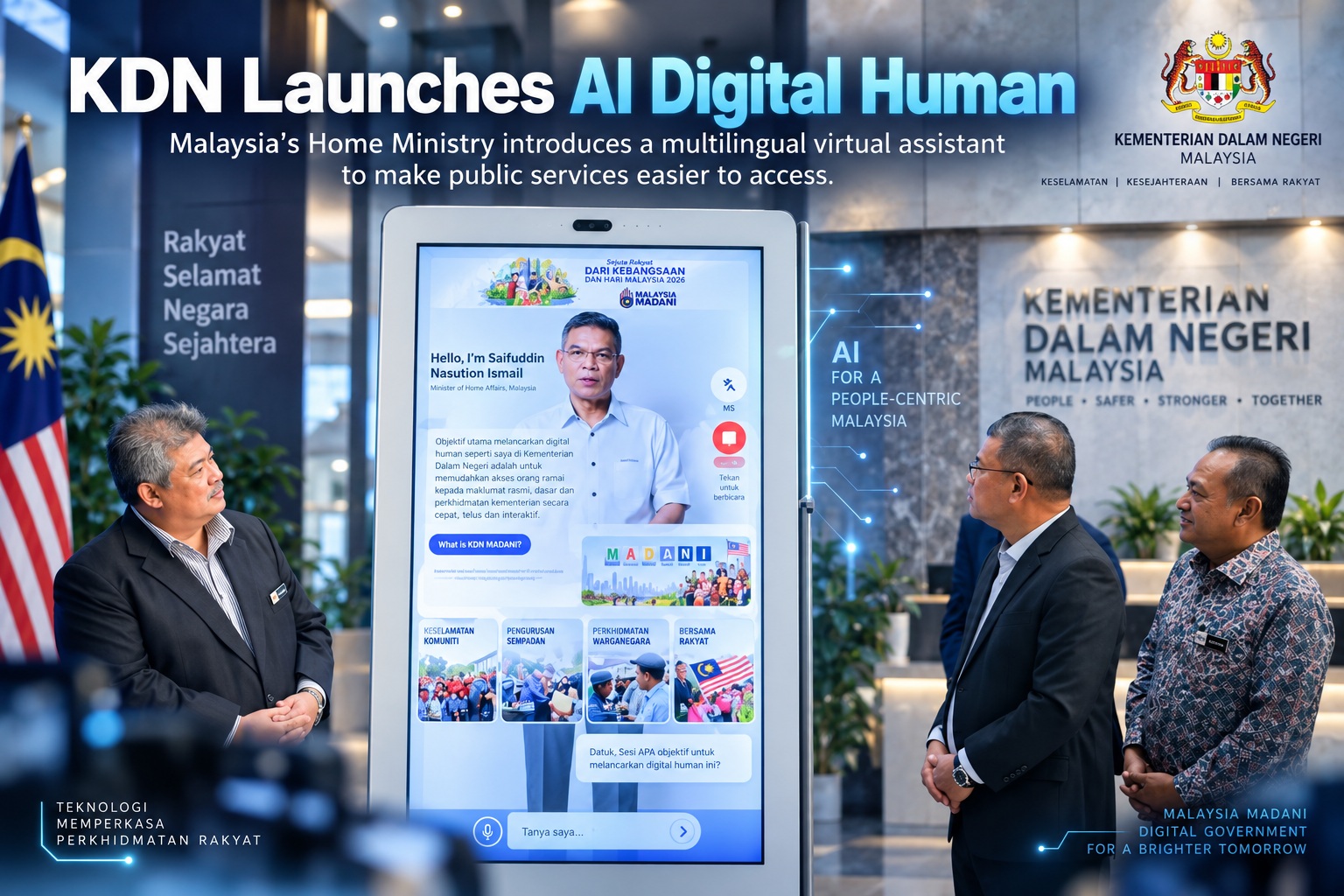
Malaysia's Ministry of Home Affairs, or KDN, is taking another step into AI-powered public services with the launch of its new AI Digital Human, a virtual representative designed to help the public get information about the ministry's services through natural conversation.
The initiative forms part of KDN's broader digital transformation strategy under its "AI for KDN, KDN for AI" aspiration. Rather than forcing users to search through multiple websites, menus, FAQs, or government documents, the AI Digital Human is intended to provide a more direct way of asking questions and receiving relevant information in a conversational format.
The system was officially launched by Home Minister Datuk Seri Saifuddin Nasution Ismail, who said the technology is meant to make government information more accessible and easier to understand, particularly for users who may not be familiar with how different KDN services are organised online.
A More Conversational Way to Access Government Information
One of the biggest frustrations with government websites is often not the lack of information, but finding the right information quickly. Different services may be spread across separate portals, agencies, departments, and document repositories, making even relatively simple questions harder to answer than they should be.
KDN's AI Digital Human is designed to reduce that complexity.
Instead of navigating through layers of web pages, a user can simply ask a question in natural language. The system then interprets the request and returns an answer related to matters under the ministry's jurisdiction.
This kind of conversational interface could be especially useful for common public-service queries, where users may know what they want to do but not which department, webpage, or government process they need to look for.
In that sense, the AI Digital Human acts more like a digital front desk than a traditional chatbot hidden inside a website.
A Holographic Version of the Home Minister
KDN has also chosen a more visually ambitious presentation than a standard text-based assistant.
The AI Digital Human is presented as a holographic representation of Saifuddin Nasution, creating an experience designed to resemble a face-to-face conversation with the Home Minister.
The idea appears to be making the interaction feel more personal and less mechanical. Rather than presenting users with a simple chat window, the ministry is attempting to create the impression of speaking directly with a recognisable government representative.
KDN has stressed, however, that the technology is not intended to replace the minister, civil servants, or government officers.
Instead, it is positioned as another service-delivery channel that can handle information requests more efficiently while allowing human personnel to focus on tasks that require judgement, verification, or direct intervention.
That distinction is important as governments around the world experiment with AI. Public-service automation can improve convenience, but citizens still need access to human officials when a case is complicated, sensitive, or requires formal decision-making.
Support for 12 Languages Could Broaden Accessibility
Another major feature of the AI Digital Human is its multilingual support.
KDN says the system can communicate in 12 languages, including Malay, English, Mandarin, Tamil, and Arabic. Saifuddin highlighted the capability during the launch, encouraging users to ask questions in different languages.
"Ask in Mandarin, Arabic, Japanese, just ask," he said. "The AI can answer all of them."
For Malaysia, this could be particularly useful given the country's multilingual population and the range of people who interact with government agencies.
Language can sometimes become an additional barrier when dealing with official procedures, especially for users who are more comfortable explaining a situation in their preferred language. A system capable of understanding and responding across several languages could potentially make government information more approachable.
It may also be useful for foreign visitors, expatriates, international workers, and others dealing with KDN-related services such as immigration matters.
AI Could Help Reduce the Complexity of Government Portals
The broader idea behind the project is not simply adding AI for the sake of appearing more technologically advanced.
Government digital services have grown considerably over the years, but that growth can create fragmentation. Each department develops its own portal, forms, guidance documents, FAQs, and online systems.
From the government's perspective, those systems may be logically organised. From the citizen's perspective, however, the experience can sometimes feel like searching through a maze.
Conversational AI could sit above those systems and provide a single starting point.
A user might not know whether a question belongs to KDN itself, the Immigration Department, the National Registration Department, or another agency. Instead of requiring the user to understand the government's organisational structure, the AI could potentially interpret the request and direct them to the appropriate information.
If implemented accurately, this could make public services feel significantly less complicated.
KDN Wants AI Adoption Across Its Agencies
The AI Digital Human is only one part of KDN's wider artificial intelligence strategy.
During the launch, Saifuddin called on all agencies under the ministry to incorporate AI into their core operations, particularly where it could improve productivity, efficiency, and service delivery.
KDN oversees several major government bodies, including the National Registration Department, Immigration Department, and Royal Malaysia Police, among others.
The intention appears to be moving beyond one central AI project and encouraging each agency to identify practical areas where artificial intelligence can support its own responsibilities.
That could mean very different applications depending on the department. AI used by an immigration agency might focus on document processing or public enquiries, while another department could use it for administrative support, workflow automation, analytics, or internal knowledge retrieval.
The important point is that KDN wants individual agencies to move from discussing AI conceptually to building operational use cases around it.
Three Years of Preparation Behind the Strategy
According to Saifuddin, KDN has spent around three years developing its "AI for KDN, KDN for AI" approach.
The ministry estimates that approximately 75% of its personnel are now ready to adopt and use artificial intelligence.
That figure is significant because technology adoption in government is rarely just about buying software. Employees need to understand how the technology works, where it can be trusted, when human verification is still necessary, and how it fits into existing procedures.
AI systems can only improve productivity when people know how to use them effectively.
The next phase therefore focuses on turning that organisational readiness into actual applications within each agency.
Agency leadership will be expected to drive the implementation rather than waiting for a single central KDN system to solve every problem.
AI Is Already Being Used Behind the Scenes
KDN has already started using AI internally in a less visible but potentially important area: preparing responses to parliamentary questions.
The ministry uses AI to generate initial drafts of answers to questions raised by Members of Parliament during Dewan Rakyat sittings.
Those drafts are not sent out automatically.
Instead, ministry officers review, verify, and refine the AI-generated content before the final answer is approved.
This human-review approach is a sensible model for government use of generative AI. The technology can save time by producing a first draft, but officials remain responsible for checking accuracy, context, and policy details.
That is particularly important in parliamentary responses, where incorrect or misleading information could have political, legal, or administrative consequences.
The Human Verification Layer Still Matters
The use of AI in government raises a basic question: how much authority should these systems actually have?
For straightforward informational queries, AI can be useful because it can quickly retrieve or summarise information. But government decisions often involve laws, eligibility requirements, personal circumstances, confidential information, and formal procedures.
That means AI should not automatically become the final authority.
KDN's existing approach to parliamentary responses—AI produces a draft, humans verify it—offers a useful example of how these systems can be deployed more responsibly.
The same principle is likely to be important for public-facing AI.
If the AI Digital Human provides information about immigration, registration, policing, permits, or other official processes, users need confidence that the information reflects current government policy.
There should also be a clear path for escalation when the system cannot confidently answer a question.
Accuracy Will Be the Real Test
The success of the AI Digital Human will ultimately depend less on how impressive the holographic presentation looks and more on the quality of its answers.
Government information changes frequently. Procedures are updated, regulations change, forms are replaced, and policies may vary depending on individual circumstances.
An AI assistant therefore needs access to reliable, current information.
If it provides outdated guidance, users could waste time, submit the wrong documents, or misunderstand their obligations.
For that reason, the underlying knowledge system is arguably more important than the visual interface.
KDN will need strong processes for keeping information updated and ensuring the AI does not confidently invent answers when it lacks sufficient data.
That challenge is common across almost every generative AI deployment, but the consequences are more significant when the system represents a government ministry.
Multilingual AI Also Needs Careful Testing
Supporting 12 languages sounds impressive, but multilingual public-service AI introduces another layer of complexity.
A system may perform extremely well in one language while misunderstanding specific legal or administrative terminology in another.
Translation quality is also not enough on its own. The AI needs to understand how official government terms are commonly used in each language and ensure that the meaning remains consistent.
For example, an immigration or registration requirement should not become ambiguous simply because the user asked about it in a different language.
That means multilingual capability will need ongoing testing using real-world questions rather than relying entirely on generic language benchmarks.
Privacy and Data Handling Will Be Important
Any government AI platform also needs to be clear about what happens to user interactions.
Some people may ask simple general questions, while others could potentially provide sensitive personal details while describing their situation.
That creates important questions around data storage, retention, access, and privacy.
Ideally, users should understand whether conversations are recorded, how long they are retained, whether they are used to improve the system, and what types of information should not be entered.
Government AI services need especially strong safeguards because citizens may naturally assume that a system operated by a ministry can safely handle almost any personal information.
Clear privacy guidance can help prevent people from sharing information that the AI does not actually need.
AI Could Change How Citizens Interact With Government
If systems like KDN's AI Digital Human work well, they could gradually change expectations around government digital services.
People are becoming accustomed to conversational interfaces in commercial applications. Instead of navigating complicated menus, they increasingly expect to simply describe what they want.
Government portals may eventually evolve in the same direction.
Rather than presenting dozens of categories, forms, and links, a public-service platform could begin with a simple question: "What do you need help with?"
The AI could then interpret the request, provide information, identify the relevant agency, explain the next steps, and direct the user toward the appropriate form or service.
That does not remove the need for traditional websites. Forms, official documents, legal notices, and reference materials still need permanent locations.
AI simply provides another layer that can help users reach the right information faster.
Digital Humans Could Become More Common in Public Services
KDN's choice to use a digital human rather than a normal chatbot is also worth watching.
Digital avatars are increasingly being explored for customer service, education, tourism, healthcare, and public information. They are intended to make AI interactions feel more natural by adding a face, voice, and personality.
For public services, that could help make technology feel less intimidating, particularly for users who are uncomfortable with conventional web interfaces.
However, governments will also need to ensure users understand that they are speaking to an artificial system rather than a real official.
Transparency matters.
A realistic digital representation of a minister could create authority and trust, but it should never leave users uncertain about whether a statement came directly from the minister or was generated automatically by an AI system.
AI Adoption Across Government Will Need Governance Too
As more KDN agencies begin experimenting with AI, governance will become increasingly important.
Different departments could easily end up adopting separate models, data practices, security standards, and verification procedures.
Without coordination, that could create inconsistent quality across government services.
A shared framework could help establish requirements around accuracy testing, privacy protection, human oversight, cybersecurity, model procurement, auditing, and acceptable uses.
It would also make it easier for agencies to learn from one another instead of repeating the same implementation mistakes independently.
KDN's "AI for KDN, KDN for AI" strategy could therefore become as much about governance as it is about technology.
Final Thoughts
KDN's AI Digital Human represents an interesting shift in how Malaysia's public sector is experimenting with artificial intelligence. Rather than limiting AI to internal automation, the ministry is placing the technology directly in front of the public as a new way to access government information.
The combination of natural conversation, a holographic representation of the Home Minister, and support for 12 languages gives the project a more ambitious scope than a typical government chatbot.
The larger story, however, is KDN's plan to spread AI adoption across its agencies.
If departments such as Immigration, the National Registration Department, and PDRM begin integrating AI into their workflows, the technology could potentially improve administrative efficiency and make services easier to access.
The challenge will be ensuring that convenience does not come at the expense of accuracy, transparency, privacy, or human accountability.
AI can help people find information faster, prepare drafts, and automate repetitive tasks, but government decisions still carry real consequences. The strongest approach is therefore likely to be one where AI assists rather than replaces public officers.
If KDN can maintain that balance, the AI Digital Human could become more than an eye-catching technology demonstration. It could become an early example of how conversational AI gradually reshapes the way Malaysians interact with public services.











Comments 0