

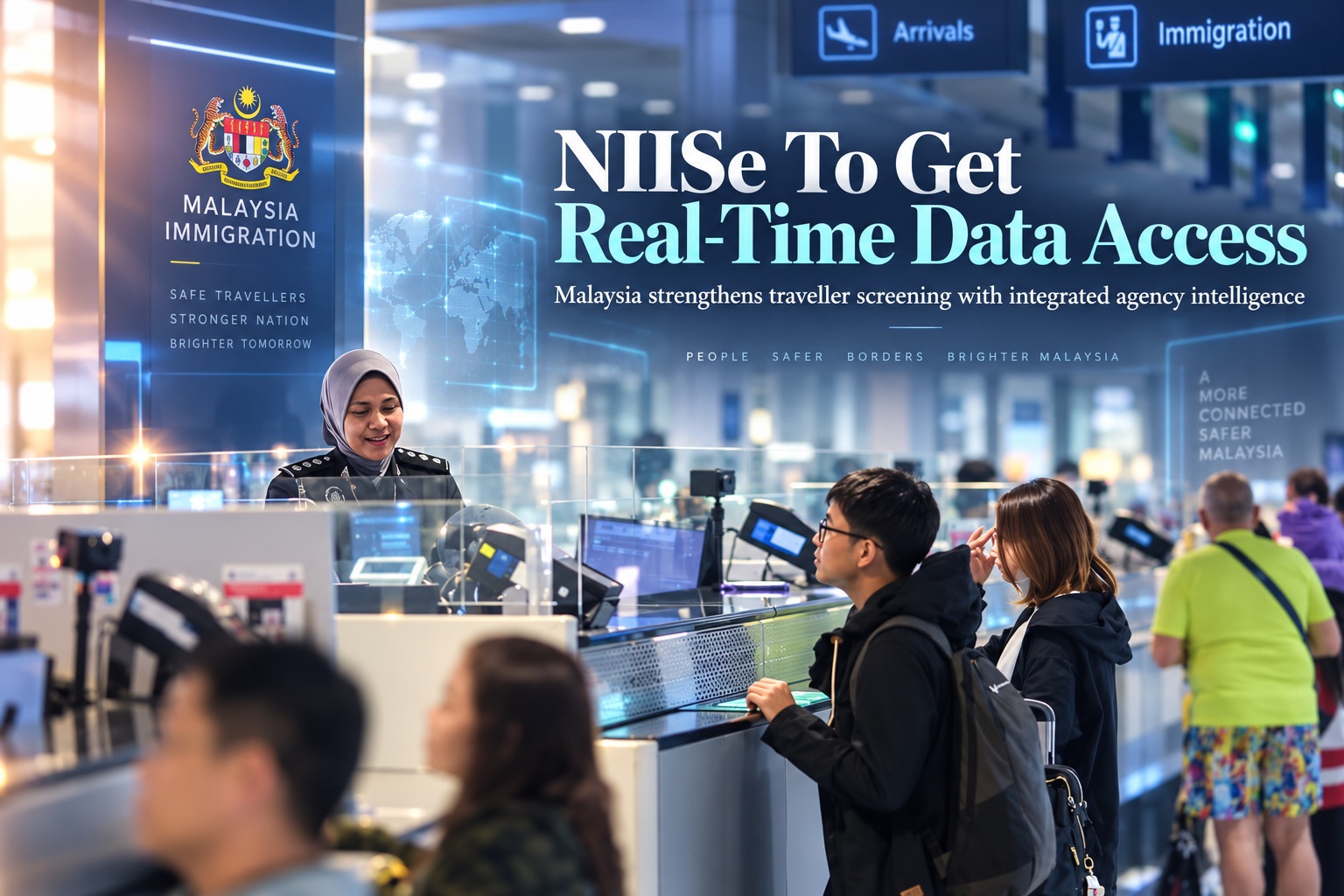
Malaysia's Immigration Department is preparing to significantly strengthen its border screening capabilities through the National Integrated Immigration System, or NIISe. The new platform will eventually provide immigration officers with real-time access to information from agencies including Interpol, the Royal Malaysia Police, the Prisons Department, the Inland Revenue Board and the National Higher Education Fund Corporation. This should allow travellers entering or leaving the country to be assessed using a much broader range of information than is currently available through the existing MyIMMs system.
Home Minister Datuk Seri Saifuddin Nasution Ismail said the Immigration Department is progressively transitioning from MyIMMs to NIISe. The system is intended to improve preliminary screening, traveller risk assessment and information sharing between government agencies. In practical terms, immigration officers would be able to make faster and more informed decisions when a traveller is subject to restrictions, investigations or other government records.
Real-Time Data Sharing Across Multiple Agencies
One of the biggest changes under NIISe will be the ability to integrate information from multiple agencies into the immigration screening process. This includes data from Interpol, police, the Prisons Department and LHDN, allowing border officers to identify individuals who may be linked to criminal investigations, travel restrictions or unresolved government matters. Instead of relying on separate databases or delayed information exchanges, the intention is for relevant data to be available in real time.
Saifuddin said the system will also improve traveller risk profiling. This could allow authorities to assess individuals using a combination of immigration records and information provided by other enforcement or government agencies. The broader objective is to strengthen border security while making the screening process more coordinated.
PTPTN And Transport Ministry Data Will Also Be Integrated
NIISe will also consolidate information from PTPTN and the Ministry of Transport. This means immigration officers could receive updated information about individuals who may be subject to travel restrictions related to education loan repayments or other government requirements. Combining this information within one platform should reduce the need for separate checks across multiple systems.
The integration could be particularly useful at busy immigration checkpoints where officers need to make quick decisions. If a traveller is subject to a restriction recorded by another agency, that information could be surfaced immediately during the immigration process. This would make enforcement more consistent across airports, land borders and other entry points.
A Bigger Shift Away From MyIMMs
The migration to NIISe represents a major upgrade from the existing MyIMMs environment. Rather than functioning primarily as an immigration processing system, NIISe is being positioned as a broader national platform that connects immigration operations with other government databases. The emphasis is therefore not only on replacing older technology, but also on improving how information moves between agencies.
For the Immigration Department, this could provide a more complete view of each traveller at the point of entry or departure. It may also reduce situations where relevant information exists within another government agency but is not immediately available to immigration officers. Real-time integration is intended to close that gap.
Travel Restrictions Could Be Identified More Quickly
The importance of inter-agency data sharing is already visible in existing travel restrictions. In September last year, around 209,000 taxpayers were reportedly barred from travelling after failing to settle outstanding taxes. PTPTN had also blacklisted nearly 3,000 borrowers over unpaid education loans.
With NIISe, information of this kind could be made available directly to immigration officers through one integrated system. This would allow restrictions to be enforced more efficiently while also reducing the risk of outdated or incomplete information being used during border checks. The quality and timeliness of the data will therefore be critical to how effective the system becomes.
AI And Data Analytics Planned For Future Border Control
Looking further ahead, the government plans to develop a national border control system that uses artificial intelligence and data analytics. Saifuddin said the long-term goal is to prepare Malaysia for future security challenges by using more automated and intelligent border-monitoring capabilities. The proposed system would support both land and maritime border protection.
The government envisions a platform capable of operating continuously, rapidly distributing information and maintaining round-the-clock surveillance. According to the minister, some functions could eventually operate without direct supervision. The details of this future system are still being refined, so its exact scope and deployment timeline have not yet been finalised.
What AI Could Mean For Border Security
The use of AI and data analytics could allow authorities to process much larger volumes of information than traditional manual screening methods. For example, systems could potentially identify patterns or unusual activity across travel records, border movements and information supplied by participating agencies. This could help officers focus attention on higher-risk cases while routine travellers move through the system more efficiently.
However, such systems would also need strong governance because decisions involving travel and border access can have significant consequences for individuals. Data accuracy, system transparency and clear procedures for handling incorrect records would be important considerations as the technology becomes more automated. The effectiveness of AI-based screening will depend heavily on the quality of the underlying data.
Continuous Surveillance Across Land And Maritime Borders
The government's plans extend beyond airports and conventional immigration counters. Saifuddin said the future system is intended to support continuous surveillance of both Malaysia's land and maritime borders. This suggests a broader strategy combining immigration data with national border-monitoring capabilities.
Real-time information sharing could help agencies respond more quickly when suspicious movements or security concerns are detected. A common platform may also improve coordination between immigration, police and other enforcement agencies during operations. For a country with extensive land and maritime borders, faster information exchange could become an important part of national security planning.
Final Thoughts
The transition from MyIMMs to NIISe represents more than a routine technology upgrade for Malaysia's Immigration Department. By bringing together real-time information from Interpol, police, prisons, LHDN, PTPTN and the Ministry of Transport, the new system is designed to give immigration officers a more complete picture when screening travellers entering or leaving the country.
The longer-term plan to introduce AI, data analytics and continuous border surveillance could take that capability even further. While those future features are still being developed, NIISe already points towards a more integrated approach to immigration and border security, where information from multiple agencies can be accessed and acted upon more quickly from a single platform.











Comments 0