

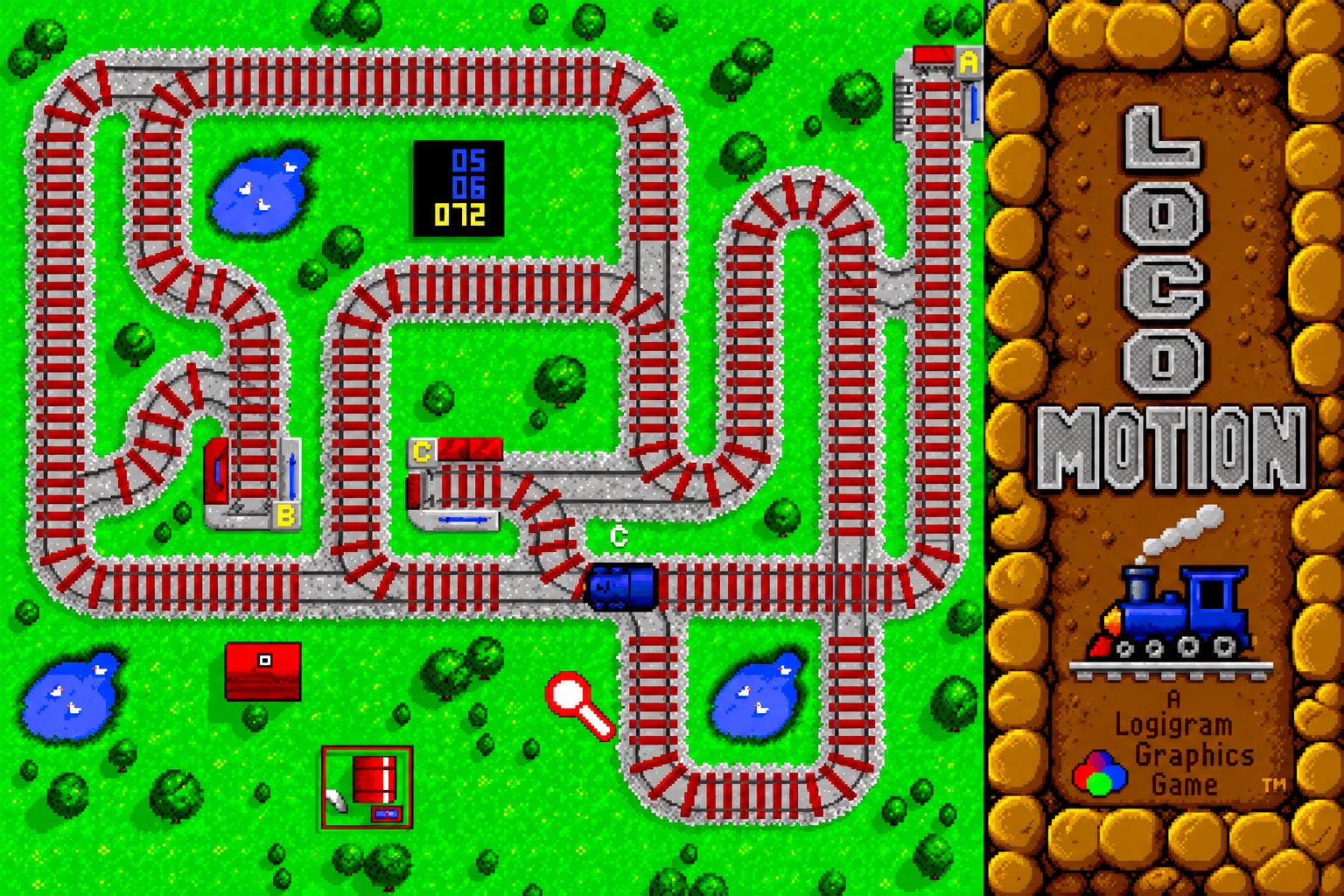
Locomotion is a clever 1992 railway puzzle game that turns a simple idea—switching tracks at the right moment—into an increasingly demanding test of timing, planning, and concentration. Viewed from a top-down perspective, players are placed in control of a busy railway network where trains depart from stations and must be guided toward their correct destinations. The challenge comes from manually changing junctions before each train reaches them, ensuring that every locomotive follows the correct route without becoming trapped, reversed, or involved in a collision. What begins as a manageable exercise in track switching gradually develops into a frantic puzzle where several trains may need attention at the same time.
Unlike traditional railway management games, Locomotion is not about building an empire, setting ticket prices, or purchasing new locomotives. Everything revolves around controlling traffic on an existing network. Trains leave stations at unpredictable intervals, travel across interconnected tracks, and rely entirely on the player to prepare a safe path ahead of them. One incorrectly positioned switch can disrupt the entire network, while a collision can cost valuable progress and make completing the stage much harder. The result is a game that feels part puzzle, part strategy, and part arcade challenge.
Now playable online through Lemon Web Games, Locomotion brings its classic railway puzzles, top-down track layouts, junction-switching mechanics, and real-time train management directly into the web browser. Players must watch every active locomotive, anticipate where each one is heading, and change track switches before trains reach critical junctions. As the networks become more complicated, successful play depends less on reacting at the last second and more on planning several moves ahead. For fans of classic DOS games and old-school puzzle design, Locomotion remains an excellent example of how a small set of rules can create surprisingly intense gameplay.
A Railway Puzzle Built Around One Simple Mechanic
At the heart of Locomotion is the railway switch. Junctions determine which direction a train will travel, and the player can alter those junctions by clicking them before a locomotive arrives. There are no complicated construction tools or menus to navigate, making the basic concept easy to understand almost immediately.
The difficulty comes from the fact that every train is moving in real time. A junction that is correct for one locomotive may be wrong for another arriving only moments later. The player constantly needs to decide which train should receive priority and when a switch needs to be changed again.
This creates a strong rhythm of observation and action. Players watch the network, identify upcoming conflicts, change a junction, and then immediately begin looking for the next problem. The controls are simple, but the decisions quickly become demanding.
Every Train Has a Destination
Trains are not simply trying to reach any available station. Each locomotive has a specific destination that must be reached successfully. This means the shortest-looking route is not necessarily the correct one.
A train can pass through several junctions before reaching its intended station, and every one of those switches needs to be set correctly. If the player sends the locomotive down the wrong branch, recovering from the mistake may take valuable time.
Because several trains can be active simultaneously, route planning becomes increasingly important. It is not enough to know where one train needs to go; the player must understand how the entire network connects.
Wrong Stations Do Not Always Mean Instant Failure
One interesting part of Locomotion is that sending a train toward the wrong station does not necessarily destroy it. Instead, the locomotive can reverse and continue traveling through the railway network.
This gives players an opportunity to recover from certain routing mistakes. However, reversal creates another problem because the train now begins traveling in the opposite direction, potentially interfering with locomotives already using the same tracks.
A small mistake can therefore create a much larger traffic-management problem. The game rarely stops the action to allow recovery. Players need to repair the situation while continuing to manage everything else happening across the network.
Collisions Are the Real Danger
The greatest threat in Locomotion is allowing two trains to occupy the same section of track at the wrong moment. When locomotives collide, they are lost and a penalty is applied, making successful completion more difficult.
Avoiding collisions requires constant awareness of where every train is heading. A junction may safely guide one locomotive toward its station but accidentally redirect another directly into its path.
As traffic becomes heavier, preventing collisions becomes more important than simply choosing the shortest routes. Sometimes the safest decision is to temporarily delay a train rather than risk sending two locomotives toward the same piece of track.
Stopped Trains Create Temporary Breathing Room
When a train reaches a junction that does not allow it to continue properly, it may stop until the route is corrected. This can initially feel like a mistake, but a stationary train can sometimes become useful.
Temporarily holding one locomotive in place gives another train time to pass through a shared section. Once the track is clear, the player can change the junction and release the waiting train.
This introduces an important tactical idea: not every train needs to keep moving continuously. Deliberately controlling the order in which locomotives move through busy areas can make complicated stages much easier.
The Top-Down View Makes Every Decision Visible
Locomotion uses a simple overhead perspective that allows players to see the entire railway layout at once. Stations, tracks, trains, and junctions remain visible without needing to scroll through a large map.
This is essential because the challenge depends on understanding the network as a complete system. The player needs to notice two trains approaching the same junction long before they actually reach it.
The visual simplicity also helps the game remain readable when several locomotives are active. There is very little unnecessary detail competing for attention. Everything important is immediately visible on the track.
Timing Matters as Much as Route Planning
Knowing the correct route is only half of the challenge. Switches must also be changed at the correct time. Altering a junction too early may accidentally redirect another train that reaches it first.
This becomes particularly important when several locomotives are close together. The player may need to wait until one train clears a junction before immediately changing it for the next arrival.
Later stages turn these moments into rapid timing puzzles. A few seconds can determine whether two trains pass safely or collide. The network becomes something the player needs to read almost like moving machinery.
Multiple Trains Quickly Increase the Pressure
Managing a single locomotive is straightforward because attention can remain focused on one route. The game becomes much harder once several trains begin moving simultaneously.
Each locomotive creates its own sequence of upcoming decisions. While the player is preparing one junction, another train may already be approaching a different switch elsewhere on the map.
The challenge grows rapidly because every additional train can interact with the others. More traffic does not simply mean more work; it creates more opportunities for conflicts between routes.
Planning Ahead Is Better Than Reacting Late
Beginners often play Locomotion by waiting until a train is almost at a junction before checking the switch. That approach works during easier stages but becomes increasingly dangerous as traffic grows.
A better strategy is to constantly scan ahead. Identify the next two or three junctions each train will reach and prepare those routes before they become urgent.
Planning ahead also makes it easier to notice conflicts. If two trains are likely to require the same junction in different directions, the player has time to decide which should move first. This turns chaotic situations into manageable sequences.
Track Layouts Become Increasingly Complicated
Early stages use relatively simple railway networks that make routes easy to understand. Later layouts contain more junctions, intersecting paths, and alternative routes that require much greater attention.
Complexity changes how players think about the map. Instead of seeing a series of individual tracks, experienced players begin recognizing important traffic corridors and dangerous junctions.
Some parts of a network become natural bottlenecks where multiple trains regularly cross. Identifying these locations is crucial because they usually deserve the most attention.
Bottlenecks Require Careful Traffic Control
A bottleneck is any area where several routes converge onto the same small section of track. These areas are particularly dangerous because trains approaching from different directions may all need access.
The safest strategy is often to control the order in which locomotives enter. Allow one train to clear the area completely before sending another through.
This can feel slower than routing everything immediately, but avoiding collisions is far more important than maintaining maximum speed. Controlled traffic usually produces better results than aggressive routing.
The Time Limit Creates Constant Pressure
Each stage requires the player to successfully deliver a specific number of trains before time expires. This prevents the safest strategy from simply stopping everything and moving trains one at a time.
Players need to balance safety against efficiency. Holding a train for too long may prevent a collision but also reduce the number of successful deliveries.
The timer creates a useful tension. There is always pressure to keep traffic moving, but rushing creates mistakes. Good play sits somewhere between those two extremes.
Successful Deliveries Are the Real Measure of Progress
Locomotion is ultimately about getting enough trains to the correct destinations. Every successful arrival brings the player closer to completing the stage.
This gives each locomotive a clear importance. Losing a train to a collision does not simply look bad—it directly reduces the player's ability to reach the required total.
The system encourages careful play without making the game feel slow. The best players deliver trains quickly while still keeping the network safe.
Mistakes Can Create Chain Reactions
One of the most interesting parts of Locomotion is how a single routing mistake can lead to several additional problems. A train sent the wrong way may reverse, return toward another locomotive, and suddenly create a collision risk on a completely different part of the network.
The player must then solve this new problem while still controlling every other active train. The situation can deteriorate rapidly if attention becomes too focused on the original mistake.
This makes recovery an important skill. Good players do not necessarily avoid every error; they become better at preventing one error from becoming several.
The Mouse-Driven Controls Suit the Puzzle Perfectly
Locomotion's control system is extremely direct. Players interact with junctions using the mouse, allowing track switches to be changed quickly without navigating menus or complicated commands.
This simplicity is important because the challenge comes from decision-making rather than control difficulty. The player should be thinking about which junction needs attention, not struggling to perform the action.
The mouse also makes rapid corrections possible. When several trains approach different switches at once, the player can quickly move across the map and adjust each route.
There Is an Arcade Quality Beneath the Strategy
Although Locomotion is clearly a puzzle and strategy game, its real-time structure gives it a strong arcade feeling. Trains never stop simply because the player needs more time to think.
This constant movement creates excitement that would be absent in a turn-based railway puzzle. Decisions need to be made quickly, especially once the network becomes crowded.
The combination works surprisingly well. Strategic planning determines what should happen, while arcade-style reactions determine whether the player can make it happen in time.
Learning the Network Makes Replays Easier
Repeated attempts at the same stage gradually become more manageable because players begin remembering which routes are most efficient and where collisions are most likely to occur.
A junction that initially seems confusing eventually becomes familiar. The player starts anticipating problems before trains even reach the area.
This creates a natural learning curve without requiring upgrades or new abilities. Progress comes from understanding the layout more thoroughly.
Simple Graphics Keep the Focus on Gameplay
Locomotion's presentation is functional rather than elaborate. The graphics clearly show the tracks, trains, stations, and junctions without unnecessary visual effects.
For a game centered on real-time traffic management, that clarity is extremely valuable. Players need to instantly understand the current position and direction of every locomotive.
The straightforward DOS-era presentation also gives Locomotion considerable retro charm. Its appearance immediately reflects a period when clever mechanics often mattered more than graphical complexity.
Why Locomotion Still Works Today
The central puzzle behind Locomotion has aged remarkably well because it does not depend on outdated technology or complicated systems. Watching moving objects, predicting their paths, and changing routes at the correct time remains naturally engaging.
The game also creates difficulty without needing dozens of mechanics. Trains, destinations, junctions, collisions, and a timer are enough to create increasingly complicated situations.
That simplicity makes Locomotion easy to revisit. Players can understand the rules quickly, yet mastering later networks still requires genuine concentration.
Playing Locomotion Online Today
Through Lemon Web Games, Locomotion can now be played directly in your web browser with no downloads or setup required. Features of the web-based version include:
New players should resist the temptation to watch only one train at a time. After setting a route, immediately scan the rest of the network for another locomotive approaching a junction. Staying aware of the whole map prevents many last-second emergencies.
It also helps to identify busy junctions early. These locations are where most collisions are likely to happen, so keeping them under control should usually take priority over less important parts of the track.
Who Should Play Locomotion
Locomotion is particularly enjoyable for players who like games where success depends on concentration rather than complicated controls. The rules are easy to understand, but handling several trains at once can quickly become demanding.
It should also appeal to fans of transport games who want something faster and more focused than a full management simulation. Instead of spending hours constructing networks, Locomotion puts players directly in control of the traffic already using them.
Play Locomotion Online Now
Locomotion turns railway switching into an addictive real-time puzzle where every train, junction, and second matters. Players must guide locomotives toward the correct stations, recover from routing mistakes, manage busy intersections, and prevent collisions while racing against the stage timer. The basic controls remain simple throughout, but increasingly complicated layouts ensure that the challenge continues growing.
Through Lemon Web Games, players can experience this classic DOS railway puzzle directly in a modern browser. Whether carefully planning several routes in advance or frantically changing switches moments before two trains meet, Locomotion delivers a compact but surprisingly intense strategy experience.
Final Thoughts
Locomotion demonstrates how much gameplay can be created from a very small set of ideas. There are trains, tracks, stations, junctions, destinations, and a clock, yet the interaction between those elements produces constantly changing problems. Every additional locomotive increases the pressure, and every complicated junction forces players to think more carefully about what will happen next.
Its greatest strength is the balance between planning and reaction. Players need to understand the railway network strategically, but they also need enough speed to change switches before trains arrive. A perfect route planned too late is just as dangerous as a bad route chosen quickly.
Through Lemon Web Games, Locomotion remains an entertaining piece of early 1990s PC puzzle design that is still easy to appreciate today. Its graphics are simple and its rules are straightforward, but managing a crowded railway network without causing a collision remains remarkably satisfying. For anyone who enjoys trains, puzzles, strategy, and escalating real-time pressure, Locomotion is still well worth putting back on the rails.











Comments 0