

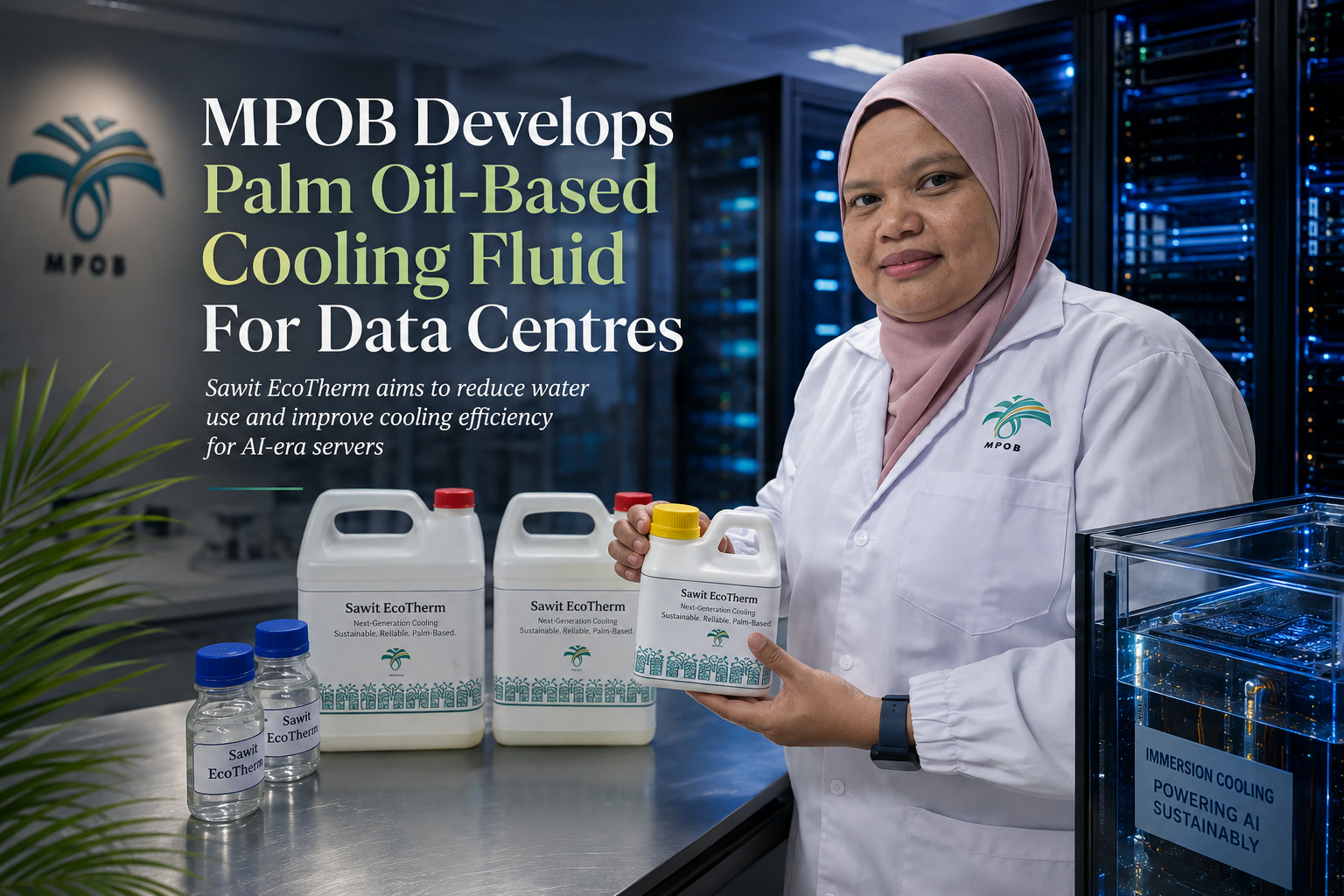
Malaysia's rapid data centre expansion is creating plenty of opportunities, but it is also putting growing pressure on electricity and water resources. As AI servers become more powerful and considerably hotter, keeping those systems cool is becoming one of the industry's biggest infrastructure challenges.
The Malaysian Palm Oil Board (MPOB) believes part of the answer could come from an industry Malaysia already knows extremely well: palm oil. Researchers have developed Sawit EcoTherm, a palm-derived immersion cooling fluid designed to cool entire servers by allowing their components to operate while submerged directly in a non-conductive liquid.
This Is Liquid Cooling On A Much Bigger Scale
PC enthusiasts are already familiar with liquid cooling. High-performance gaming computers commonly use all-in-one coolers to transfer heat away from processors and graphics cards, but immersion cooling takes the idea significantly further.
Instead of circulating coolant through a small block attached to a CPU, immersion systems place server hardware directly inside a specially formulated dielectric fluid that does not conduct electricity. Heat passes from processors, GPUs, memory and other components straight into the surrounding liquid, which is then circulated through a cooling system before returning to the tank.
Sawit EcoTherm was developed by MPOB's Advanced Oleochemical Technology Division using locally sourced palm-based materials. Rather than positioning the technology as another petroleum-derived industrial coolant, MPOB is targeting a more renewable alternative that could fit naturally into Malaysia's rapidly expanding data centre sector.
AI Is Making Traditional Data Centre Cooling Harder
Cooling has always been important for servers, but AI has dramatically increased the challenge. Modern AI accelerators consume enormous amounts of electricity and pack substantial computing power into relatively small spaces, which means far more heat needs to be removed from each rack.
MPOB says AI-focused servers can generate around three to five times more heat than conventional server systems. That creates problems for traditional air cooling, where rows of fans and large air-conditioning systems must continuously move enormous volumes of cold air through the facility.
Eventually, simply blowing more air across increasingly powerful hardware becomes inefficient. Data centres either need more cooling infrastructure or need to move heat away from the electronics more directly.
Immersion cooling does exactly that. Because the coolant makes direct contact with the hardware, heat can be transferred much more efficiently than through surrounding air.
Sawit EcoTherm Could Dramatically Reduce Water Consumption
One of MPOB's biggest arguments for immersion cooling involves water.
Dr Noor Khairin Mohd, senior research officer with MPOB's process engineering and design unit, estimates that conventional water-based cooling across Malaysia's data centre industry could potentially consume around 876 million litres of water every day. According to the comparison provided, that is roughly equivalent to the daily water requirements of almost four million people.
That figure highlights an increasingly important issue as more hyperscale and AI data centres are developed locally. A data centre may appear largely digital from the outside, but its physical infrastructure still depends heavily on energy, cooling equipment and, in many cases, substantial quantities of water.
Traditional cooling towers can continually lose water through evaporation. Sawit EcoTherm instead operates in a closed-loop immersion cooling environment, allowing the same fluid to absorb heat and circulate repeatedly rather than depending on large volumes of evaporative cooling water.
If the approach proves practical at commercial scale, the water savings could become one of its strongest advantages.
Higher Server Density Could Become Easier To Manage
Immersion cooling is also attractive because it can support considerably higher computing density.
A traditional server rack can only accommodate so much power before cooling becomes a limitation. Packing additional GPUs into the same space produces additional heat, and eventually the facility must reduce rack density or significantly upgrade its cooling infrastructure.
Direct liquid cooling changes that equation. If heat can be removed more efficiently from individual components, operators can potentially place more computing hardware into the same physical area.
That is particularly valuable for AI training, cloud computing and hyperscale infrastructure, where companies increasingly want large numbers of high-powered accelerators operating as closely together as possible.
Better cooling can therefore affect more than temperature. It can influence how much computing capacity a data centre can physically accommodate.
MPOB Says Cooling Energy Could Fall By Up To 50%
Water is not the only potential saving.
MPOB says immersion cooling using Sawit EcoTherm could reduce cooling-related electricity consumption by approximately 30% to 50% compared with more conventional approaches.
Part of that saving comes from eliminating or reducing the need for individual server fans. Once hardware is submerged in coolant, continuously pushing air across every heatsink becomes unnecessary.
Data centres may also require less energy-intensive air handling and cooling equipment overall.
That could help improve a facility's Power Usage Effectiveness, or PUE, one of the key measurements used to evaluate how efficiently a data centre uses electricity. The closer the facility can bring its total power consumption toward the electricity actually being consumed by computing hardware, the better its overall efficiency.
Lower electricity consumption also reduces associated indirect carbon emissions, particularly when the power grid still depends partly on fossil fuels.
The Fluid Itself Is Designed To Be More Sustainable
Another interesting aspect of Sawit EcoTherm is what it is made from.
MPOB says the formulation can contain up to 95% renewable bio-based materials derived from palm oil, reducing reliance on conventional petroleum-based dielectric fluids.
The organisation also says the coolant is PFAS-free, readily biodegradable and designed to have relatively low ecological toxicity.
PFAS have become increasingly controversial internationally because many compounds in the group break down extremely slowly in the environment. They are often described as "forever chemicals" because they can persist for long periods once released.
Avoiding those chemicals could therefore make disposal and accidental leakage less environmentally problematic, although commercial deployments would still require proper handling and environmental controls.
For Malaysia, using locally produced palm-derived feedstock could also create a domestic supply-chain advantage if immersion cooling grows substantially.
This Could Create A New High-Tech Use For Malaysian Palm Oil
Palm oil is normally associated with food, cosmetics, soaps, chemicals and biofuels. Data centre cooling represents a very different application.
If Sawit EcoTherm proves commercially competitive, it could push Malaysian palm-derived products further into the advanced technology sector.
That would be particularly interesting because Malaysia is simultaneously trying to attract major international investments in cloud computing and AI infrastructure. Companies such as hyperscale cloud providers require enormous amounts of cooling capacity, so developing some of that technology locally could create additional economic value around the data centre ecosystem.
Instead of Malaysia simply hosting foreign-built computing infrastructure, local research and industrial capabilities could potentially contribute to how that infrastructure operates.
Real-World Data Centres Will Be The Important Test
Laboratory development is only the beginning.
Before data centre operators are willing to submerge expensive servers and accelerators into a new coolant, they will want substantial evidence that the fluid remains stable and effective over long operating periods.
Compatibility will be extremely important. The fluid must not damage circuit boards, plastics, seals, cables, connectors or other materials used inside server hardware. Its thermal characteristics need to remain predictable, and maintenance procedures must be practical for technicians.
Operators will also want to understand how often the coolant needs replacement, how easily it can be filtered or recycled and whether long-term operating savings justify the initial cost of adopting an immersion system.
That is why MPOB is calling for pilot projects, technical validation and industry demonstrations rather than treating Sawit EcoTherm as immediately ready for widespread deployment.
Commercialisation Will Need An Entire Ecosystem
Successfully bringing the technology to market will require more than MPOB working alone.
Data centre developers, server manufacturers, cooling-system specialists, technology providers and government agencies will all need to participate. Server warranties and hardware certifications may also need to account for immersion operation.
System integrators will be especially important because immersion cooling changes how servers are installed and maintained. Conventional rack layouts may need to be replaced with tanks or specialised enclosures, while heat-exchange infrastructure must be designed around the fluid.
This makes commercialisation as much an engineering and ecosystem challenge as a chemistry challenge.
Government support could help accelerate pilot deployments, while partnerships with major data centre operators would provide valuable real-world performance information.
Malaysia Could Have A Unique Advantage
Malaysia has already become an increasingly important location for regional data centre investment. That makes the country an unusually relevant testing ground for something such as Sawit EcoTherm.
There is plenty of local demand for new cooling technology, and the primary raw material is also produced domestically.
If Malaysia can successfully combine its palm-based oleochemical expertise with its growing data centre industry, it could potentially develop a specialised technology that is difficult for other markets to replicate at the same scale.
The opportunity is therefore bigger than simply selling another coolant. There could eventually be an ecosystem around bio-based immersion cooling fluids, cooling hardware, engineering services and sustainable data centre design.
Could Palm-Based Coolant Eventually Reach Gaming PCs?
For now, Sawit EcoTherm is clearly aimed at commercial servers and data centres rather than somebody's gaming PC.
Still, the idea is entertaining.
If the formulation performs well and eventually becomes commercially available in smaller quantities, there is no technical reason why palm-derived dielectric fluids could not inspire cooling products for workstations or enthusiast PCs.
A conventional AIO cooler using a palm-derived fluid would be considerably less dramatic than dropping an entire motherboard into a tank, but it would certainly give Malaysian PC enthusiasts something unusual to talk about.
That possibility remains speculative, of course. The immediate opportunity is much larger: helping the data centre industry deal with rapidly increasing thermal loads.
Final Thoughts
Sawit EcoTherm is an interesting example of two very different Malaysian industries beginning to intersect.
On one side is palm oil, an industry Malaysia has spent decades developing and refining. On the other is one of the fastest-growing areas of digital infrastructure, driven increasingly by cloud computing and artificial intelligence.
MPOB's palm-based immersion coolant could potentially help address several data centre challenges at once by reducing water consumption, lowering cooling energy requirements and replacing some petroleum-derived materials with renewable alternatives.
But the next stage will be critical. Data centre operators will need convincing evidence that the technology is reliable, cost-effective and compatible with expensive server hardware over years of continuous use.
If those trials succeed, however, Malaysia may have an opportunity to contribute something genuinely distinctive to the global data centre industry: a cooling technology built not from conventional industrial chemicals, but from one of the country's most established natural resources.











Comments 0