

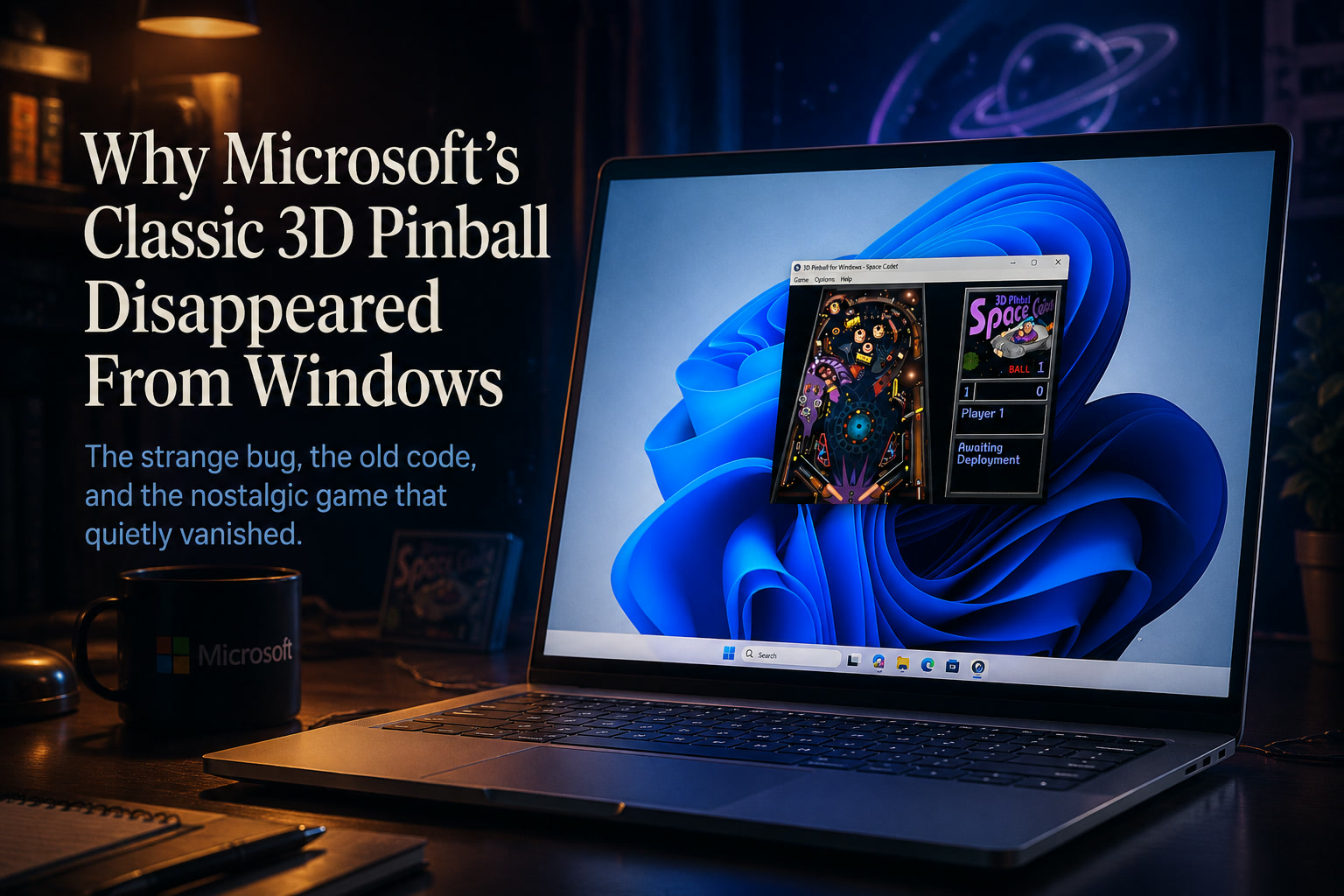
For anyone who grew up using Windows 95, Windows 98 or especially Windows XP, 3D Pinball: Space Cadet is probably one of those games that instantly brings back memories. It was simple, colourful and always sitting there inside Windows whenever you needed a short distraction from homework, office work or simply waiting for the internet to connect. Yet when Windows Vista arrived, Pinball suddenly disappeared.
For years, many assumed licensing problems were responsible. The actual story is much more interesting: Microsoft encountered a strange bug while moving Windows to 64-bit, and fixing one old game simply became too expensive in engineering time.
The 64-Bit Version Had a Very Strange Problem
The story comes from longtime Microsoft engineer Raymond Chen, who has worked on Windows for decades and regularly shares stories about its development through his The Old New Thing blog.
During Microsoft's effort to port Windows XP from 32-bit to 64-bit architecture, engineers also had to ensure the operating system's bundled applications continued working.
That included Space Cadet Pinball.
Unfortunately, the 64-bit version behaved very differently.
When a new game started, the ball would enter the launcher as expected, but instead of resting against the plunger, it would simply fall straight through the bottom of the table.
There was effectively no collision.
That made every game extremely short because the player could not even launch the ball.
Microsoft engineers obviously knew something was wrong, but finding the cause turned out to be much harder than expected.
Nobody Really Understood the Original Code
One of the biggest problems was that Microsoft had not originally developed the game.
The code came from an external developer and, according to Chen, much of it lacked useful comments explaining how the system worked.
Microsoft engineers therefore found themselves looking through unfamiliar code trying to locate the collision-detection logic responsible for keeping the ball inside the table.
They could not easily find it.
The problem was believed to involve some obscure floating-point rounding behaviour introduced during the transition to 64-bit computing.
Fixing it could have meant spending days reverse-engineering a relatively small game while the Windows development team still had millions of lines of much more important operating-system code waiting to be ported.
That forced Microsoft to make a practical decision.
As Chen later explained, the team simply could not afford to spend days studying the Pinball code while working against a larger Windows release schedule.
So Space Cadet Pinball was removed.
Sometimes Software Disappears Because of Priorities, Not Technology
The story is a surprisingly relatable example of how software development works in the real world.
From the outside, users might look at Pinball and think:
"It's just a simple game. Surely Microsoft could fix it."
But software complexity is rarely proportional to what appears on the screen.
A tiny application can contain old assumptions, undocumented behaviour and code written for hardware architectures that no longer exist.
Engineers also have limited time.
When the choice is between fixing an optional game and completing critical operating-system components required to ship Windows, the operating system naturally wins.
This is something developers encounter constantly.
Sometimes a feature disappears not because it is impossible to repair, but because the time required to understand and maintain it is no longer justified by its importance to the larger project.
Raymond Chen Had Actually Improved Pinball Before
Interestingly, Chen was not someone who disliked the game.
In fact, one of the Windows XP improvements he remembers proudly involved fixing Pinball's CPU usage.
The original game apparently had no proper frame-rate limiter.
As computer hardware became dramatically faster than the machines available when Pinball was originally developed, the game would simply render frames as quickly as the processor could manage.
On newer PCs, that reportedly meant it could exceed one million frames per second, unnecessarily driving CPU utilisation toward 100%.
There was obviously no visual benefit to calculating that many frames for a simple pinball game.
Chen added a frame-rate limit of approximately 120 frames per second, which reportedly reduced CPU utilisation to around 1%.
That tiny change made the game far more efficient on modern hardware.
It also demonstrates another classic software-development problem: code often survives far longer than the hardware assumptions under which it was originally written.
Space Cadet Pinball Wasn't Actually a Microsoft Game
Another interesting piece of the story concerns where the game came from.
Space Cadet originally appeared as one of the tables in Full Tilt! Pinball, released in 1995 by developer Cinematronics and published by Maxis.
Microsoft licensed the Space Cadet table and included it with Microsoft Plus! for Windows 95, which launched alongside Windows 95 on 24 August 1995.
It later became one of the most recognisable games bundled with Windows.
Because it appeared inside Microsoft's operating system for so many years, many people naturally assumed Microsoft owned it.
It didn't.
That distinction became important years later.
Microsoft Apparently Tried to Bring It Back
In 2018, Chen revealed that a Microsoft Garage team had explored resurrecting Space Cadet Pinball by repackaging the working 32-bit version.
Technically, there was a straightforward path.
Legally, however, things were much more complicated.
Microsoft's original licence reportedly allowed the company to distribute the game as part of Windows, Microsoft Plus! and their successors.
It did not necessarily give Microsoft the right to release Pinball independently or distribute its source code.
By that point, the companies involved with the original game had also changed considerably, with Cinematronics and Maxis eventually becoming part of Electronic Arts.
What looked like a simple nostalgic rerelease therefore became a licensing headache.
So even after the original technical problem was no longer the main obstacle, Microsoft's rights to the game prevented an easy official comeback.
The Original 64-Bit Problem May Have Eventually Fixed Itself
There is another twist.
Chen later clarified that the problematic build he had been working with was not actually running on Intel Itanium hardware, which eventually became associated with Windows XP 64-bit Edition.
The internal development environment used an older Alpha AXP 64-bit processor architecture while Microsoft waited for suitable Itanium hardware.
Chen eventually suspected that the bizarre collision behaviour was related to a rounding-mode issue in the C runtime library.
That underlying problem was apparently fixed later for unrelated reasons.
In other words, Pinball may eventually have started working correctly again without anyone specifically repairing Pinball itself.
Unfortunately, by then the decision had already been made.
The game was gone.
Why Space Cadet Pinball Became So Memorable
What makes this story interesting today is not simply the bug.
It is how much emotional value a tiny Windows accessory managed to accumulate.
Space Cadet Pinball was never a cutting-edge AAA game.
It did not require expensive hardware.
There was no subscription, account or online service.
It simply came with the computer.
That accessibility meant millions of people encountered it naturally.
Alongside Solitaire, Minesweeper and FreeCell, Pinball became part of the personality of older Windows releases.
It is difficult to imagine many Windows 11 applications producing the same nostalgia decades from now.
Modern operating systems certainly contain more sophisticated technology, but some of the playful personality once associated with desktop computing has gradually disappeared.
You Can Still Relive Space Cadet Pinball on Lemon Web Games
Fortunately, the disappearance of Pinball from modern Windows does not mean the game itself has to remain only a memory.
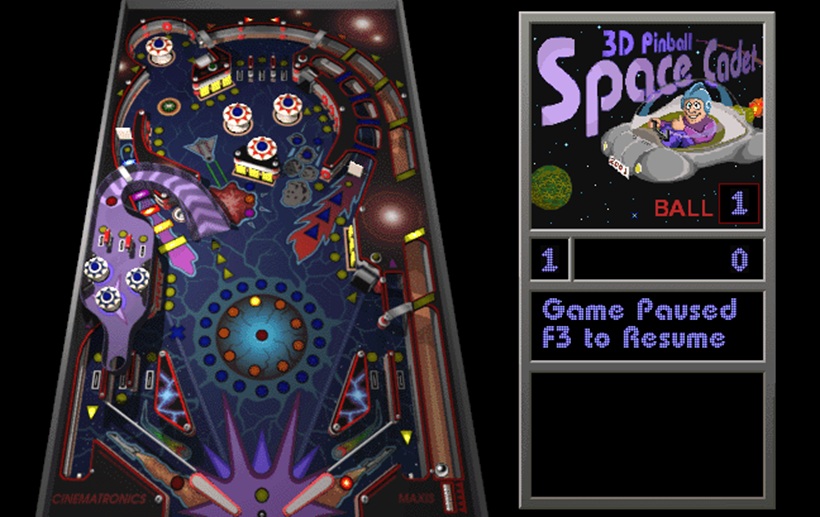
We uploaded the classic 3D Pinball: Space Cadet into the Lemon Web Games library some time ago, allowing players to revisit one of the most memorable games associated with classic Windows.
For anyone who spent countless hours trying to increase multipliers, complete missions or simply beat their previous high score, it is a fun opportunity to experience that familiar table again.
Younger players who never used Windows 95 or Windows XP can also finally understand why something as simple as a bundled pinball game still generates so much nostalgia decades later.
That is one of the reasons we continue adding classic games to Lemon Web Games.
Older games are not always technically impressive by modern standards, but they capture a particular period in computing history that would otherwise gradually disappear.
Old Games Are Part of Computing History
Stories such as Space Cadet Pinball also demonstrate why software preservation matters.
Older games were often designed around specific operating systems, processors, graphics technologies and assumptions that no longer exist.
When platforms change, those games can become difficult or impossible to run.
Licensing creates another problem.
A company may technically possess the original files while lacking the legal right to distribute them independently.
Over time, source code may also be lost, development teams disappear and documentation becomes incomplete.
The result is that software once used by millions of people can become surprisingly fragile.
Preserving access to classic games therefore means preserving part of the history of personal computing itself.
Final Thoughts
The disappearance of 3D Pinball from Windows was not caused by some dramatic corporate decision to eliminate fun from the operating system.
It came down to something much more familiar to software developers: an obscure bug, poorly understood legacy code and a deadline that mattered more than one small application.
Microsoft's engineers were already responsible for moving millions of lines of Windows code into the 64-bit era. Spending several days reverse-engineering an old Pinball collision system simply could not be justified at the time.
The later licensing complications made an official standalone revival even harder.
Yet the fact that people are still talking about Space Cadet Pinball more than two decades later shows just how successful the game was at becoming part of Windows culture.
For those of us who remember it, the sound effects, missions and familiar blue space-themed table can instantly transport us back to an earlier era of computing.
And thankfully, you do not need to reinstall Windows XP to experience it again — Space Cadet Pinball is already waiting inside the Lemon Web Games library for another round.











Comments 0