

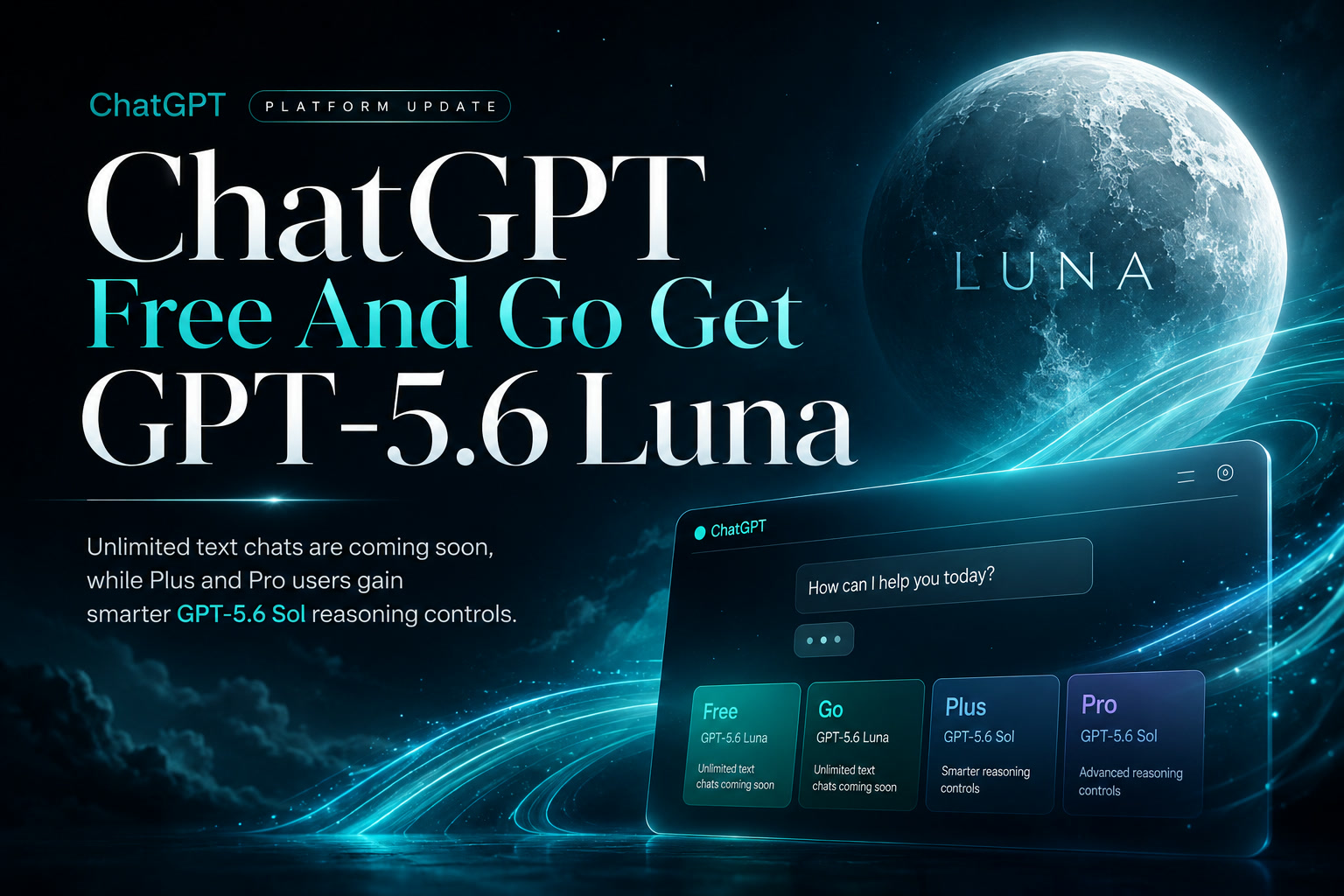
OpenAI is rolling out another sizeable round of ChatGPT updates, and this time the changes are not limited to paying subscribers. Free and Go users are being moved to GPT-5.6 Luna as their default model, while Plus and Pro subscribers are getting an upgraded GPT-5.6 Sol experience with more flexible reasoning controls and improvements aimed at accuracy, consistency and response quality.
There is also a bigger change coming shortly for users on the lower-cost tiers: unlimited GPT-5.6 Luna text conversations. Combined with a new optional "Think" capability, the update could significantly narrow the everyday experience gap between free ChatGPT accounts and the more expensive subscription plans.
GPT-5.6 Luna Becomes The Default For Free And Go
Starting with the biggest change for mainstream users, OpenAI is making GPT-5.6 Luna the standard ChatGPT model for both Free and Go subscribers.
That means users on these plans will no longer need to specifically select a newer model just to benefit from the latest improvements. GPT-5.6 Luna effectively becomes the normal ChatGPT experience for everyday conversations, writing assistance, explanations, brainstorming and other common tasks.
The move is particularly significant for Free users, as OpenAI has traditionally placed tighter model and usage restrictions on accounts that do not have a paid subscription.
Go subscribers will receive the same default model, although their overall plan continues to provide additional benefits compared with the Free tier.
Unlimited GPT-5.6 Luna Text Chats Are Coming
Perhaps the more interesting announcement is that OpenAI plans to remove the normal text-chat limit for GPT-5.6 Luna on both the Free and Go plans.
In other words, users should eventually be able to keep having regular text conversations without encountering the familiar model usage cap.
There is some uncertainty surrounding exactly when the change will arrive, however.
OpenAI's blog reportedly says unlimited chat access is coming next week, while a separate announcement posted on X suggests it could arrive as early as tomorrow.
Either way, the important part is that OpenAI appears to be moving toward effectively unlimited standard text conversations for these plans.
There will still be restrictions elsewhere. OpenAI says the unlimited access remains subject to abuse protections, while things such as file uploads, image generation and other ChatGPT tools will continue to have their own usage limits.
So "unlimited" here should primarily be understood as unlimited normal text chatting rather than unrestricted access to every feature available inside ChatGPT.
Free Users Are Also Getting A "Think" Option
OpenAI is also bringing a more deliberate reasoning mode to Free and Go accounts.
The upcoming Think feature allows users to tell ChatGPT that a question deserves additional reasoning before responding.
Most everyday questions do not necessarily benefit from this. Asking for a quick explanation, rewriting a paragraph or checking a simple fact generally works perfectly well through the normal chat experience.
More complicated requests are different.
Something involving several conditions, a detailed plan, troubleshooting, comparison between multiple options or a problem requiring several logical steps can benefit from allowing the model more time to work through the request.
Think essentially gives users a straightforward way of saying: don't just answer quickly—spend more effort working this out.
Importantly, users will not need to activate it for every conversation. Normal ChatGPT remains the default, while Think becomes something users can switch on when the question actually warrants deeper reasoning.
GPT-5.6 Sol Gets A Bigger Role For Plus And Pro
OpenAI is taking a slightly different approach with ChatGPT Plus and Pro.
GPT-5.6 Sol will now handle both fast Instant-style responses and deeper reasoning inside regular ChatGPT conversations.
Previously, users could sometimes find themselves choosing between different models depending on whether they wanted speed or more intensive reasoning.
OpenAI appears to be simplifying that experience by letting GPT-5.6 Sol handle both situations.
For the user, the idea is fairly simple: ChatGPT should be able to answer quickly when the question is straightforward but apply substantially more reasoning when the request becomes complicated, without forcing people to constantly think about which model they should choose.
There is one important exception.
OpenAI says these changes currently apply specifically to the regular ChatGPT experience. The GPT-5.6 Sol versions used by Work and Codex are not being updated as part of this particular release.
OpenAI Says GPT-5.6 Is Significantly More Accurate
Accuracy is another area OpenAI is highlighting heavily with the new models.
According to internal testing conducted by the company, GPT-5.6 Sol produced considerably fewer responses containing factual mistakes compared with GPT-5.5 Instant.
For a set of financial, medical and legal questions where factual accuracy was particularly important, OpenAI says responses containing at least one factual error were 68% less common with GPT-5.6 Sol.
Interestingly, the improvements are not limited to the premium model.
GPT-5.6 Luna reportedly produced responses containing at least one factual error 62% less frequently than GPT-5.5 Instant in the same evaluation.
Those improvements are especially useful for questions involving precise information such as dates, figures, rules, sources and assumptions, where a seemingly small factual mistake can substantially change the usefulness of an answer.
Of course, lower error rates do not mean AI-generated information suddenly becomes infallible. Important information should still be verified where accuracy matters, but reducing the frequency of factual errors is nevertheless one of the most important improvements OpenAI can make.
Plus And Pro Users Can Now Control Reasoning With A Slider
Another interesting addition for ChatGPT Plus and Pro subscribers is a new reasoning slider.
Instead of simply choosing between a normal response and a separate reasoning mode, users can now control how much thinking effort ChatGPT should apply.
For a quick question, the slider can favour speed.
For something more demanding—perhaps software development, technical troubleshooting, research, planning, writing or analysing several possible decisions—the reasoning effort can be increased.
This provides a more flexible middle ground than simply having one "fast" model and another "slow but smart" model.
The control is being made available across ChatGPT on web, desktop and mobile, so the behaviour should remain broadly consistent regardless of where the service is being used.
Responses Should Become More Appropriate To The Question
OpenAI is also trying to improve something that sounds simple but has a surprisingly large impact on the experience: knowing how much to say.
GPT-5.6 Sol is designed to better judge the appropriate response length based on the question.
A straightforward question should therefore receive a relatively concise answer instead of several unnecessary sections of explanation.
More complicated requests should still receive the depth they require.
OpenAI also says the model should rely less heavily on unnecessary formatting, helping responses feel more natural rather than turning every simple question into an overly structured document.
That could make a noticeable difference for people who use ChatGPT constantly throughout the day, particularly when they simply want a quick answer rather than an essay.
ChatGPT Should Be Less Likely To Simply Agree With You
Another behavioural improvement involves how ChatGPT handles incorrect assumptions.
OpenAI says GPT-5.6 Sol is more willing to correct inaccurate information provided by the user instead of simply agreeing with it.
This is an important distinction.
An AI assistant that always tries to be agreeable can become less useful if it reinforces a mistaken assumption simply because that is how the question was phrased.
A better assistant should be able to say that something does not appear correct, explain why and then provide the more accurate information.
OpenAI says the change is part of its broader effort to make ChatGPT more dependable across ordinary conversations rather than simply making the underlying model more powerful.
What ChatGPT Currently Costs In Malaysia
For Malaysian users considering an upgrade, the current subscription structure remains relatively straightforward.
ChatGPT Go costs RM24 per month, positioning it as the affordable step above the Free plan.
ChatGPT Plus costs RM99.90 per month, providing access to higher-end models and additional capabilities.
At the top end, ChatGPT Pro costs RM420 per month, aimed largely at heavy users who want greater access to OpenAI's most capable features.
The Go and Pro plans are particularly interesting because both became substantially cheaper earlier this year.
Go originally cost RM38.99 per month before dropping to RM24, while Pro previously carried a considerably higher RM999 monthly price before being reduced to RM420.
With GPT-5.6 Luna and unlimited text conversations coming to Free and Go accounts, the differences between the plans may increasingly revolve around advanced models, reasoning capacity, tools and usage allowances rather than how many ordinary text conversations someone can have.
Final Thoughts
This update feels like another step toward making the basic ChatGPT experience considerably more capable without requiring everyone to subscribe to the highest-priced plans.
Giving Free and Go users GPT-5.6 Luna, unlimited text conversations and access to Think could make those tiers more than sufficient for a large percentage of everyday users.
Meanwhile, Plus and Pro appear to be moving further toward power-user territory, with GPT-5.6 Sol combining quick responses and deeper reasoning while giving users considerably more control over how much processing is applied to a request.
The reasoning slider may actually be one of the more useful additions here. Not every question deserves maximum reasoning, but having the option available when working through complicated coding, research, planning or decision-making tasks makes ChatGPT considerably more flexible.
Most importantly, OpenAI appears to be simplifying the overall experience. Rather than expecting users to understand an increasingly complicated list of AI models, ChatGPT itself is gradually becoming better at deciding whether a question needs a quick response or substantially more thought.











Comments 0