


In recent years, transparency in healthcare pricing has become more than just a nice-to-have feature. It is now a requirement. Across Malaysia, healthcare providers are expected to make drug pricing visible and accessible to the public, ensuring patients are better informed before making decisions.
That's exactly where the Drug Kiosk Price Information system comes in. This is not just another system built to tick a compliance checkbox. It was developed with real-world hospital workflows in mind, combining flexibility, practicality, and cost efficiency into one solution.
Why This System Exists
The Malaysian Government has introduced a requirement for healthcare providers to display drug pricing information clearly to patients. The intention is simple and meaningful: empower patients with knowledge. But in reality, implementing this requirement isn't always straightforward. Hospitals and clinics operate on complex systems. Some rely on legacy databases, others use modern Hospital Information Systems (HIS), and many have a mix of both. Extracting clean, accurate, and presentable drug pricing data from these environments can be challenging. That's where this system was designed to fit in seamlessly.
Built to Work with Your Existing Systems
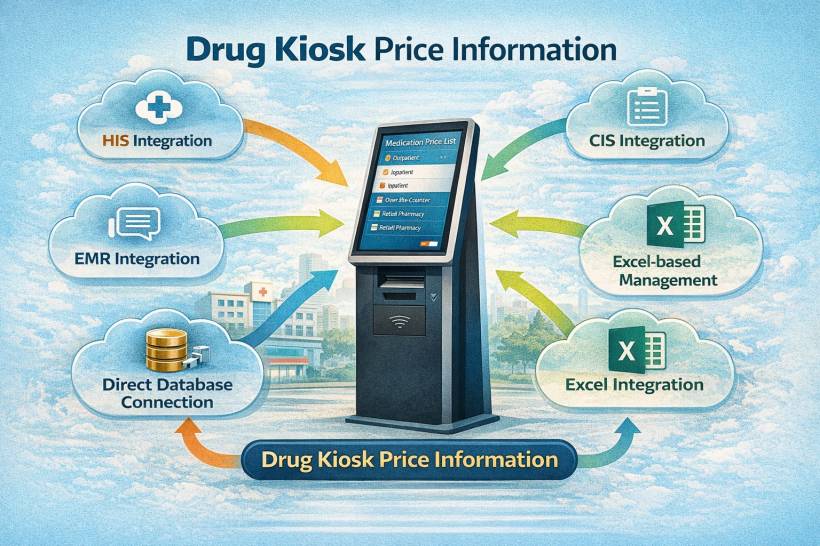
One of the biggest strengths of the Drug Kiosk Price Information system is its openness. Instead of forcing healthcare providers to change how they work, the system adapts to your environment. It can integrate with:
• Electronic Medical Records (EMR)
• Clinical Information Systems (CIS)
• Finance Information Systems (FIS)
• Or even directly connect to your existing database
This flexibility means you don't need to overhaul your infrastructure just to comply with pricing transparency requirements. The system simply plugs into what you already have. And if your setup is more manual? That's covered too.
Excel-Friendly for Simpler Workflows
Not every facility maintains a fully integrated system, and that's perfectly fine. For hospitals or clinics that prefer simplicity, the system can directly read from Excel files. This allows teams to maintain drug pricing in a familiar format while still presenting it professionally through the kiosk interface. It's a practical approach that reduces dependency on IT-heavy workflows while still achieving compliance.
Full Control Over What Gets Displayed
Let's be honest — not every item in your database should be visible to patients.
Many healthcare systems contain test entries, temporary drug codes, or internal-use items that are not meant for public display. Without proper control, these could accidentally appear on a kiosk. This system addresses that directly. You have full control over what gets shown and what stays hidden. Healthcare providers can selectively display only approved drug listings, ensuring that patients see accurate, relevant, and meaningful information. This level of customization is especially important in maintaining professionalism and avoiding confusion.
Smart Segmentation of Drug Pricing
Another key feature is the ability to categorize and segment drug pricing clearly. The system supports multiple pricing groups such as:
• Inpatient medications
• Over-the-counter (OTC) drugs
• Retail pharmacy items
This makes the kiosk more intuitive for patients. Instead of scrolling through a long, mixed list, users can easily find what they're looking for based on context. It's a small detail, but it significantly improves usability.
Many hospitals already have kiosks deployed for patient registration, queue management, or information display. The good news is — you don't need to replace them. As long as your kiosk supports touch input and web browsing, the Drug Kiosk Price Information system can be deployed directly on it. This allows you to extend the functionality of your existing infrastructure without additional investment.
Of course, if you prefer a more polished look, you can always opt for a dedicated kiosk setup. The system is flexible enough to support both approaches.
Designed for Real-World Healthcare Environments
This system wasn't built in isolation. It was designed with the realities of healthcare operations in mind:
• Varying levels of IT maturity
• The need for quick deployment
• Budget constraints
• Compliance requirements
By addressing these factors, the Drug Kiosk Price Information system becomes more than just a display tool. It becomes a practical bridge between regulatory requirements and everyday operations.
Final Thoughts
Healthcare transparency is moving in the right direction, and initiatives like mandatory drug price display are a big step forward for patients in Malaysia. But compliance doesn't have to be complicated or expensive. The Drug Kiosk Price Information system offers a flexible, scalable, and cost-effective way to meet these requirements while improving patient experience at the same time. Whether you are running a large hospital with complex systems or a smaller clinic managing data in Excel, this solution adapts to you — not the other way around.
And sometimes, that's exactly what makes a system truly useful.











Comments 0