

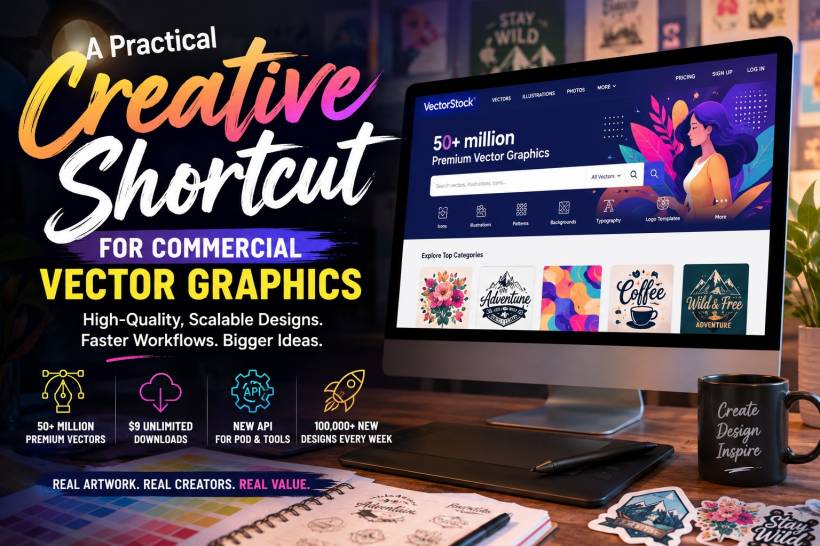
Creative work often starts with a blank page, but it does not always have to. For designers, marketers, print-on-demand sellers, and small creative teams, the pressure to produce new visuals never really stops. There are social media campaigns to prepare, product listings to refresh, seasonal promotions to launch, packaging ideas to test, and customer requests that need quick turnaround.
In that environment, speed is not about cutting corners. It is about knowing where to focus your time.
Rather than rebuilding every illustration, icon, pattern, or product graphic from scratch, many creatives are turning to ready-made vector assets as a practical starting point. A good design resource can help turn an early concept into a finished commercial visual much faster, while still leaving room for editing, customisation, and original creative direction.
That is where platforms such as VectorStock can be especially useful.
A Large Design Library Can Save Hours of Production Time
For many creative professionals, the hardest part of a project is not always execution. Sometimes it is getting past the first idea.
A large vector graphics library gives designers a quicker way to explore concepts, discover visual styles, and find assets that can be adapted to suit a particular campaign or brand. Instead of spending hours drawing every base element from scratch, creatives can begin with a professionally made illustration, icon set, typography treatment, background, or product design and then build something more specific around it.
VectorStock offers access to a broad catalogue of vector artwork across many common commercial design categories. Users can search for illustrations, logos, patterns, seasonal artwork, marketing visuals, decorative graphics, backgrounds, icons, typography, and product-ready artwork.
That variety makes it useful for different types of work.
A social media manager may need a quick promotional visual. A print-on-demand seller may be looking for designs to test on shirts, mugs, stickers, or tote bags. A small business may need visual elements for posters, packaging, menus, banners, or website graphics. A freelance designer may simply need a strong foundation for a client concept.
Having access to a focused library means less time hunting through random sources and more time refining the actual creative direction.
Why Vector Files Still Matter in Commercial Design
One of the biggest benefits of vector graphics is flexibility.
Unlike standard image files, vectors are built using shapes, lines, and points rather than fixed pixels. This allows them to be enlarged or reduced without losing sharpness. A small icon can become a large poster graphic. A shirt design can be adapted into a sticker, product label, banner, sign, or website element while still keeping clean edges and professional quality.
That makes vectors particularly useful for commercial work where a single design may need to appear across many different formats.
For example, a graphic created for a product listing could later be reused for packaging, social media advertising, printed merchandise, and event signage. Instead of recreating the artwork each time, the designer can work from the same scalable source file.
This flexibility is especially valuable for print-on-demand businesses. Product artwork often needs to work across a wide range of items and print sizes. A design that looks good on a phone case may need to be enlarged for a hoodie, wall art print, or display banner. Vector files make that transition much easier.
A More Flexible Way to Explore Creative Ideas
One of the most practical parts of a large design platform is the freedom to explore.
Creative ideas do not always come together perfectly on the first attempt. A designer may test several styles before finding the right direction. A print-on-demand seller may try different themes, colour combinations, or niche markets before deciding which products are worth developing further.
A low-cost unlimited-download approach can make that process less restrictive.
Rather than carefully calculating the cost of every individual asset, users can download multiple options, compare concepts, experiment with variations, and move through the ideation stage faster. This can be especially helpful for freelancers and small studios that need to remain efficient while still delivering visually varied work.
For print-on-demand sellers, this flexibility can support faster testing of seasonal collections, niche product designs, holiday artwork, and emerging trends. Instead of investing heavily in a single concept before knowing whether it will perform, sellers can explore more ideas and build a wider product pipeline.
The result is not necessarily less creativity. In many cases, it creates more room for creativity because the time-consuming base work has already been reduced.
Connecting Vector Libraries to Modern Creative Platforms
Creative tools are becoming more connected, and design libraries are increasingly becoming part of that ecosystem.
VectorStock's move towards API access reflects this shift. Instead of requiring users to leave their preferred platform and search elsewhere for artwork, a connected library can bring vector content directly into print-on-demand tools, marketplaces, and creative software.
For platforms, this can provide an immediate way to offer users access to a large collection of ready-made design assets without building and maintaining an artwork library from scratch.
For sellers and designers, it can make the workflow much smoother. They can search for commercial-ready graphics while working inside the tools they already use to create products, prepare listings, or manage design projects.
This type of integration matters because creative work is often slowed down by unnecessary steps. Switching between websites, downloading files manually, organising assets, and re-uploading them into another platform can add friction to an otherwise simple process.
Bringing a live design library closer to the workflow helps reduce that friction.
A Library That Keeps Growing With Design Trends
A useful creative resource needs to stay current.
Design trends move quickly, especially in areas such as online retail, branding, fashion, seasonal promotions, merchandise, social media content, and packaging. A library that never changes can quickly begin to feel outdated.
VectorStock's catalogue continues to grow through contributions from designers, with new vector graphics added regularly. That helps make the platform feel more like an active creative marketplace than a static archive.
New designs can reflect current interests, changing visual styles, holiday themes, product trends, and popular niches. Whether someone is looking for retro-inspired artwork, minimalist branding elements, seasonal decorations, lifestyle graphics, or commercial product illustrations, a growing catalogue gives them more options to work with.
For creatives, this is important because clients and customers often expect visuals that feel fresh. Having access to an evolving library makes it easier to respond to those expectations without constantly starting from zero.
Human-Made Assets Still Have a Place in an AI-Driven Workflow
Generative AI has become part of the creative conversation, and it can certainly be useful for brainstorming, concept exploration, and visual experimentation.
However, AI is not always the quickest route to finished commercial artwork.
A generated image may require multiple prompts before it gets close to the desired result. It may need cleanup, editing, background removal, resolution improvement, colour correction, or conversion into a usable vector format. For print work, there may also be questions around clean edges, file quality, consistency, and production readiness.
That process can take more time than expected.
Ready-made vector artwork offers a more direct route for projects that need polished, editable assets quickly. The design already exists in a vector format and can often be customised immediately for a specific campaign, product, or brand direction.
This does not mean vector libraries replace creative thinking. They simply give designers a stronger starting point.
A designer can combine multiple assets, adjust colours, edit typography, modify composition, add original elements, and create a final result that fits the project properly. The vector artwork becomes part of the toolkit rather than the entire answer.
A Creative Accelerator Rather Than a Creative Replacement
The best design resources do not remove creativity. They help people spend more of their energy on the parts that matter most.
Instead of using hours to build a basic floral illustration, decorative background, or product motif from scratch, a designer can focus on brand personality, layout, messaging, colour direction, user appeal, and campaign strategy.
That is where a platform such as VectorStock becomes valuable.
It can help creative teams move faster, give freelancers more flexibility, support print-on-demand sellers with product-ready artwork, and provide businesses with an easier way to access scalable commercial visuals.
For many projects, the smartest workflow is not always creating every element from nothing. It is knowing when a strong existing asset can become the foundation for something even better.
Final Thoughts
In a fast-moving creative market, time is one of the most valuable resources a designer or business has.
Ready-made vector graphics offer a practical way to reduce repetitive production work while keeping visual quality high. With scalable files, a wide variety of design styles, commercial usefulness, and access to a growing catalogue of contributor-made artwork, VectorStock can serve as a helpful creative shortcut for modern design workflows.
Whether the goal is building a print-on-demand collection, preparing marketing visuals, developing branded content, or simply finding inspiration for the next project, editable vector assets can make the journey from concept to finished design much faster.











Comments 0