

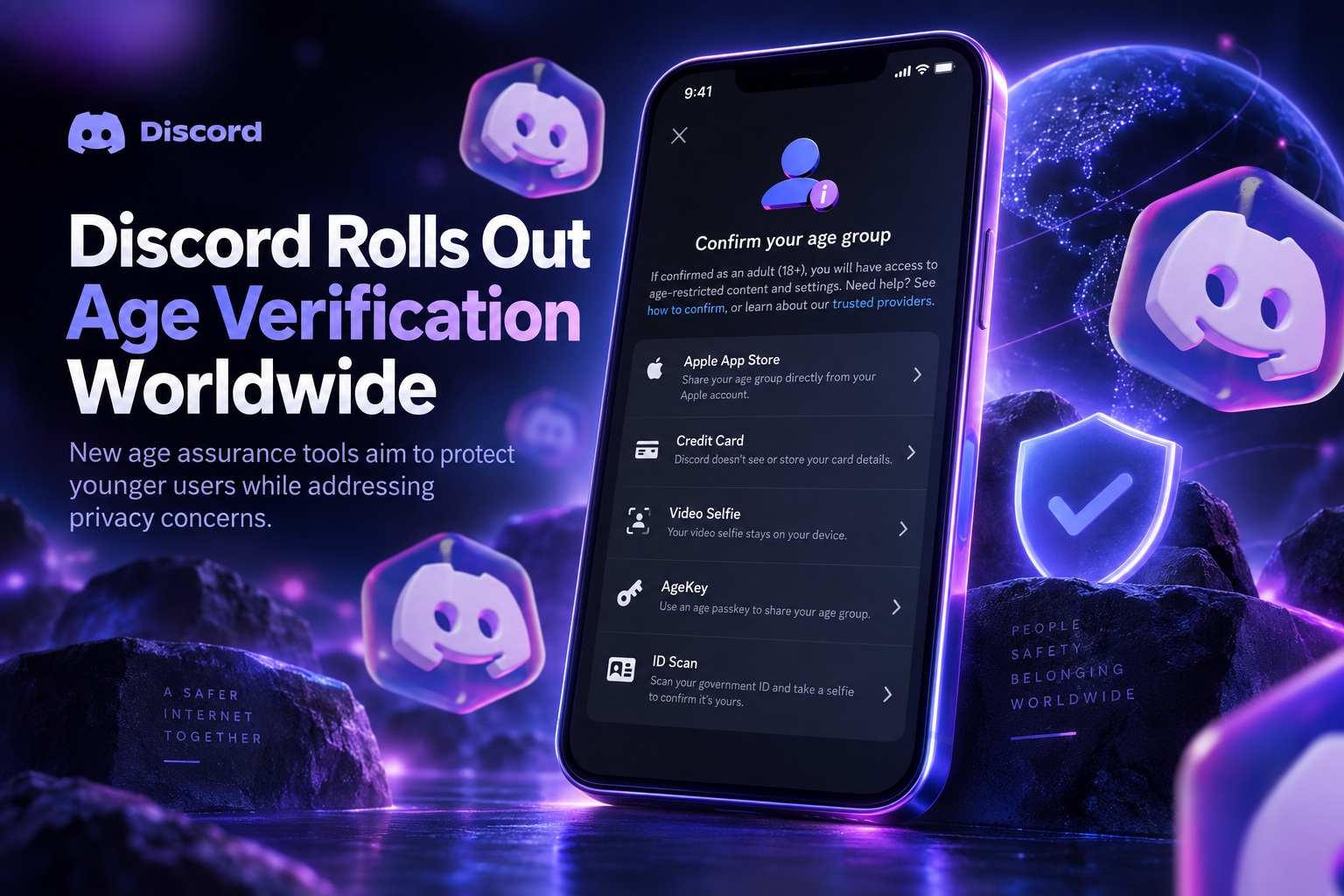
Discord is officially starting the global rollout of its updated age assurance system this week, months after postponing the original implementation following significant community criticism. The company first announced plans for broader age verification earlier this year as part of its response to growing legislation designed to protect minors online, but privacy concerns quickly became one of the most contentious parts of the proposal. Discord says the revised system is intended to reduce the number of people who need to submit identity information while still allowing the platform to apply different protections to adults and younger users.
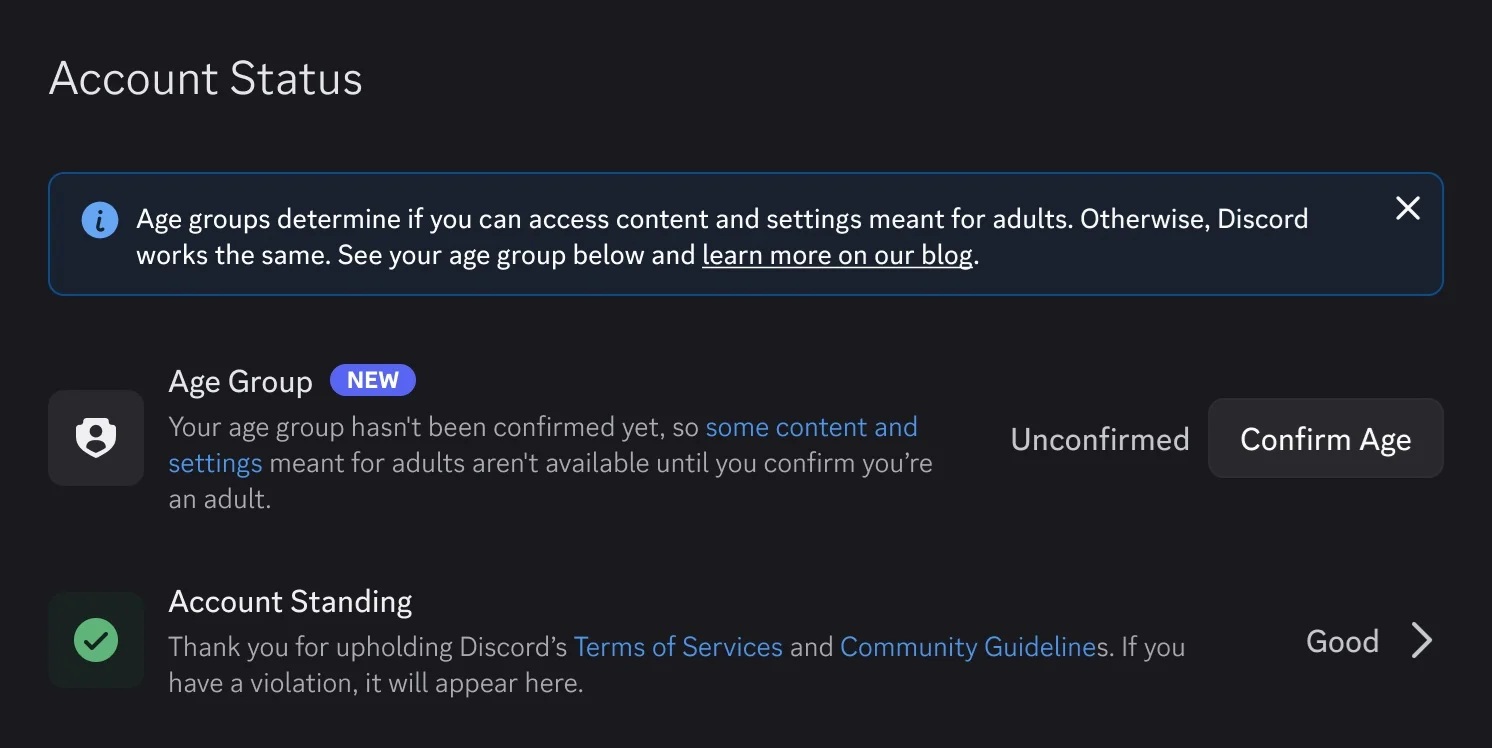
The rollout will happen gradually throughout the week, so individual accounts may not see the changes immediately. Once activated, Discord will automatically classify users into one of three groups: Adult for users aged 18 and above, Teen for those between 13 and 17, or Unconfirmed when the platform cannot determine an age range confidently enough. Users will be able to see their assigned category through the Account Status section inside User Settings.
Most Users Should Not Need to Verify Their Age Manually
One of the biggest changes from Discord's earlier proposal is that the majority of people are not expected to go through a manual verification process. Discord CTO and co-founder Stanislav Vishnevskiy says more than 90% of users should be classified automatically using signals that already exist around their accounts.
Those signals can include how long the Discord account has existed, the servers and communities it belongs to, games associated with the account, and general activity patterns. Discord says it does not inspect private messages, voice calls or other user-generated content when estimating someone's age category.
If the system confidently determines that a user belongs in either the Adult or Teen category, nothing else needs to be submitted. That approach is intended to reduce the number of people who have to provide photographs, identification documents or payment-card information simply to continue using the platform normally.
Unconfirmed Accounts Can Still Use Discord
Being placed in the Unconfirmed category does not lock someone out of Discord. Users can continue chatting, joining servers and accessing ordinary platform features, although some functionality will be restricted until adulthood is confirmed.
The main limitations involve age-restricted content and certain settings that Discord reserves for adults. In other words, Discord appears to be taking a cautious approach when it cannot confidently determine someone's age rather than automatically assuming the account belongs to an adult.
Unconfirmed users can later verify themselves through one of several available methods, with the exact options depending on the region and device being used. Once the verification succeeds, their account can be moved into the appropriate age category.
Discord Is Offering Several Ways to Confirm Age
For users who need to prove they are adults, Discord is not relying on a single verification method. The company says available options may include credit card verification, sharing an age range through the Apple App Store or Google Play Store, Google Wallet, or the AgeKey credential service.
Users may also be able to submit an identity document scan or video selfie. The presence of several methods is important because no single approach will be suitable for everyone. Some people may prefer using an existing age credential associated with their app store account, while others may choose an ID-based method.
The exact availability of each option will vary depending on local regulations, device support and regional services. Discord's broader objective appears to be giving users more than one path instead of forcing everyone through the same identity-verification process.
Privacy Was the Biggest Concern During the Original Rollout
Discord's first age-verification announcement attracted criticism because users were concerned about submitting identity documents or biometric information to a communications platform. Those concerns were particularly strong among communities that use Discord under pseudonyms or otherwise place a high value on separating their real-world identity from their online profile.
The revised system attempts to address that by limiting manual verification to users the automated age-assurance system cannot classify. If Discord's estimate works as intended, most users will never need to submit additional identity information.
The company has also introduced stricter requirements for any third-party vendors involved in verification. Discord says those providers must permanently delete submitted information once the age-check process has been completed, reducing the amount of sensitive information retained after verification.
Facial Age Estimation Will Stay on the Device
Another important privacy measure involves facial age estimation. Discord says this process must be performed entirely on the user's device, meaning the biometric information used for the estimate should not be uploaded to Discord or an external server.
Keeping the processing local reduces the risk associated with transferring or centrally storing facial data. The system can determine an estimated age range and return the result without sending the underlying biometric data elsewhere.
This does not necessarily eliminate every privacy concern around age estimation, but it does address one of the most sensitive aspects of the earlier proposal. Users who choose this method should not have their face data leaving the device as part of the verification process, according to Discord.
Teen Accounts Will Receive Additional Messaging Protections
Discord is also introducing several default protections specifically for users classified as teenagers. The first involves direct messages from people who are not already friends.
Messages from unknown users will be moved into the Message Requests inbox rather than appearing directly alongside ordinary conversations. Discord will also display a warning before a teen accepts a friend request from someone when they have no mutual friends or do not share a small server.
The idea is to introduce a little more friction around unsolicited contact without preventing teenagers from meeting new people entirely. Discord has always been heavily community-driven, so completely blocking interaction with unfamiliar users would significantly change how many servers work. The new approach instead attempts to make potentially risky interactions more visible before they begin.
Age-Gated Content Will Be Blocked for Teen Users
The second major safeguard is stricter access control around adult-oriented content. Teen users will not be able to view age-gated servers, channels or bot commands, and Discord will also restrict images its content filters identify as sensitive.
This creates a clearer distinction between ordinary community spaces and areas intended only for adults. Age gating has existed on Discord before, but the new age-assurance system gives the platform another mechanism for deciding which accounts should actually be allowed into those spaces.
Unconfirmed users will also be subject to these restrictions until their age has been verified. That means an account Discord cannot confidently classify will effectively receive the safer set of content controls rather than the adult defaults.
Profile Visibility Will Also Be More Limited for Teens
The third safeguard relates to profile information and activity visibility. Teen users will have their full profile details and activity exposed only to friends and members of smaller servers that they share.
That reduces how much information unfamiliar users can learn simply by encountering a teenager in a large community. Activity information can sometimes reveal what someone is playing, what communities they interact with or other behavioural details, so limiting visibility provides another layer of protection.
This particular restriction is more targeted than simply hiding profiles entirely. Teenagers can still participate normally in communities, but Discord is reducing the amount of personal context available to people who have little or no established relationship with them.
Unconfirmed Users Receive Some Teen Protections Too
Accounts placed in the Unconfirmed category will also receive part of the teenager-focused safety setup. Specifically, the rules covering message requests and age-restricted content will apply until the user confirms that they are an adult.
That design makes sense from a risk-management perspective. If Discord does not know whether a person is 16 or 26, it cannot safely assume the less restrictive adult settings should apply.
The result is that some adult users may temporarily experience stricter defaults until they verify their age. Discord appears to be accepting that inconvenience in exchange for avoiding the opposite mistake of giving a potentially underage user unrestricted access to adult content.
Why Discord Is Introducing Age Assurance Globally
The rollout is taking place against a backdrop of increasingly strict online-safety rules in multiple countries and regions. Regulators are placing more responsibility on platforms to distinguish between adults and minors when services contain age-restricted material or allow strangers to interact.
For Discord, that creates a particular challenge because the platform is used by teenagers and adults side by side. Servers can range from school clubs and gaming groups to professional communities and adult-only spaces, all operating within the same application.
A platform-wide age-assurance layer gives Discord a way to apply different protections without requiring every server administrator to independently verify users. It also allows the company to respond more consistently as online-safety legislation develops in different markets.
The Real Test Will Be How Accurate the Automatic Classification Is
Discord's claim that more than 90% of users will avoid manual verification sounds promising, but the quality of the experience will depend heavily on how accurately the system assigns age groups. False classifications could create frustration if adults are treated as teenagers or if younger users are incorrectly identified as adults.
The Unconfirmed category provides something of a safety net because accounts that cannot be classified confidently can simply remain restricted until the user decides to verify. Even so, Discord will need to make the appeal and correction process straightforward when the system gets something wrong.
Transparency will also matter. Users are likely to be more comfortable with automated age estimation if they understand which broad account signals are being considered and what information is explicitly excluded.
Final Thoughts
Discord's revised age-assurance rollout is noticeably different from simply forcing every user to upload an ID or scan their face. By relying primarily on existing account signals, the company says more than 90% of users should be classified without taking any additional action, while manual verification is reserved mainly for people whose age remains uncertain.
The system also introduces meaningful protections for teenagers, including stricter handling of messages from strangers, limits on adult content and reduced profile visibility. Unconfirmed users receive some of those protections as well until their age can be established.
Privacy remains the most sensitive part of the entire project, but Discord is attempting to address those concerns through on-device facial age estimation and requirements that verification vendors delete submitted information once the process is complete.
The rollout will happen gradually throughout the week, so not everyone will see their new account status immediately. Once it arrives, users can check User Settings > Account Status to see whether Discord has classified them as Adult, Teen or Unconfirmed.
The larger challenge for Discord is finding the right balance between child safety, regulatory compliance and the privacy expectations of a community that has historically valued pseudonymous online interaction. This revised system is the company's latest attempt to make those three priorities coexist.











Comments 0