

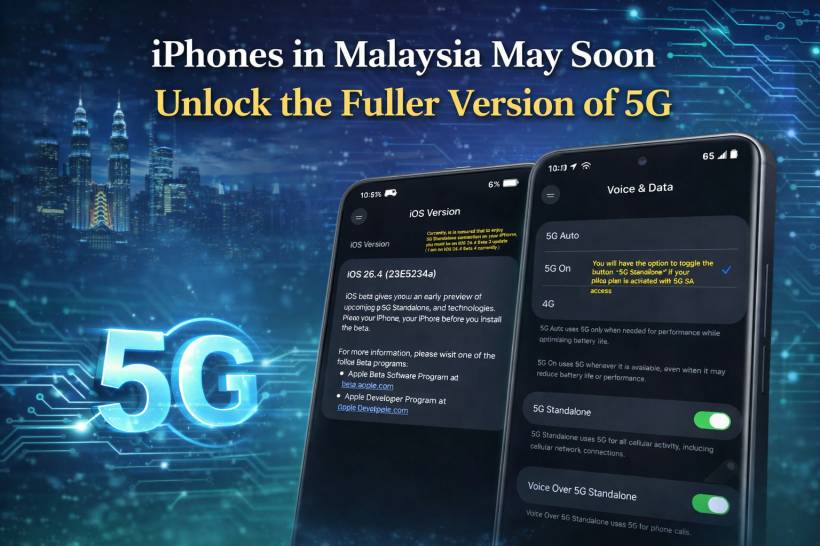
Apple could finally be getting ready to switch on 5G Standalone and even 5G Advanced support for iPhones in Malaysia, and that would be a pretty meaningful upgrade for local users who have been waiting for Apple to catch up with what some networks are already capable of offering.
The clue comes from the iOS 26.4 beta, where users have started spotting new cellular settings tied to standalone 5G connectivity. Nothing is officially confirmed for everyone just yet, but the appearance of those settings strongly suggests Apple is moving in that direction.
If this does happen in the public release, it would mark an important step for iPhone users in Malaysia, especially for those on telcos that already have the right network infrastructure in place.
A quiet but important discovery in the iOS beta
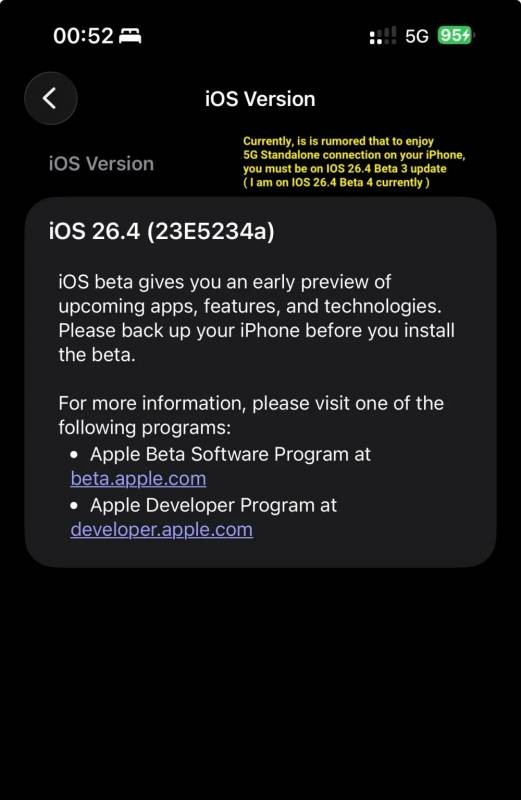
The first signs of the feature surfaced through beta testers, including X user @nukm4n, who shared screenshots showing additional 5G-related controls on an iPhone running the test version of iOS 26.4.
That is often how these things begin with Apple. Major features are not always loudly announced at first. Sometimes the early hint comes from a beta menu, a hidden toggle, or a newly enabled carrier setting. In this case, the discovery points to Apple preparing broader network support rather than simply redesigning the settings page.
It is still limited to beta software for now, but the fact that the controls are already visible suggests this is more than just a theoretical possibility.


New 5G options are showing up in Settings
According to the screenshots shared, the Voice & Data section in cellular settings now includes a 5G Standalone option, along with support for Voice over 5G Standalone, often shortened to Vo5G.
That second part is especially interesting.
Vo5G is essentially the next step after VoLTE. Just as Voice over LTE allowed calls to travel over 4G without falling back to older network standards, Voice over 5G Standalone would allow calls to remain entirely on a true 5G connection.
That means, on a supported network, an iPhone could place and receive calls without needing to temporarily jump back to 4G. Right now, on many non-standalone 5G setups, that fallback still happens during voice calls. The phone may show 5G while idle or using data, but once a call comes in or goes out, it often shifts to LTE before returning to 5G afterwards.
That behaviour is normal on current 5G Non-Standalone, or NSA, networks. But it also shows the limits of the current arrangement.
Why 5G Standalone matters more than it sounds
To the average user, "5G Standalone" may sound like just another technical label buried inside a settings menu. In reality, it represents a much more complete version of 5G.
Today, a lot of 5G deployments around the world still rely partly on existing 4G foundations. That is what non-standalone 5G is. It gives users access to faster mobile data, but the network is still leaning on older infrastructure in key areas.
5G Standalone, on the other hand, runs on a dedicated 5G core. It is built to let networks deliver more of what 5G was supposed to offer from the start.
That includes lower latency, quicker network responsiveness, better handling of modern services, and more efficient management of traffic across the network. It is not just about raw speed. It is also about how the network behaves under the hood.
So while many users may not immediately see a giant speed jump in every situation, the upgrade can still improve the overall experience in ways that feel more subtle but very real.
It could also help with efficiency
Another benefit of 5G Standalone is that it can simplify how the phone stays connected.
With non-standalone 5G, the device may need to maintain links to both 4G and 5G layers at the same time. That extra juggling can create inefficiencies. With standalone 5G, the connection is more direct because it uses the 5G core itself without depending on 4G to hold everything together.
In practical terms, this could mean more stable connectivity and possibly even better battery efficiency in some situations. That does not automatically mean every user will suddenly gain hours of extra battery life, but reducing the complexity of the connection can help the modem operate more cleanly.
For people who spend a lot of time on mobile data, that matters.

Malaysia's 5G SA rollout is still selective
Even if Apple enables support, not every Malaysian iPhone user will benefit immediately. That is because 5G Standalone availability in Malaysia is still relatively limited.
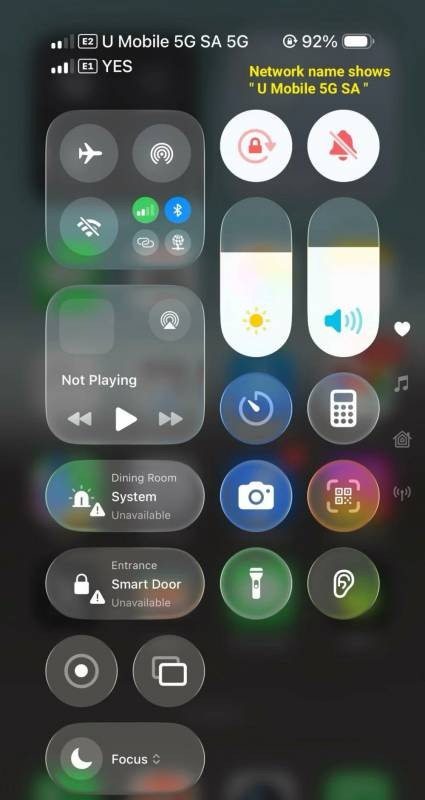
At the moment, Yes 5G and U Mobile are among the local operators already associated with 5G SA and 5G Advanced capabilities. The catch is that compatibility has so far leaned heavily toward selected Android devices.
That has created a familiar pattern in telecom rollouts. The network may already support a feature, but the device side is not fully there yet. Apple enabling 5G SA and 5G Advanced for iPhones would help close that gap in a big way.
There is also some suggestion that Maxis may be moving into the picture. Based on beta-related tracking and early support indicators, Maxis appears to be showing signs of compatibility in the latest iOS test builds alongside U Mobile and Yes. Still, that should not be mistaken for full public activation just yet. A support indicator in beta software does not always mean the service is already live and ready for all users.
5G Advanced is part of the story too
The mention of 5G Advanced makes this development even more notable.
5G Advanced is often seen as the next refinement stage of 5G, bridging the gap between current 5G deployments and what future-generation mobile experiences may look like. It is about improving network intelligence, efficiency, performance, and service handling beyond the first phase of 5G rollout.
For most users, the technical details may not matter as much as the real-world outcome. What matters is whether the network becomes more responsive, more stable, and better suited for increasingly demanding mobile tasks.
If Apple is indeed preparing support for both 5G Standalone and 5G Advanced in Malaysia, then this is not just a checkbox update. It is part of a broader move toward letting iPhones take fuller advantage of newer network capabilities already being developed by local carriers.
When users might get it
For now, these new settings appear to be limited to people running the iOS 26.4 beta. That means everyday users who stick to the normal release version of iOS may have to wait a little longer.
The expectation is that iOS 26.4 could roll out publicly as soon as next week, which means the wait may not be very long if Apple keeps to schedule.
Those who are eager to try it earlier can join Apple's public beta programme and install the beta software on a compatible device. Of course, beta software always comes with some risk. New features may be unfinished, bugs can appear, and battery or app stability is not always ideal. So this is usually better suited to people who do not mind some testing rough edges.
Which iPhones are expected to support it
Based on the current iOS 26 device list, supported models include the iPhone 11 series and newer, along with the iPhone SE second generation and later.
That means quite a wide range of existing iPhones could potentially benefit, assuming the carrier side also supports the feature and Apple enables it fully in the final public release.
So the real equation here comes down to three things working together: the iPhone model, the iOS version, and the telco's network readiness.
Why this matters for Malaysian iPhone users
For years, iPhone users in Malaysia have often had to wait while Android devices got first access to newer network features. This looks like one of those moments where Apple may finally be catching up.
And while it may sound like a niche upgrade at first glance, it actually matters because it signals something bigger. Malaysia's mobile networks are continuing to mature, and device support needs to evolve alongside them. There is little point in building advanced network capability if large groups of premium smartphone users cannot fully access it.
If Apple flips the switch in the public iOS 26.4 release, Malaysian iPhone users may finally start getting a more complete version of 5G rather than the more transitional version many have been using up to now.
In simple terms, this could be one of those under-the-hood updates that does not look flashy on the surface, but ends up being much more important than it first appears.











Comments 0