

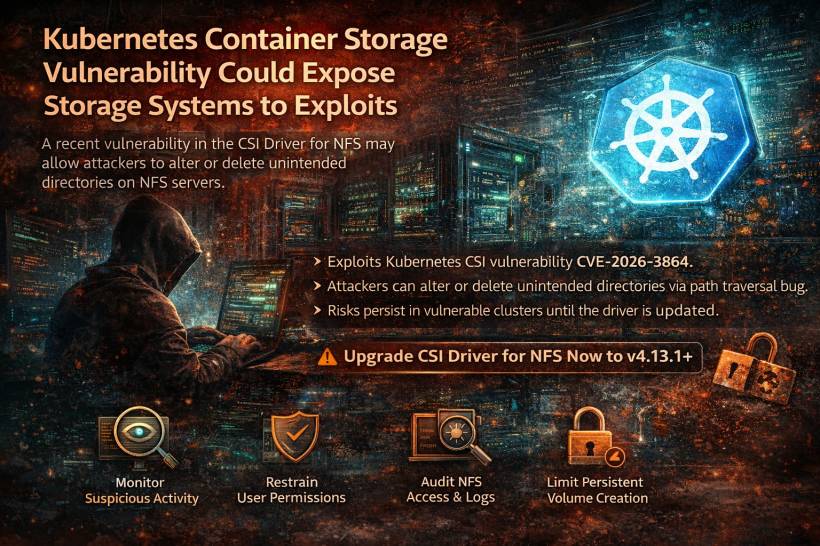
A recently identified vulnerability in Kubernetes is drawing attention from security professionals, particularly those managing cloud-native environments. According to findings outlined in , the issue affects the Kubernetes Container Storage Interface (CSI) Driver for NFS and could allow attackers to manipulate or even delete data beyond intended boundaries.
While the vulnerability is not rated as critical, its potential impact on storage systems makes it something organizations should not ignore.
What the Vulnerability Is About
The flaw, tracked as CVE-2026-3864, carries a medium severity rating but introduces a serious risk in specific configurations.
At its core, the problem lies in how the CSI driver handles a parameter known as subDir. This parameter is supposed to define where data operations should occur within a controlled directory. However, due to insufficient validation, attackers can manipulate it to escape the intended directory path.
This opens the door to what is known as a path traversal attack, where malicious inputs allow access to directories outside the expected scope.
How an Attack Could Happen
In environments where certain permissions are granted, an attacker could exploit this weakness by crafting a malicious volume identifier.
By inserting path traversal sequences such as ../, the attacker can trick the system into navigating outside the designated directory. When the system processes operations like deletion or cleanup, it may end up modifying or removing unintended directories on the NFS server.
In practical terms, this means:
• Critical data could be accidentally or maliciously deleted
• Storage systems could be disrupted without obvious warning
The danger increases when these actions occur automatically as part of routine Kubernetes operations.
Who Is Most at Risk
Not every Kubernetes setup is equally vulnerable.
Organizations are most exposed if their environments meet several conditions:
• Non-administrative users are allowed to create PersistentVolumes
• The deployed driver version does not properly validate path inputs
If all these factors are present, the system becomes significantly more susceptible to exploitation.
Another important point is that all versions of the CSI Driver for NFS before v4.13.1 are affected, making older deployments particularly vulnerable.
Signs That Something Is Wrong
Detecting exploitation early can make a big difference.
Administrators are advised to monitor for unusual activity, especially in logs. Certain patterns may indicate that the vulnerability is being abused, such as unexpected directory operations or unusual path structures containing traversal sequences.
For example, log entries showing directory removal actions outside expected paths should be treated as a warning sign.
Regularly reviewing PersistentVolumes and checking their configurations can also help identify suspicious setups before they are exploited.
What Can Be Done to Reduce Risk
The most effective solution is straightforward: upgrade.
Updating the CSI Driver for NFS to version 4.13.1 or later resolves the issue by adding proper validation for directory paths. This ensures that traversal sequences cannot be used to escape the intended scope.
For organizations that cannot update immediately, several interim steps can help reduce exposure:
• Audit NFS storage configurations to ensure only intended directories are accessible
• Avoid granting broad permissions to untrusted users
• Monitor logs closely for unusual or suspicious activity
These measures can help contain the risk while a permanent fix is implemented.
Why This Matters in Modern Infrastructure
Kubernetes has become a backbone for many modern applications, especially in cloud and enterprise environments. With that scale comes complexity, and vulnerabilities like this highlight how small validation gaps can lead to larger risks.
What makes this issue particularly important is that it does not require highly advanced techniques to exploit. Instead, it takes advantage of how systems are configured and how permissions are managed.
This reinforces a familiar lesson in cybersecurity: even medium-severity vulnerabilities can have serious consequences if the conditions are right.
Final Thoughts
The Kubernetes CSI vulnerability is a reminder that infrastructure security is not just about patching critical flaws—it is also about understanding how systems behave under different conditions.
In this case, a simple lack of validation in a directory parameter creates an opportunity for unintended access and data loss. For organizations relying on Kubernetes and NFS storage, taking action early—whether through updates, access control, or monitoring—is essential.
Because in environments where automation handles large-scale operations, even a small weakness can quickly turn into a much bigger problem.











Comments 0