

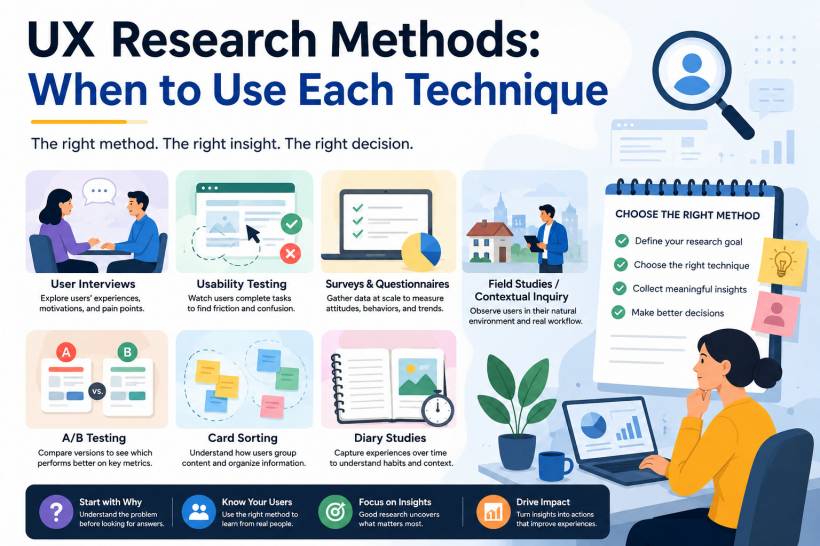
UX research is not something you can approach with a single fixed method every time. Different questions require different research techniques, and choosing the wrong one can easily lead to confident but misleading conclusions. When the right method is used, however, the findings become much more useful because they directly support better product decisions.
Before deciding on a UX research method, it helps to understand two important differences. The first is attitudinal versus behavioral research. Attitudinal methods focus on what users say, while behavioral methods focus on what users actually do. These are not always the same. A user may say they prefer simplicity, but their real behaviour may show that they still expect advanced features.
The second difference is qualitative versus quantitative research. Qualitative research helps explain why something happens through deeper, smaller-sample insights. Quantitative research helps measure how often something happens using larger sample sizes and data. In many cases, it is useful to begin with qualitative research to understand the problem, then follow up with quantitative research to measure how widespread it is.
User Interviews
User interviews are one-on-one conversations designed to explore users' experiences, motivations, frustrations, and needs. They are especially useful during the early discovery stage when the team is still trying to understand the problem space.
Interviews work well because they reveal the reasoning behind user behaviour. For example, analytics may show that users abandon a checkout process, but an interview can uncover that the real frustration comes from shipping fees appearing too late in the journey.
However, interviews should not be used to ask users to design the solution for you. People are often not good at predicting what they will actually use. Instead of asking what they want, it is better to ask about their recent experiences, problems, workarounds, and frustrations.

Usability Testing
Usability testing involves watching users attempt tasks using a product or prototype. The goal is to identify where they succeed, where they struggle, and where they become confused.
This method is highly useful when testing navigation, interface clarity, and task flows. Watching someone fail to find a button or misunderstand a label can quickly reveal problems that may not be obvious to the design team.
The key is to avoid testing only the perfect "happy path." Real users explore, hesitate, make mistakes, and take unexpected routes. A good usability test gives them enough freedom to behave naturally.
Surveys And Questionnaires
Surveys are useful when you need responses from a larger audience. They help measure satisfaction, identify common issues, and understand how many users are affected by a known problem.
Unlike interviews, surveys are not ideal for discovery because you may not yet know the right questions to ask. They are better suited for validating assumptions or measuring something already identified through earlier research.
A good survey should be short, clear, and carefully worded. Long surveys, confusing questions, and leading language can reduce response quality and completion rates.
Field Studies And Contextual Inquiry
Field studies involve observing users in their real environment, such as an office, home, shop floor, or any place where they naturally perform their tasks.
This method is valuable because users often develop workarounds they no longer think to mention. For example, a sticky note system beside a computer may reveal a gap in the software that interviews alone might miss.
The purpose of field research is not to confirm assumptions, but to discover what is really happening in context. The best findings often come from observing things users have stopped noticing themselves.
A/B Testing
A/B testing compares two or more versions of a design to see which performs better against a specific metric. It is useful for optimizing existing designs and validating specific hypotheses.
For example, instead of debating which button colour or headline might perform better, an A/B test can provide measurable evidence. This makes it helpful for product teams that want to reduce opinion-based decisions.
The biggest mistake is testing too many changes at once. If several elements are changed together, it becomes difficult to know which change actually caused the result.
Card Sorting
Card sorting helps designers understand how users group information. Users are asked to organize topics or content into categories that make sense to them.
This is especially useful for planning navigation, menu structures, and information architecture. It helps reveal whether the company's internal way of organizing content matches how users actually think.
To keep the results useful, the number of cards should be manageable. Too many items can tire participants and reduce the quality of the sorting exercise.
Diary Studies
Diary studies ask participants to record their experiences, actions, or thoughts over a period of time. This can happen across days or weeks using written notes, photos, app logs, or other simple recording methods.
They are useful for understanding habits, routines, and long-term behaviour. Instead of relying on memory, diary studies capture what users experience closer to the actual moment.
The main challenge is participant effort. If the process is too difficult, people may stop recording properly. Keeping it simple and giving reminders can help improve completion.

Matching Methods To Product Stages
During the discovery phase, user interviews, field studies, diary studies, and card sorting are useful because they help uncover problems, workflows, and mental models before major design work begins.
During the design phase, usability testing, surveys, and A/B testing can help evaluate prototypes, validate assumptions, and refine specific decisions.
After launch, usability testing, satisfaction surveys, A/B testing, and analytics review become important for improving the live product and tracking ongoing user experience.
The Truth About Testing With Five Users
The idea that five users can uncover most usability issues is useful, but it should not be misunderstood. Testing with five participants can reveal many major problems in a specific task flow, especially during early formative testing.
However, five users are not enough when you need to understand different user groups, measure task completion rates, or detect edge cases. For those situations, larger samples or different research methods are needed.
In simple terms, small samples are good for finding what is broken. Larger samples are needed when you want to measure how serious or widespread the issue is.
Final Thoughts
The best UX research method is always the one that answers the question you are trying to solve. Before choosing a technique, start by defining what you need to learn. Once the question is clear, the right method becomes much easier to select.
Good research should also lead to action. If the findings do not influence decisions, improve the product, or help the team move forward, then the research becomes more of a formality than a useful process. UX research works best when every study ends with clear next steps, design improvements, or product decisions.











Comments 0