

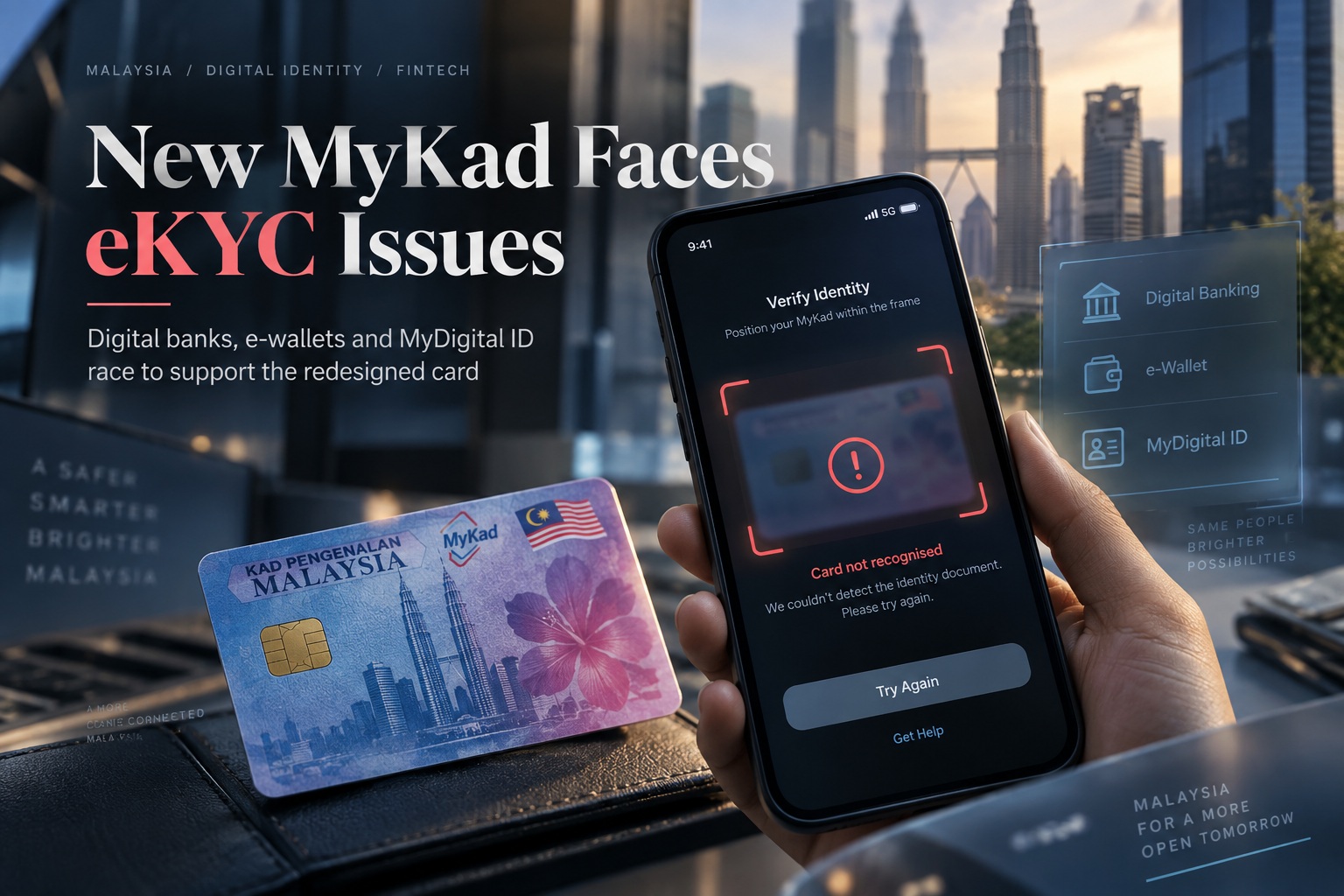
Malaysia's newly redesigned MyKad has only just begun rolling out, but some users are already discovering that the updated card does not play nicely with several digital verification systems. Early tests have shown that the new-generation MyKad can be rejected during electronic Know Your Customer, or eKYC, checks on services including Touch 'n Go eWallet, Ryt Bank, AEON Bank and GXBank. The issue appears to stem from the card's substantially different physical layout, which some automated verification systems were not yet prepared to recognise.
The problem does not mean the new MyKad itself is invalid or defective. Instead, it highlights how deeply banks, e-wallets and digital identity platforms depend on document-recognition systems that have been trained or configured around the previous MyKad design. When a national identity card changes its visual structure, every service that scans it must eventually adapt as well.
The New Design Is Causing Problems for Automated Verification
Malaysia began issuing the new MyKad nationwide on 17 September 2026, introducing one of the most substantial physical redesigns in years. Among the more obvious changes, the cardholder's photograph has moved to the left side of the card, while the smart chip has been relocated from the front to the back. The card also introduces significantly more security features, with the total increasing from 23 on the previous version to 53 on the new card.
Those changes improve security, but they can create problems for eKYC systems that rely heavily on visual recognition. Many automated identity-verification platforms expect a photograph, chip area, identification number and other elements to appear in specific places. If the document no longer matches the expected template, the system may incorrectly conclude that the card is unsupported or invalid.
A human looking at the card can immediately recognise it as MyKad, but an automated system can be much less forgiving. Until its recognition models and verification rules are updated, the legitimate new card may simply fail the check.
TNG eWallet and Several Digital Banks Are Affected
The compatibility issue has already been observed across several widely used digital financial services. Tests found that the redesigned MyKad was rejected during identity verification on Touch 'n Go eWallet, Ryt Bank, AEON Bank and GXBank.
This matters because eKYC has become the normal entry point for digital banking and fintech services. Instead of visiting a physical branch and presenting identification to an employee, users are increasingly expected to scan MyKad with their smartphone, take a selfie and let software confirm that the information matches.
When the document-recognition stage fails, the user may not be able to continue at all. A perfectly valid identity card can therefore become a temporary obstacle to opening an account or completing registration simply because the service provider has not yet updated its verification technology.
MyDigital ID Is Experiencing the Same Problem
First-time MyDigital ID users with the new MyKad are also affected. The normal smartphone registration flow currently cannot reliably recognise the redesigned card, meaning new users cannot complete registration entirely online.
For now, those users need to visit a physical MyDigital ID kiosk instead. This provides an alternative way to complete identity verification while the mobile registration process is being updated to support the new card.
The situation is expected to improve fairly soon. Online MyDigital ID registration using the redesigned MyKad is scheduled to become available from 1 October 2026, giving affected users a firm date for when the smartphone process should begin working normally again.
Existing MyDigital ID users are generally unaffected because their digital identity has already been established. The problem mainly concerns people attempting to create a MyDigital ID account for the first time using the new-generation card.
Why a Simple Card Redesign Can Break eKYC
From the user's perspective, moving the photograph from one side to another may seem like a minor change. Behind the scenes, however, document-verification systems often depend on very precise visual assumptions. They may check specific regions of the card for a face, identification number, hologram, chip or other expected feature before moving to the next stage.
If those elements suddenly appear somewhere else, the recognition process may fail even if every piece of information is genuine. This is particularly true for systems using rigid templates instead of more flexible document-detection models.
The addition of new security features can create further complications because reflective surfaces, transparent elements or revised printing patterns may affect how smartphone cameras capture the card. eKYC providers therefore need to test the new MyKad under different lighting conditions, camera hardware and device configurations before they can confidently support it.
JPN Says Systems Will Be Updated Progressively
The National Registration Department, or JPN, has acknowledged that supporting systems and services will need time to adapt to the redesigned card. According to JPN, adjustments will be made progressively together with the relevant parties.
That approach suggests compatibility will improve over time as banks, e-wallet operators, government services and other providers update their verification systems. The issue is therefore likely to be temporary rather than a fundamental limitation of the new MyKad.
Still, the early problems show how complicated a national identity-card transition can be. MyKad is not used only at government counters; it sits at the centre of a huge ecosystem involving finance, telecommunications, healthcare, insurance, digital identity and countless other services.
Every organisation that reads, scans or electronically verifies the card effectively becomes part of the rollout.
The New MyKad Brings Much Stronger Security
The inconvenience should also be viewed alongside the reasons Malaysia redesigned MyKad in the first place. The new generation includes 53 security features, substantially more than the 23 found on the previous card.
The physical redesign is intended to make counterfeiting and tampering more difficult while improving durability and modernising the underlying technology. Features such as revised security printing, updated card construction and relocated electronic components are all part of strengthening identity protection.
That increased security has value because MyKad is used for everything from banking and government services to telecommunications and identity verification. A national ID card needs to remain difficult to reproduce even as printing, imaging and fabrication technologies become more sophisticated.
The challenge is making sure stronger physical security does not temporarily reduce digital usability.
The Rollout Shows Why Ecosystem Testing Matters
The early failures raise a broader question about whether enough compatibility testing took place before nationwide issuance began. Services such as digital banks and e-wallets depend heavily on MyKad verification, so they are among the most obvious platforms that need to be prepared before a major card redesign goes live.
A coordinated pilot involving banks, fintech companies, eKYC providers and digital identity platforms could potentially identify template and recognition issues before the new card reaches ordinary users. Even a limited group of sample cards would give providers time to update their systems and test the new layouts under real conditions.
This becomes increasingly important as more services move toward digital-only onboarding. When there is no physical branch available as a fallback, a failed document scan can completely block access to the service.
The new MyKad rollout is therefore a useful reminder that identity modernisation needs to happen across the entire ecosystem, not just at the card-manufacturing level.
It Is Still Unclear How Many Services Are Affected
At the moment, the known problems involve several prominent financial and identity services, but it is not yet clear how widespread compatibility issues may be. Many organisations use third-party eKYC providers, which means multiple applications could depend on the same underlying recognition technology.
If one verification vendor has not yet updated its MyKad model, several unrelated services may encounter similar failures. Conversely, other banks or digital platforms may already have updated their systems and work without any problems.
The next few weeks should provide a clearer picture as more Malaysians receive the new card and attempt to use it across different services. Providers will also likely begin rolling out software updates quickly now that the issue is visible in real-world use.
Existing MyKad Holders Do Not Need to Rush
For Malaysians whose existing MyKad remains in good condition, there is still no need to replace it simply because the new design is available. JPN has repeatedly stated that current MyKad cards remain valid and can continue to be used normally.
That may actually be convenient while the digital ecosystem catches up. The older MyKad is already recognised by virtually every existing eKYC platform, meaning users with no reason to replace their card can avoid these early compatibility problems entirely.
The new-generation card will gradually become more common through first-time issuance, replacements, lost cards and other normal processes. There is no requirement for every Malaysian to switch immediately.
Government Benefits Are Not Affected by the Card Change
JPN has also clarified that moving to the new MyKad does not change eligibility or balances tied to government assistance programmes. Initiatives such as Sumbangan Asas Rahmah continue to depend on the individual's identity and programme eligibility rather than which physical generation of MyKad they carry.
That is an important distinction because some users may worry that changing cards could affect subsidies, aid balances or other MyKad-linked programmes. The redesign changes the physical document, not the underlying identity record.
Existing cardholders therefore do not need to replace their MyKad to maintain access to current benefits, while new-card holders should continue to receive the same entitlements subject to the usual programme rules.
Final Thoughts
Malaysia's new-generation MyKad delivers a meaningful security upgrade, but its first days in circulation are showing that physical modernisation needs to be matched by digital readiness. The redesigned layout is already causing eKYC failures on Touch 'n Go eWallet, Ryt Bank, AEON Bank, GXBank and first-time MyDigital ID registration.
The good news is that these problems appear to be software compatibility issues rather than faults with the card itself. MyDigital ID has already confirmed that online registration support for the new MyKad is coming on 1 October 2026, while JPN says other systems will be adjusted progressively with the relevant service providers.
For Malaysians with an existing MyKad that still works properly, there is little reason to rush into replacement. The old card remains valid, continues to work with established eKYC systems and does not affect government entitlements.
The broader lesson is that replacing a national identity card is no longer simply about printing a more secure piece of plastic. In a digital economy, the card is connected to hundreds of automated systems, and every one of them needs to understand the new design.
The new MyKad may be ready. For now, parts of the digital ecosystem are still catching up.











Comments 0