

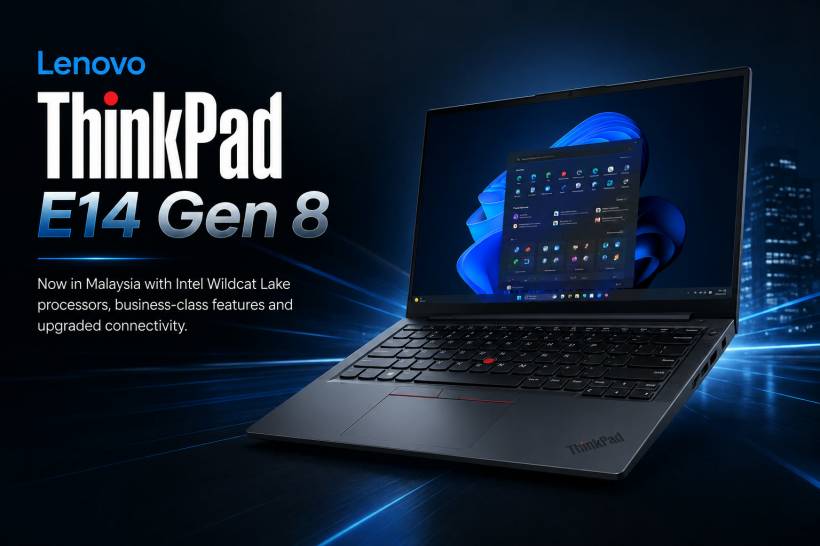
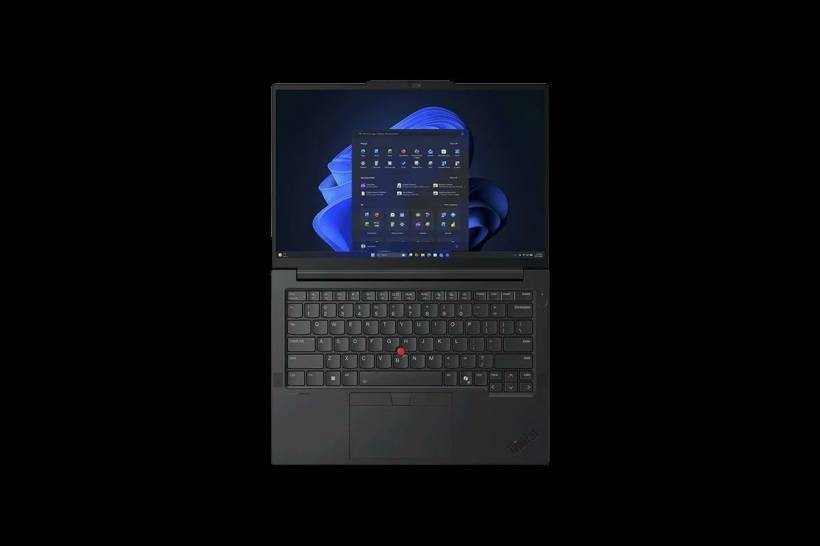
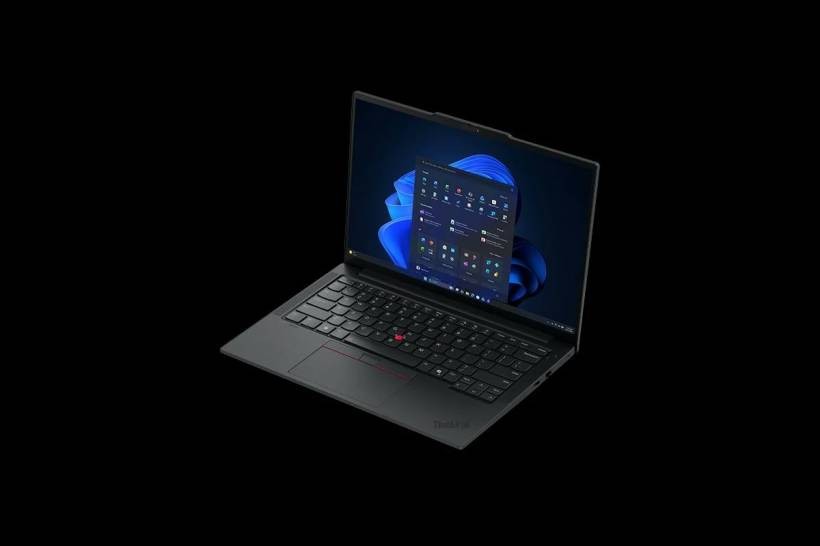
Lenovo has introduced the ThinkPad E14 Gen 8 in Malaysia, making it one of the earliest business laptops in the local market to arrive with Intel's new Wildcat Lake processors. The E-series has traditionally been positioned as a more accessible entry point into the ThinkPad family. It retains familiar business-focused features such as a practical design, upgradeable memory and storage options, and Lenovo's well-known keyboard experience, while remaining more affordable than premium ThinkPad models such as the X1 Carbon or T-series.
With the eighth-generation model, Lenovo is giving buyers several processor choices, starting with the Intel Core 3 304 and extending to the Core 7 350.
Four Intel Wildcat Lake Processor Options
Malaysian buyers can configure the ThinkPad E14 Gen 8 with one of four processors:
The entry-level configuration uses the Intel Core 3 304, while higher-tier models can be equipped with the Core 5 315, Core 5 320 or Core 7 350.
These processors belong to Intel's Wildcat Lake family, which was introduced as a more streamlined alternative to the company's Panther Lake chips. Although both families are based on Intel's 18A manufacturing process, Wildcat Lake models use smaller core configurations and are intended for mainstream laptops rather than high-end performance systems.
This makes them particularly suitable for productivity-focused machines such as the ThinkPad E14, where power efficiency, battery life and everyday responsiveness are often more important than maximum multi-core performance.
A Practical Base Configuration for Everyday Work
The starting configuration of the ThinkPad E14 Gen 8 includes 8GB of DDR5-5600 memory and a 256GB M.2 PCIe 4.0 solid-state drive.
That specification should be sufficient for basic office work, web browsing, cloud applications and video conferencing. However, users who regularly work with large spreadsheets, multiple browser tabs or heavier business software may want to increase the memory and storage capacity during configuration.
Wireless connectivity on the base model includes Wi-Fi 6E and Bluetooth 5.3. Power is supplied by a 48Wh three-cell battery, which keeps the laptop relatively lightweight while still providing enough capacity for general mobile use.
The actual battery life will depend on the selected processor, screen brightness, workload and power settings. Nevertheless, Wildcat Lake's focus on efficiency may help the laptop deliver longer operating times than older entry-level business systems.
A 14-Inch Display With a Taller Aspect Ratio
The standard ThinkPad E14 Gen 8 comes with a 14-inch WUXGA IPS display offering a resolution of 1,920 x 1,200 pixels.
This gives the screen a 16:10 aspect ratio, providing more vertical workspace than traditional 16:9 laptop panels. The extra height can be helpful when editing documents, reviewing spreadsheets, browsing websites or working with coding environments.
The display operates at a fixed 60Hz refresh rate. It is clearly intended for productivity rather than gaming or high-refresh-rate multimedia use, but it should be perfectly adequate for normal business applications.
Lenovo also offers a touchscreen version of the same WUXGA panel on higher configurations.
What Is Intel Wildcat Lake?
Wildcat Lake sits below Panther Lake within Intel's latest mobile processor lineup.
While Panther Lake is associated with more advanced configurations and higher performance tiers, Wildcat Lake is designed for smaller, more affordable systems that do not require a large number of processing cores.
Intel's Wildcat Lake range reportedly consists of seven processor models. The family begins with the Core 3 304 and extends to the Core 7 360, although Lenovo's Malaysian ThinkPad E14 configuration currently tops out at the Core 7 350.
Because the platform uses Intel's 18A manufacturing process, it may offer improvements in power efficiency and thermal behaviour compared with older mainstream laptop chips. That could be particularly valuable in compact business laptops, where lower power consumption can result in better battery life, quieter cooling and less heat during everyday workloads.
Real-world performance will still vary between models, especially when comparing the entry-level Core 3 configuration with the higher-end Core 7 option.
Pricing Starts at RM5,662
The Lenovo ThinkPad E14 Gen 8 is already available in Malaysia, with the entry-level configuration priced at RM5,662.
That model includes the base specifications mentioned earlier: an Intel Wildcat Lake processor, 8GB of DDR5 memory, a 256GB PCIe 4.0 SSD, Wi-Fi 6E, Bluetooth 5.3, the 14-inch non-touch WUXGA display and a 48Wh battery.
The price places it firmly within the business laptop category rather than the budget consumer segment. Buyers are paying not only for the processor and hardware specifications but also for the ThinkPad platform, its keyboard, business-oriented design and Lenovo's support ecosystem.
A Fully Equipped Model Costs More Than RM14,000
At the top of Lenovo's configuration range, the ThinkPad E14 Gen 8 can cost as much as RM14,431.
The fully upgraded model includes an Intel Core 7 350 processor, 32GB of DDR5-5600 memory and a 1TB M.2 2242 PCIe 4.0 SSD.
It also upgrades the standard display to a touchscreen version while retaining the same 1,920 x 1,200 resolution and 60Hz refresh rate.
Wireless connectivity is improved to Intel Wi-Fi 7 and Bluetooth 5.4, while additional features include a built-in fingerprint reader and a backlit keyboard.
Battery capacity also increases from 48Wh to 64Wh through the use of a larger four-cell unit. The bigger battery should help offset the additional power requirements of the faster processor, touchscreen and other upgraded components.
A Wide Price Gap Between Configurations
The difference between RM5,662 and RM14,431 is substantial, especially when the laptop retains the same overall chassis and display resolution.
Much of the additional cost comes from the processor, increased memory, larger storage capacity, touchscreen functionality, newer wireless connectivity and added security features.
For many business users, the most balanced configuration may sit somewhere between the two extremes. Upgrading to at least 16GB of RAM and a 512GB SSD would likely provide a more comfortable experience without approaching the cost of the fully equipped model.
The maximum configuration may make sense for companies that require a standardised fleet with additional memory, stronger connectivity and longer battery life. Individual buyers, however, may want to compare it against more premium ThinkPad models or similarly priced business laptops before committing.
Who Is the ThinkPad E14 Gen 8 Designed For?
The ThinkPad E14 Gen 8 is primarily aimed at professionals, small businesses, corporate users and students who want a reliable productivity laptop rather than a gaming or content-creation system.
Its 14-inch size makes it portable enough for travelling between offices, classrooms and client locations, while the 16:10 screen provides useful additional workspace.
The availability of multiple processor, memory and battery configurations also allows companies to select different specifications for different employee roles. A basic model may be sufficient for administrative work, while the Core 7 configuration could support more demanding multitasking and business applications.
Final Thoughts
The Lenovo ThinkPad E14 Gen 8 represents an important early appearance for Intel's Wildcat Lake processors in Malaysia.
Its base configuration offers the essentials for everyday business use, while the higher-end model introduces significantly more memory, storage, connectivity and battery capacity. However, the large price difference means buyers should carefully consider which upgrades will genuinely improve their work.
For users who prioritise productivity, a familiar ThinkPad experience and potentially improved power efficiency, the E14 Gen 8 could be an appealing option. The most sensible choice will likely be a mid-range configuration that avoids the limitations of the base model without reaching the premium price of the fully upgraded version.











Comments 0