

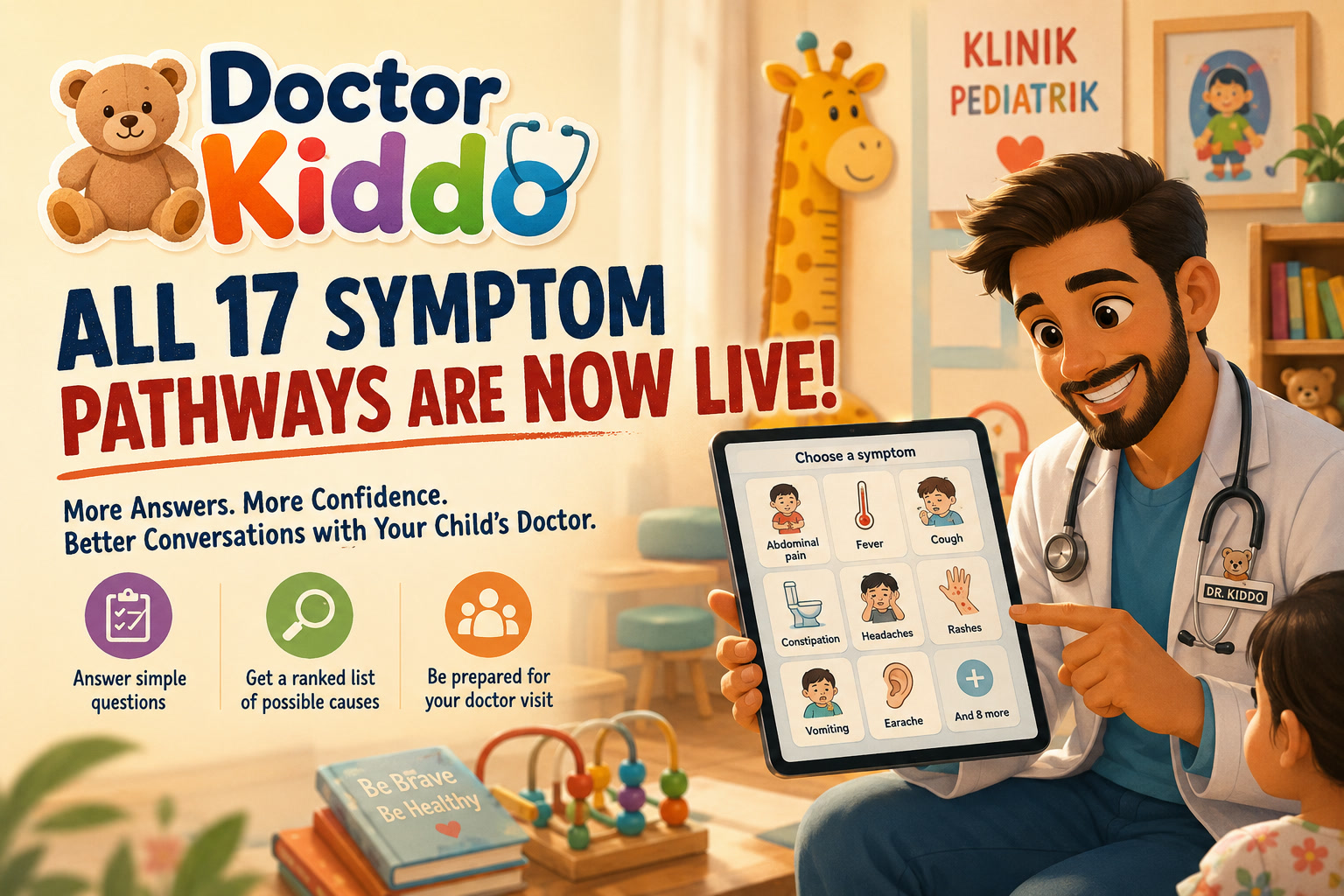
Doctor Kiddo has just received one of its biggest updates yet. What originally started with only two working symptom pathways — abdominal pain and constipation in children — has now expanded into a complete pediatric symptom checker with all 17 pathways fully available.
That means there are no more "Coming Soon" tiles. Parents can now choose a symptom, answer a short series of questions, and receive a ranked list of possible causes that can be discussed with a healthcare professional.
From Two Symptoms to Seventeen
The latest version of Doctor Kiddo now includes symptom pathways for:
Each pathway includes a range of possible conditions, from common childhood problems such as colds, growing pains and minor rashes to more serious conditions that may require urgent medical attention.
The purpose is not to provide a diagnosis, but to help parents better understand what may be associated with the symptoms they are seeing and prepare for a more informed conversation with a doctor.
How Doctor Kiddo Works
Doctor Kiddo is intentionally lightweight. The entire application runs from a single PHP file and four CSV data files rather than relying on a database or framework.
The four files each handle a specific part of the system:
pedsymptoms.csv contains the possible conditions and the descriptions shown in the results.
pedfactors.csv stores the symptom factors used by the scoring engine, such as whether pain is crampy or whether fever is present.
pedsymptomsquestion.csv contains the questions and answer choices presented to the user.
pedscoring.csv contains the scoring matrix that connects each condition to its relevant factors.
When a symptom such as Cough in children is selected, Doctor Kiddo loads the appropriate question set. Each answer is translated into a factor, the scoring engine compares those factors against the available conditions, and the results are ranked according to how closely they match.
Fixing an Important Condition-Matching Bug
One of the more important improvements in this update involved how conditions are stored internally.
Some conditions can appear under several different symptom pathways. For example, intussusception may be relevant to abdominal pain, constipation and nausea or vomiting, while GERD may appear under cough, sore throat, nausea and wheezing.
The original version identified conditions only by their names. This meant that when the same condition appeared under multiple symptoms, one entry could overwrite another.
The system has now been revised so that every condition is identified using both the symptom and condition name together. This allows the same condition to safely appear under multiple pathways without affecting the scoring results.
It is a small architectural change, but an important one for keeping the application accurate as the symptom library continues to expand.
Cleaning Up the CSV Data
Expanding Doctor Kiddo also uncovered a few classic CSV problems.
Some condition names and descriptions contained commas, which could accidentally cause the parser to split a single field into several columns. These entries were corrected by properly quoting the affected fields.
Another issue involved the scoring file header, which previously contained the typo "synmptom" instead of "symptom." The header has now been corrected, while the parser was also made tolerant of the older spelling to reduce the chance of future data errors breaking the application.
These may sound like minor details, but with an application driven almost entirely by CSV data, clean and consistent formatting is essential.
Correcting the Question Bank
While reviewing all 17 pathways, I also found a copy-and-paste error in the Joint pain or muscle pain section.
One question incorrectly asked whether the pain had been preceded by an injury or scratch to the eye. This has now been corrected to refer to an injury or trauma, with the corresponding scoring factor updated as well.
This was exactly the kind of issue I wanted to catch before opening every pathway to users.
Testing All 17 Pathways
Before making the update live, I ran a verification process against the complete CSV dataset and scoring logic.
The checks confirmed:
I also simulated several realistic combinations of answers to make sure the expected conditions appeared near the top of the results.
For example, a cough combined with dry coughing fits and wheezing correctly ranked asthma highly, while bed-wetting combined with excessive thirst identified type 1 diabetes as an important possibility.
These tests helped confirm that the expanded dataset was working as intended before release.
What Could Come Next
With the core symptom checker now complete, the focus can move toward improving the experience further.
Some ideas I would like to explore include adding more symptom categories, introducing clearer red-flag warnings for combinations that may require urgent attention, and making questions more age-aware.
A fever in a newborn, for example, can have very different implications compared with the same temperature in an older child, so age-specific pathways could make Doctor Kiddo even more useful.
Saved sessions or offline functionality could also be helpful for parents who want to complete a symptom check gradually or return to it later.
A Reminder About Medical Advice
Doctor Kiddo is designed as an educational and informational tool only. It does not provide a diagnosis and should never be used as a replacement for professional medical assessment.
Its purpose is to help parents organize what they are observing, explore possible explanations and arrive at a consultation better prepared to describe their concerns.
If a child appears seriously unwell, is having difficulty breathing, is in severe pain or the situation feels urgent, the symptom checker should be skipped and appropriate medical care sought immediately.
Final Thoughts
Taking Doctor Kiddo from just two working symptom pathways to all 17 has been a much larger update than simply adding more questions. It required improvements to the scoring engine, cleaner data handling, duplicate-condition support, question-bank corrections and a full round of validation.
With those foundations now in place, Doctor Kiddo finally feels like the complete pediatric symptom-checking tool I originally set out to build.
All 17 pathways are now live, and this gives the project a much stronger foundation for whatever comes next.











Comments 0