

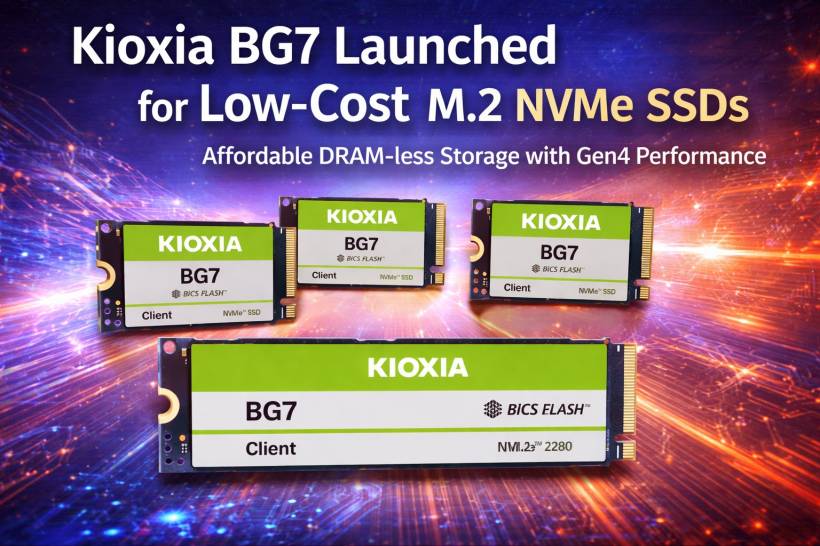
Kioxia has officially unveiled the BG7 series, its latest lineup of low-cost M.2 NVMe SSDs aimed squarely at mainstream and value-focused PCs. Arriving roughly two and a half years after the BG6 generation, the BG7 continues Kioxia's strategy of supplying affordable solid-state storage primarily for OEM systems rather than retail consumers.
These drives are designed to balance cost, efficiency, and modern interface support, making them well-suited for laptops, compact desktops, and other systems where price and power efficiency matter more than peak performance.
Designed for OEMs, Not Enthusiasts
As with previous BG-series products, the BG7 is expected to appear mostly in prebuilt systems from PC manufacturers. Kioxia's BG drives rarely show up as standalone retail products, and that trend is unlikely to change with this release.
This positioning is intentional. The BG7 is not designed to compete with high-end consumer SSDs or enthusiast drives. Instead, it targets large-volume deployments where consistency, affordability, and acceptable performance are more important than raw speed.
New BiCS FLASH Generation 8 NAND
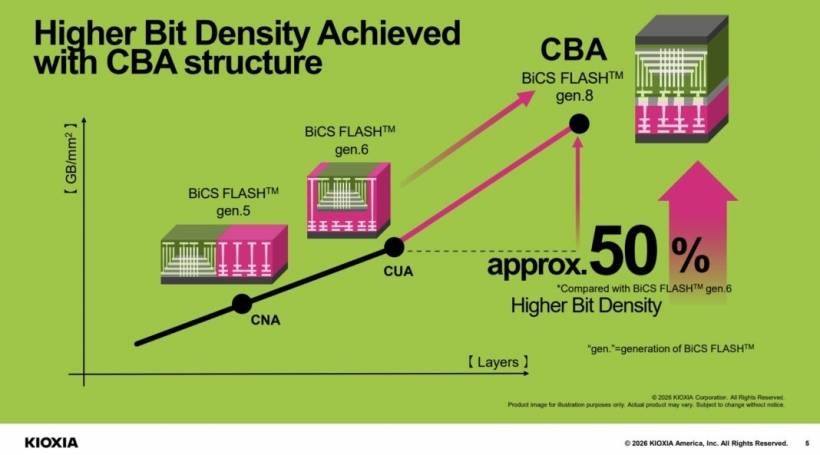
One of the most important upgrades in the BG7 series is the move to Kioxia's BiCS FLASH Generation 8 NAND. This latest NAND generation introduces higher density through a design known as CMOS directly Bonded to Array (CBA). In practical terms, this allows more storage capacity to be packed into the same physical space, helping to reduce manufacturing costs.
Higher density NAND is a key enabler for lower-cost SSDs, especially in a market where component pricing can fluctuate significantly.
Compact Form Factor Meets Modern Systems
Another notable addition is support for the M.2 2242 form factor, measuring just 42mm in length. This shorter format is increasingly popular in thin-and-light laptops, compact desktops, and embedded systems where space is at a premium.
While the same form factor has appeared in enterprise or specialized hardware before, such as certain accelerator-based servers, the BG7 brings it firmly into the consumer value segment.


DRAM-Less by Design
To keep costs down, the BG7 remains a DRAM-less SSD. Removing onboard DRAM significantly reduces manufacturing expenses, but it also means performance relies more heavily on host memory and controller optimizations.
This design choice makes sense for the BG7's intended audience. Budget systems and everyday workloads like web browsing, office applications, and light content consumption rarely benefit from the extra performance that DRAM-equipped SSDs provide.
Specifications at a Glance
The BG7 continues to use the PCIe Gen4 interface, ensuring compatibility with modern platforms. Capacity options range from 256GB up to 2TB, covering the most common storage needs for mainstream systems.
Some may wonder why there is no 4TB variant, especially given the use of higher-density NAND. The answer lies in market segmentation. At higher capacities, buyers typically expect stronger sustained performance and endurance, which would push the BG7 out of its low-cost positioning.
DRAM Shortages and the Bigger Picture
The timing of the BG7 launch is also interesting given ongoing DRAM supply challenges. As memory prices fluctuate, removing DRAM from SSD designs becomes an increasingly attractive way to control costs across entire systems.
For many devices, especially entry-level and mid-range PCs, DRAM-less SSDs may well become the default choice moving forward.
Final Thoughts
The Kioxia BG7 doesn't aim to impress with headline-grabbing speeds or enthusiast features. Instead, it represents a pragmatic approach to storage in a cost-sensitive market. By combining PCIe Gen4 support, compact form factors, and higher-density NAND with a DRAM-less design, Kioxia is clearly targeting OEMs looking to keep prices in check without abandoning modern standards.
If and when one of these drives appears in a shipping system, real-world benchmarks will tell the full story. But on paper, the BG7 looks like a logical evolution of Kioxia's value-oriented NVMe strategy.











Comments 0