


Malaysia's planned Base Medical and Health Insurance/Takaful (MHIT) Plan is set to enter its pilot stage by the end of July, marking an important step in the government's wider effort to make private healthcare coverage more affordable, easier to understand, and more sustainable over time.
The pilot will involve selected insurers, takaful operators, and private hospitals in the Klang Valley. It is meant to test how the plan works in real settings before a broader rollout targeted for early 2027. The government refers to it as the Base MHIT Plan, although it is often described as a basic medical insurance or takaful option because it is intended to provide a more accessible baseline level of protection.
Part of Malaysia's RESET Strategy
The pilot sits under the government's RESET strategy, a reform framework involving the Ministry of Finance, Ministry of Health, Bank Negara Malaysia, insurers, hospitals, consumer groups, and other stakeholders.
RESET is focused on several major challenges affecting private healthcare in Malaysia: rising treatment costs, higher medical insurance and takaful premiums, limited price transparency, and the need for more efficient payment structures. Its five broad areas cover MHIT reform, clearer pricing, stronger digital-health systems, more cost-effective care options, and changes to how hospitals are paid.
The Base MHIT Plan is therefore not simply another insurance product. It is intended to become part of a wider healthcare-cost reform programme, where coverage design, hospital billing, consumer information, and provider payments are improved together.
What the Base MHIT Plan Is Expected to Offer
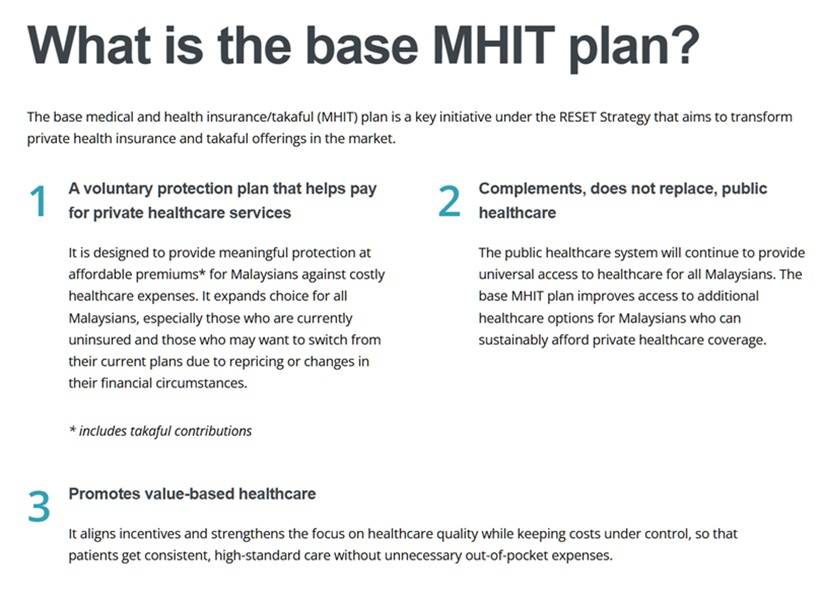
The government's earlier design framework describes the Base MHIT Plan as a voluntary hospitalisation product aimed at helping more Malaysians obtain meaningful financial protection against major medical expenses.
It is expected to offer standardised benefits and premiums, wider risk pooling, guaranteed renewal up to age 85, no lifetime limit, and an annual limit intended to cover most common hospitalisation bills. The plan is also designed to include shared-room hospitalisation, selected pre- and post-hospital care, and cost-effective treatment options.
Another significant feature is the intention to allow people with stable and controlled pre-existing medical conditions to obtain coverage, subject to the plan's eventual terms and underwriting requirements. This could be especially relevant for Malaysians who have found it difficult to obtain or maintain medical protection because of previous health conditions.
The Base MHIT Plan is also expected to be offered as a standalone product rather than an investment-linked policy. This is intended to reduce exposure to investment-market fluctuations and make the product easier for consumers to compare and understand.
Why DRG Is Important to the Plan
One of the most important parts of this reform is the gradual introduction of the Diagnosis-Related Group, or DRG, payment system.
Today, many private-hospital bills are largely based on a fee-for-service model, where charges can increase depending on individual services, tests, consumables, length of stay, specialist fees, and other treatment components. DRG works differently. It groups inpatient cases according to diagnosis, severity, and treatment complexity, creating a more structured basis for hospital payment.
In simple terms, instead of every item being billed separately without a common benchmark, hospitals and payers can work from a more standardised price structure for comparable cases. The aim is not to make every patient's bill identical, because severity and complications still matter, but to create clearer pricing references and reduce unnecessary variation.
For the Base MHIT Plan, DRG-based pricing is expected to apply to inpatient hospital cases. ProtectHealth has said that the pricing framework is being developed using data submitted by more than 100 private hospitals, with an initial version expected ahead of the pilot and further refinement planned before the national launch.
How DRG Could Affect Patients and Premiums
For patients, DRG could eventually make private-hospital bills easier to understand and compare. It may also give insurers and takaful operators a clearer benchmark when negotiating with hospitals, which could help control the escalation of treatment costs over time.
For hospitals, the system encourages more efficient care because payment is linked to the overall clinical case rather than simply adding up every service used. This does not mean hospitals should reduce necessary treatment. Instead, the intention is to reward appropriate, efficient care while discouraging unnecessary cost build-up.
The government has stressed that DRG will be introduced gradually to avoid sudden disruption or "pricing shock" for hospitals and patients. It will take time to refine the classifications, collect reliable hospital data, and ensure that treatment complexity is properly reflected in the final payment framework.
More Transparency for Malaysians
The Base MHIT pilot is also supported by several other RESET measures already introduced or being developed. These include the MHIT white paper, published treatment-cost ranges for common private-hospital procedures, medical-inflation reporting, consumer guides, insurance-planning tools, and tax incentives for welfare funds established by private hospitals.
These measures are meant to help Malaysians better understand what they are paying for, what their insurance or takaful plan covers, and how private healthcare costs compare across providers.
Final Thoughts
The Base MHIT pilot is a meaningful development because it combines a more accessible insurance or takaful option with broader reforms to hospital pricing and healthcare transparency.
The real test will be whether the pilot can balance affordability for consumers, fair reimbursement for hospitals, and long-term sustainability for insurers and takaful operators. DRG will be central to that balance, as it aims to make private healthcare billing more structured, transparent, and aligned with the actual complexity of treatment.
For now, the pilot is an early but important step towards a system where Malaysians have more predictable medical coverage and clearer visibility over private healthcare costs.











Comments 0