

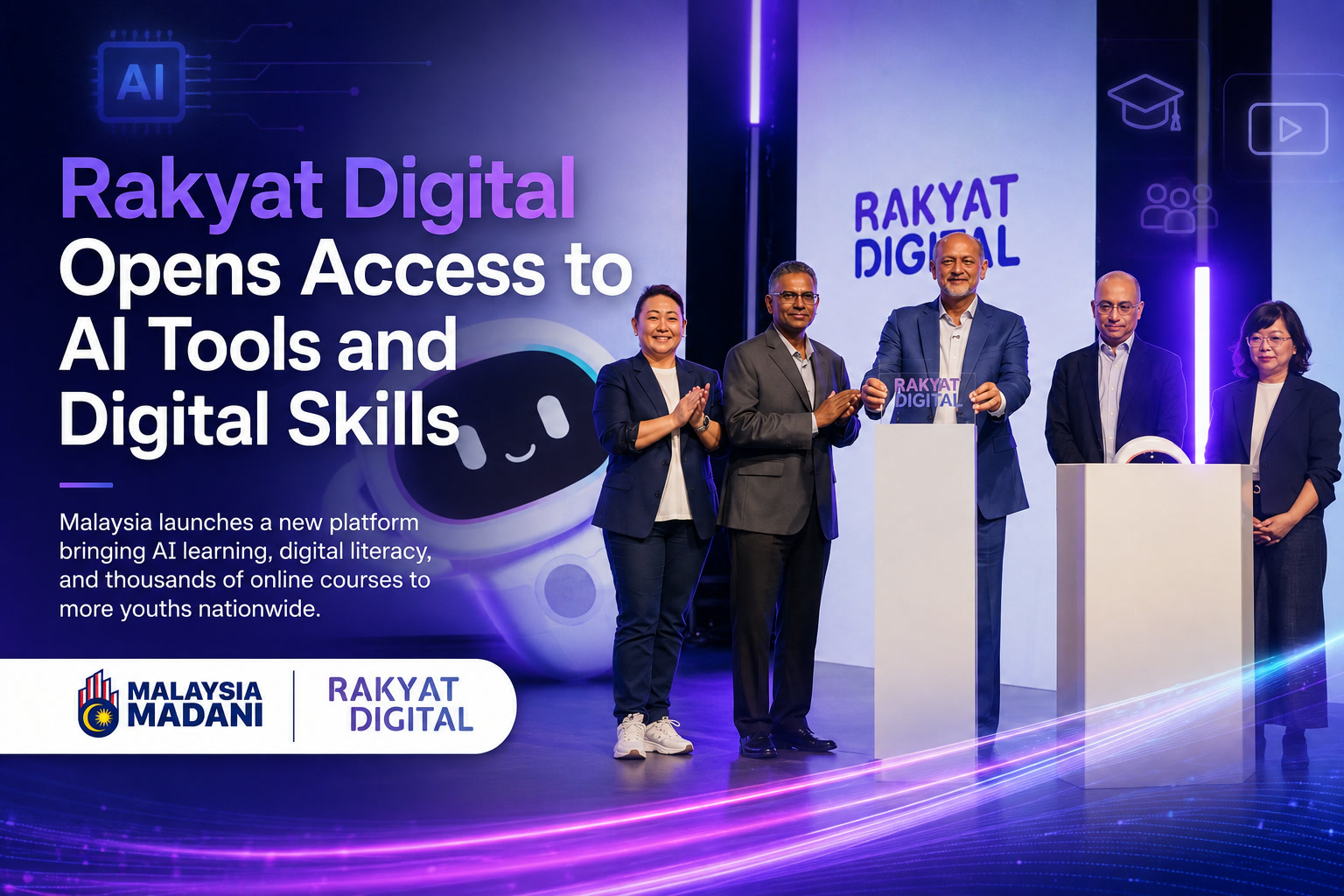
Malaysia is stepping up its digital skills agenda with the launch of Rakyat Digital, a new national platform designed to make artificial intelligence tools, digital learning and professional training more accessible to Malaysians.
The platform was announced by Digital Minister Gobind Singh Deo during AI Malaysia Takeover 2026 and forms part of the government's broader ambition to strengthen the country's AI capabilities as Malaysia works toward becoming an AI nation by 2030.
Rather than focusing only on technical professionals, Rakyat Digital is intended to widen access to practical digital knowledge and give more people the opportunity to learn, experiment and build with emerging technologies.
A Single Platform for Digital Learning
One of the main goals behind Rakyat Digital is to bring multiple learning initiatives together in one place.
The platform includes the Digital Literacy Hub, giving users access to structured learning resources aimed at improving digital confidence and technical understanding. This creates a more centralised starting point for people who may otherwise struggle to identify reliable learning resources across different platforms.
For beginners, that could mean developing a stronger understanding of digital tools and online technologies. For more experienced users, the platform can also act as a pathway toward more specialised areas such as AI, data, software development and professional digital skills.
The broader idea is to make digital education easier to access without forcing users to navigate multiple disconnected programmes.
AI Builders Hub Focuses on Practical Learning
A particularly interesting part of Rakyat Digital is the AI Builders Hub, which is designed around more than just theory.
The hybrid learning environment is intended to let users learn about AI, experiment with tools and work toward developing practical AI applications.
That distinction matters.
There is a growing difference between simply understanding what AI is and actually knowing how to use it effectively. Many people are already familiar with AI chatbots and generative tools, but fewer have experience applying those technologies to solve real problems, automate tasks or develop useful applications.
By encouraging hands-on experimentation, the AI Builders Hub could help participants move from being passive users of AI to becoming active builders.
More Than 16,000 Coursera Courses Will Be Available
Rakyat Digital will also provide access to a large catalogue of online learning through Coursera, including more than 16,000 courses and professional certifications.
That significantly expands the scope of the initiative beyond AI alone.
Learners could potentially explore areas such as:
For Malaysians looking to improve their employability or move into a more technical career path, access to professional certifications could be particularly useful.
Online learning platforms have made high-quality education easier to access globally, but subscription costs can still be a barrier. Bringing those courses into a national digital learning initiative helps reduce that obstacle.
Young Malaysians Will Get Complimentary Access to Selected AI Tools
One of the biggest incentives under the programme is aimed specifically at younger Malaysians.
Beginning 31 August, up to 100,000 Malaysians aged 18 to 30 will be eligible for three months of complimentary access to selected AI tools.
That could provide a valuable opportunity for students, young professionals, entrepreneurs and aspiring developers to explore tools that they might otherwise avoid because of subscription costs.
Three months may not sound particularly long, but it is enough time for someone to experiment seriously with AI-assisted workflows, learn how different tools operate and decide whether they are useful enough to incorporate into study, work or business.
The real value will depend on which AI services are included and how broad the access is, but lowering the initial cost barrier is an important first step.
Making AI More Accessible Beyond the Tech Industry
One of the risks surrounding the current AI boom is that adoption becomes concentrated among people who already have strong technical backgrounds or access to expensive tools.
That would leave a large portion of the population using AI only at a very basic level.
Rakyat Digital appears to be trying to avoid that.
AI skills are increasingly relevant across industries that have little to do with traditional software development. Marketing teams are using AI to generate and analyse content. Finance professionals are applying it to data. Designers are incorporating generative tools into their workflows. Healthcare, education, logistics and manufacturing are all exploring practical AI applications.
As AI becomes integrated into normal workplace tools, basic AI literacy could eventually become similar to computer literacy today.
That makes broad public access increasingly important.
Digital Literacy Still Matters as Much as AI Skills
It is easy for national digital programmes to focus heavily on the latest technology while overlooking basic digital literacy.
Rakyat Digital's inclusion of both free and paid digital literacy courses suggests a broader approach.
Understanding AI is useful, but people also need foundational skills such as evaluating online information, protecting personal data, using digital productivity tools, understanding cybersecurity risks and navigating online services safely.
Those basics are especially important as AI makes digital environments more sophisticated.
Someone who knows how to use an AI chatbot but cannot identify phishing attempts or assess unreliable information is still at a significant disadvantage.
Digital capability needs to develop as a complete skill set rather than around one fashionable technology.
Professional Certifications Could Help With Employability
The professional certification component could also become one of the more practical parts of Rakyat Digital.
Many employers increasingly look for candidates who can demonstrate specific digital competencies rather than relying solely on traditional academic qualifications.
Certifications in areas such as cloud computing, cybersecurity, data analysis and project management can provide an additional signal that someone has practical knowledge in a particular field.
For university students and recent graduates, this could help strengthen their resumes before entering the workforce.
For working adults, it could provide a pathway toward reskilling without returning to full-time education.
This is particularly relevant as automation changes the nature of many jobs and creates demand for new technical capabilities.
AI Skills Need to Translate Into Real Projects
The long-term success of Rakyat Digital will depend on whether participants actually use what they learn.
Completing online courses is useful, but practical application matters much more.
The strongest outcome would be for participants to use the platform to build projects, solve workplace problems, create businesses or develop tools that have genuine value.
For example, someone learning generative AI might build a customer-service assistant for a small business. A student learning data analytics could develop a dashboard around public data. A healthcare professional could explore ways to reduce administrative workload using automation.
Those experiences create deeper skills than simply watching course videos.
That is why the AI Builders Hub could become especially valuable if it encourages experimentation rather than purely passive learning.
Malaysia's AI Nation 2030 Ambition Needs People, Not Just Infrastructure
Malaysia's ambition to become an AI nation by 2030 will require more than data centres, cloud investments and government strategies.
Infrastructure is important, but AI capability ultimately depends on people who know how to use it.
Businesses need employees who understand AI.
Government agencies need people capable of deploying it responsibly.
Universities need graduates with relevant skills.
Startups need developers and entrepreneurs who can build new products.
The general public also needs enough digital literacy to participate confidently in an increasingly AI-driven economy.
Programmes such as Rakyat Digital therefore address a different side of national AI development: human capability.
Without that, expensive infrastructure risks becoming underutilised.
The Challenge Will Be Turning Access Into Participation
Providing access is only the first step.
One of the biggest challenges with any large-scale learning platform is keeping people engaged.
Thousands of online courses may be available, but users still need guidance on which ones to choose.
Complimentary AI tools may attract initial interest, but participants need practical reasons to continue using them.
A successful programme will therefore need clear learning pathways, useful projects and perhaps stronger links to employment opportunities.
Someone interested in cybersecurity, for example, should ideally be able to follow a structured path rather than sorting through thousands of unrelated courses.
Similarly, participants learning AI would benefit from practical challenges that help them apply what they have learned.
The easier it is to connect education to real-world outcomes, the more valuable the platform becomes.
Free and Paid Options Could Support Different Levels of Learning
Rakyat Digital will offer a combination of free and paid learning programmes.
That approach could allow the platform to serve both casual learners and people looking for deeper professional development.
Free courses can lower the entry barrier and help users discover areas they are interested in.
Paid programmes can then provide more advanced training, recognised certifications or specialised learning paths.
The important part will be maintaining enough useful free content so that cost does not become another barrier for people who are only beginning their digital journey.
If executed well, the platform could function as a progression system where users start with foundational skills and gradually move into more specialised training.
A Potential Entry Point for Malaysians Curious About AI
The explosion of AI tools over the past few years has created another problem: there are simply too many places to start.
Someone new to AI may encounter dozens of chatbots, image generators, coding assistants and productivity tools without knowing which ones are worth learning.
A national platform can help simplify that experience.
Instead of expecting people to research everything independently, Rakyat Digital could provide a more structured introduction to useful tools and relevant skills.
That may be especially beneficial for people outside the technology sector who are interested in AI but unsure how it applies to their work.
Lowering that psychological barrier can be just as important as reducing the financial one.
Final Thoughts
Rakyat Digital is an ambitious attempt to broaden access to AI tools and digital education across Malaysia.
By combining the Digital Literacy Hub, AI Builders Hub, thousands of Coursera courses and complimentary access to selected AI tools, the platform provides several different pathways for Malaysians to strengthen their digital capabilities.
The initiative for up to 100,000 young Malaysians is particularly notable because it gives people aged 18 to 30 the opportunity to experiment with paid AI tools without immediately committing to subscription costs.
However, access alone will not determine whether the programme succeeds.
The real measure will be whether participants turn those resources into practical skills, stronger career opportunities, useful projects and real AI adoption.
If Rakyat Digital can help Malaysians move from simply hearing about AI to actually building with it, it could become an important part of the country's wider push toward its AI Nation 2030 ambitions.











Comments 0