

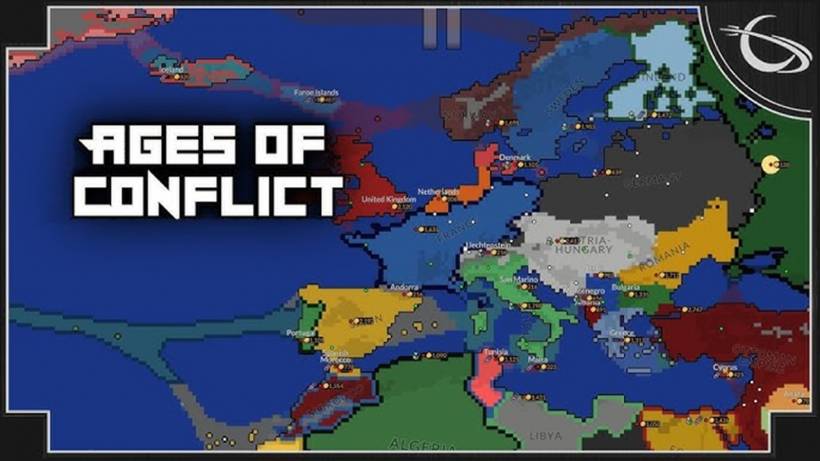
There's something oddly satisfying about watching a world change without you directly controlling every move. Ages of Conflict taps into that feeling by turning a simple map into a living, shifting stage where nations expand, collapse, and surprise you with decisions that feel almost personal. It's the kind of simulation that starts as a curiosity and quickly becomes a habit, because each run creates its own messy timeline of rivalries and unexpected victories.
What makes it stand out is how it balances clarity with unpredictability. You can understand what's happening at a glance, but you can't confidently predict what will happen next. A small country might suddenly become a dominant power, a huge empire might fracture into chaos, or a rivalry might drag on for far longer than it seems like it should. The fun is in watching patterns emerge, then break, then reform into something even stranger.
Now playable online through Lemon Web Games, Ages of Conflict becomes even easier to jump into whenever you feel like running a new "history" and seeing what the simulation decides to do this time. It's perfect for short sessions where you just want to watch a map evolve, but it also has that pull that makes you restart repeatedly to test new setups, new regions, and new combinations of factions.
A Simulation That Feels Like a Story Generator
Ages of Conflict works so well because it doesn't just simulate conflict, it simulates narrative. Each run naturally forms its own arc as borders expand, alliances appear, and long-running rivalries develop. You start recognizing "characters" in the form of nations that consistently behave a certain way, whether they are aggressive expanders, stubborn holdouts, or chaotic disruptors that constantly change the balance of power.
This storytelling effect comes from the way outcomes unfold in layers. Early stages often feel like a scramble for survival and space, while mid-game becomes a battle for dominance, and late-game usually turns into a showdown between a few remaining powers. But the real charm is that it doesn't always follow that clean structure. Sometimes you get a slow, grinding stalemate. Other times you get a rapid steamroll that shocks you with how quickly the map changes.
That sense of "watching history happen" is why the game is so watchable. Even though you're not micromanaging units, you stay engaged because every shift on the map feels like a decision. It's not about controlling the outcome. It's about witnessing how the outcome forms, and then realizing you want to run it again because the next timeline could be totally different.
The Joy of Watching Chaos That Still Makes Sense
Many simulations lean too hard into randomness and end up feeling meaningless, but Ages of Conflict avoids that by keeping the chaos readable. You can usually see why a nation is succeeding or failing based on its position, its neighbors, and the momentum it builds. That clarity helps you form expectations, and then the game becomes even more fun when it defies those expectations in a believable way.
The map becomes a kind of logic puzzle you observe instead of solve. You might predict that a central power will dominate because it has room to expand, only to watch it get boxed in by two rivals who refuse to stop fighting. Or you might assume a coastal faction is doomed, then see it survive through a series of lucky collapses around it. The outcomes often feel dramatic, but still grounded in the geography and the shifting balance of nearby forces.
This makes the simulation feel strangely "fair," even when it's messy. Instead of feeling like pure dice rolls, it feels like a set of pressures constantly reshaping the map. The game invites you to notice those pressures, build theories about what might happen next, and then keep watching to see if you were right or completely wrong.
Why Minimal Control Can Be More Addictive Than Full Control
One of the most interesting things about Ages of Conflict is how it proves that less control can sometimes create more engagement. You are not bogged down in resource management or complicated menus. Instead, you are focused on outcomes. You spend your time observing, reacting, and deciding when to intervene with setup choices rather than direct commands.
That structure makes the game feel accessible, but not shallow. The depth comes from how many different starting conditions you can create and how those conditions reshape the simulation's behavior. You are experimenting with the world rather than managing it. That mindset is what keeps it feeling fresh, because every run feels like a new experiment with new variables.
It also gives the game a unique kind of pacing. You can enjoy it passively, like watching a documentary of fictional nations, or you can get actively invested, rooting for a small faction to survive or hoping a dominant empire finally collapses. The game supports both moods naturally, and that flexibility is part of why it works so well as a repeatable experience.
Replay Value That Comes From Curiosity, Not Grinding
Ages of Conflict doesn't rely on unlocks or progression systems to keep you playing. Its replay value comes from curiosity, the simple desire to see what happens when you change the setup. Different regions create different dynamics. Different starting distributions change who gets boxed in, who gets breathing room, and who ends up becoming the unexpected star of the run.
Because the simulation is fast to start and easy to restart, you naturally fall into a rhythm of testing ideas. You might want to see how a crowded region behaves compared to a wide-open one, or what happens when you give certain factions a better starting position. You're not chasing a checklist. You're chasing outcomes, and outcomes always feel slightly out of reach because the simulation refuses to repeat itself perfectly.
This is also why it's a great "watch and learn" kind of game. You can sit back and enjoy the spectacle, but you can also start noticing trends and patterns that make future runs more interesting. Over time, you don't just watch history unfold. You start understanding how it tends to unfold, and that understanding becomes part of the fun.
Playing Ages of Conflict Online Today
Through Lemon Web Games, Ages of Conflict can now be played directly in your web browser with no downloads or setup required. Features of the web-based version include:
• Smooth browser play that suits short or extended sessions
• Easy restart flow for testing different regions and setups
• No installation needed, making it ideal for casual play and experimentation
• A convenient way to watch evolving maps on demand through Lemon Web Games
• A simple, accessible way to enjoy a strategy-style simulation in the browser
Who Should Play Ages of Conflict
• Anyone who loves maps, borders, and strategy-style world dynamics
• Fans of emergent gameplay and unpredictable outcomes
• People who want a game they can run casually without heavy controls
• Players who like experimenting with setups and seeing how the world reacts
• Anyone looking for a browser-friendly simulation that stays engaging run after run
Play Ages of Conflict Online Now
Ages of Conflict is an easy game to start, but it tends to keep you around because it constantly gives you a reason to watch a little longer. The web-based format makes it perfect for quick runs where you just want to see a map evolve, while still supporting longer sessions when you get invested in a particular timeline. Whether you're testing different starting conditions or simply enjoying the spectacle of shifting borders, it always delivers the same core appeal, a world that refuses to behave the same way twice.
Final Thoughts
Ages of Conflict succeeds by doing something deceptively simple, it turns a map into a source of drama. Instead of overwhelming you with systems, it focuses on outcomes and lets the simulation create its own logic over time. That approach makes it both relaxing and tense in a strange way, because you can watch passively while still feeling invested in the fate of nations that are essentially just shapes on a screen.
What stays with you is the way each run feels like a different timeline with its own personality. You remember the tiny faction that somehow survived against all odds, the empire that grew too fast and collapsed, or the rivalry that never ended until one side finally disappeared. Those moments are what make the game replayable, because once you've seen one world fall into chaos, you immediately want to launch another and see what kind of story it tells next.











Comments 0