

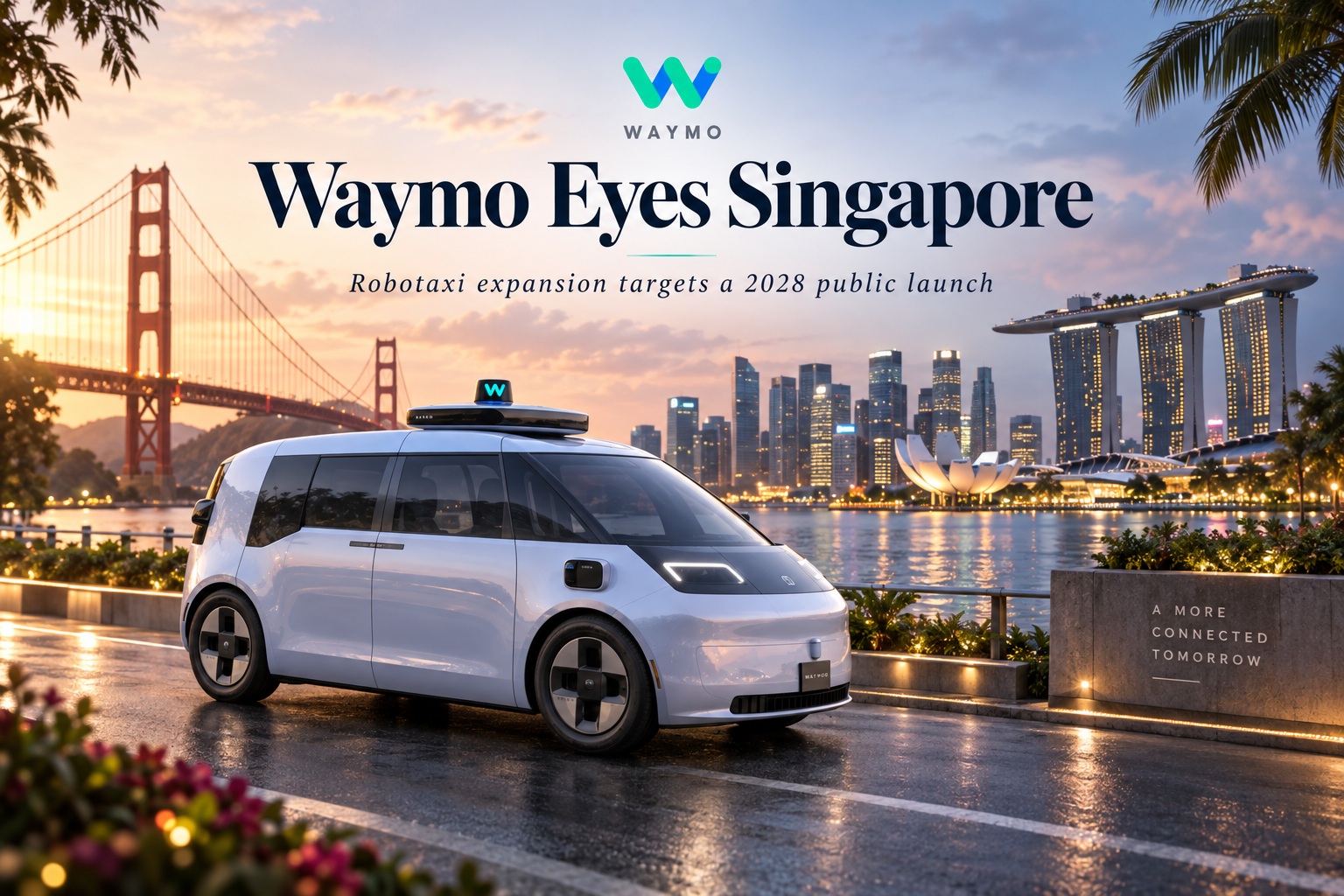
Waymo is preparing for one of its most significant overseas expansions yet, with Singapore emerging as a future market for the Alphabet-owned autonomous driving company. Best known for operating robotaxi services in several U.S. cities, Waymo has spent years developing self-driving technology and gradually expanding its commercial footprint. Now, attention is turning to Singapore, where the company is reportedly planning a phased rollout that could eventually lead to fully autonomous ride-hailing services for the public by 2028.
The move would mark an important step for Waymo because most of its current operations remain concentrated in the United States. Expanding into a dense, highly regulated city such as Singapore would provide a very different environment for testing and commercial deployment, particularly because of the country's complex traffic patterns, strict transport regulations, and heavy reliance on public transportation. If the rollout goes according to plan, Singapore could become one of Waymo's first major international robotaxi markets.
Waymo Vehicles Could Arrive in Singapore Within Months
According to reports, Waymo vehicles are expected to arrive in Singapore in the coming months as the company begins preparing for local testing and regulatory approval. The early phase is unlikely to involve public passenger services immediately, with initial activity focused more on familiarising the vehicles with local roads and gathering the data required for future autonomous operations.
The next major stage is expected in 2027, when Waymo plans to begin autonomous testing with human safety drivers on board. This is a common step in self-driving development because it allows the system to operate independently while still keeping a trained person ready to intervene if necessary. The testing period should also give Waymo time to understand how its technology performs in Singapore's urban environment before moving toward fully driverless services.
By 2028, the company hopes to begin offering fully autonomous ride-hailing to the public. That timeline still depends heavily on regulatory approval, technical readiness, and whether Waymo can demonstrate that its vehicles meet Singapore's safety requirements. The schedule therefore represents a target rather than a guaranteed launch date.
Singapore's LTA Will Play a Major Role
Before Waymo can carry paying passengers, it will need approval from Singapore's Land Transport Authority (LTA). Autonomous vehicles cannot simply begin operating commercially because the technology must first pass the country's safety and regulatory processes, which are designed to assess whether the system can operate reliably in real-world traffic.
The evaluation process is expected to involve input from the Traffic Police and testing through the Centre of Excellence for Testing and Research of Autonomous Vehicles, commonly known as CETRAN. The facility is used to evaluate autonomous vehicle behaviour under controlled conditions before broader deployment on public roads. This gives regulators a way to examine how vehicles respond to road signs, pedestrians, traffic scenarios, and unexpected situations without immediately exposing the public to unproven systems.
Singapore's structured regulatory environment could actually be one of the reasons Waymo sees the country as an attractive launch market. The island has invested heavily in smart mobility and autonomous transport research for years, giving companies a clearer framework for testing new technologies. At the same time, those regulations mean Waymo will still need to prove that its systems can meet the standards expected of any transport operator.
Why Singapore Makes Sense for a Robotaxi Launch
Singapore has several characteristics that make it appealing for autonomous ride-hailing. The country has a compact urban environment, high-quality road infrastructure, extensive digital mapping, and a transport system that already depends heavily on technology. Those conditions could make autonomous vehicles easier to integrate compared with larger countries where road quality, regulations, and driving behaviour vary significantly from region to region.
The city-state also has a relatively controlled geographic footprint. Unlike a sprawling country where a robotaxi operator would need to support thousands of kilometres of roads, Singapore offers a more manageable environment for gradually expanding coverage. That could allow Waymo to begin with selected districts before moving into broader areas once the service proves reliable.
At the same time, Singapore is not necessarily an easy market. Dense traffic, tropical weather, frequent construction, pedestrians, cyclists, motorcycles, and complex urban intersections create plenty of challenges for autonomous vehicles. Success there would therefore provide a strong demonstration of how well Waymo's technology can adapt outside the U.S.
Waymo Is Looking Beyond Singapore
Singapore is only one part of Waymo's international expansion plans. The company has reportedly been looking at several major global cities as potential markets for robotaxi services, reflecting a broader ambition to move beyond its U.S.-focused operations.
One of those cities is London, where Waymo has been exploring the possibility of launching services as early as 2026. The British capital presents a very different driving environment, including narrower roads, complex intersections, heavy traffic, and left-hand driving. A successful launch there would give Waymo valuable experience operating in one of Europe's busiest cities.
Tokyo is another market on Waymo's radar, with plans reportedly targeting 2027. Japan would present additional challenges involving local road rules, driving behaviour, signage, and a dense urban landscape, particularly in central Tokyo. Meanwhile, Munich has also been mentioned as a possible destination, with a rollout potentially coming in late 2027.
Taken together, these plans suggest Waymo is no longer thinking of autonomous ride-hailing as a service limited mainly to U.S. cities. The company appears to be preparing for a much broader international push, although every market will require separate regulatory approval and extensive local testing.
Malaysia Is Not on Waymo's List for Now
For Malaysian users interested in self-driving technology, there is currently no indication that Waymo plans to bring its robotaxi service here in the near future. Singapore may be geographically close, but the two markets differ significantly in regulation, road infrastructure, geography, and transport policy.
That does not necessarily mean Malaysia will be excluded permanently. Autonomous mobility is still developing quickly, and regional expansion could eventually make Southeast Asia more attractive once companies establish successful operations in neighbouring markets. Singapore may effectively become a proving ground for how well international robotaxi services can operate in this part of the world.
For now, however, Malaysia does not appear to be part of Waymo's publicly discussed expansion roadmap. Anyone hoping to experience a Waymo robotaxi closer to home may therefore need to look south of the border once the Singapore service eventually launches.
Waymo Will Not Be Alone in Singapore
Waymo is also not the only robotaxi company that has shown interest in Singapore. Chinese technology giant Baidu has previously been linked to plans involving its Apollo Go autonomous ride-hailing service, with Singapore and Malaysia both mentioned as possible future markets.
Apollo Go has already become one of the most prominent robotaxi services in China, making Baidu another serious player in the global autonomous mobility race. Reports last year suggested the company was evaluating expansion opportunities in Southeast Asia, while discussions were also said to be taking place in Europe through Switzerland's PostAuto.
Since then, however, there has been relatively little public information about those specific plans. It remains unclear whether Baidu is still actively pursuing Singapore or Malaysia on the same timeline, but its earlier interest demonstrates that Waymo may eventually face competition rather than entering the market alone.
The Robotaxi Race Is Becoming Global
The broader story here is that robotaxi development is gradually moving beyond experimental pilot projects and toward international commercial competition. Companies like Waymo and Baidu have already accumulated significant real-world driving experience, and the next challenge is proving that those systems can operate reliably across countries with very different road conditions and regulatory frameworks.
That international expansion is not simply a matter of shipping the same vehicle software to another city. Autonomous driving systems need detailed local maps, adaptation to road markings, traffic behaviour, weather, regulations, and even cultural driving habits. A system trained extensively in the United States may need significant additional testing before regulators are comfortable allowing it to operate without a human driver elsewhere.
This is why the Singapore plan is likely to unfold gradually. Bringing vehicles in first, moving to safety-driver testing, and only then attempting full autonomy gives Waymo time to adapt the system while giving regulators opportunities to evaluate its performance at every stage.
Fully Autonomous Does Not Mean Completely Unsupervised
The phrase "fully autonomous ride-hailing" can sometimes create the impression that the vehicles operate completely without human involvement of any kind. In practice, even driverless services typically rely on remote support teams, fleet monitoring, maintenance personnel, and operational staff who can assist when unusual situations occur.
The main difference is that no human safety driver needs to sit behind the wheel during normal passenger trips. The vehicle handles acceleration, braking, steering, navigation, and interaction with surrounding traffic itself. If the system encounters a situation it cannot confidently resolve, remote assistance may still provide guidance without directly driving the vehicle.
That model has already been used by Waymo in parts of the U.S., and Singapore would likely follow a similar operational structure if regulators approve the service. The challenge will be demonstrating that the technology can handle local conditions reliably enough for authorities to allow that final step.
What a 2028 Launch Could Mean for Singapore
If Waymo does reach its 2028 target, Singapore could become one of the most visible examples of autonomous ride-hailing outside the United States. The service could complement existing taxis, private-hire vehicles, buses, and rail rather than immediately replacing them, particularly during the early stages when coverage is likely to remain limited.
Robotaxis could potentially be useful for first-mile and last-mile connections, off-peak transport, airport transfers, or areas where demand does not justify additional fixed-route services. Much will depend on pricing, availability, coverage, and how Waymo integrates with Singapore's existing transport ecosystem.
Public acceptance will be just as important as technology. Some passengers may be eager to try a car with nobody behind the wheel, while others may need time before they are comfortable trusting the system. A gradual rollout gives both the technology and the public time to adjust.
Final Thoughts
Waymo's planned Singapore expansion is another sign that autonomous ride-hailing is moving from an American experiment into a global transport industry. Vehicles are expected to begin arriving in the coming months, followed by safety-driver testing in 2027 and a potential fully autonomous public service in 2028.
There are still several major hurdles ahead. Waymo must satisfy Singapore's Land Transport Authority, complete the necessary testing through local safety frameworks, adapt its technology to Singapore's roads, and prove that the system can operate safely under real traffic conditions. Until those steps are completed, the 2028 target should be viewed as an ambition rather than a certainty.
Even so, Singapore is a logical market for Waymo's first major Southeast Asian expansion. Its compact geography, strong infrastructure, and established autonomous-vehicle testing environment give the company a relatively controlled setting in which to prove that its technology can work outside the U.S.
Malaysia may not be on Waymo's immediate roadmap, but the Singapore launch could still matter to the wider region. If robotaxis perform well there, it could encourage regulators and transport companies elsewhere in Southeast Asia to look more seriously at similar services. For now, though, Singapore appears set to become the region's next major testing ground for a future where ordering a ride may eventually mean watching an empty driver's seat arrive at the kerb.











Comments 0