

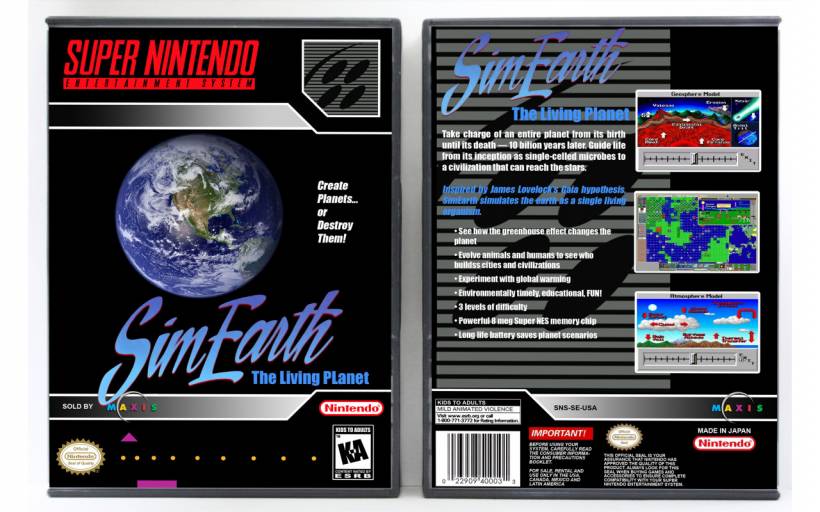
Some classic simulation games are remembered for letting you build cities, manage empires, or control populations. SimEarth takes a wider view. It invites you to think in planetary terms, shaping a world across enormous spans of time and watching how climate, geology, and life influence one another. It's not a game about winning quickly. It's a game about observing systems, testing ideas, and enjoying the slow satisfaction of seeing your choices ripple outward.
What makes SimEarth so fascinating is how it turns big scientific concepts into something you can interact with. The game encourages curiosity by letting you push and pull on planetary variables and then watch what happens. Sometimes things stabilize into a healthy world. Sometimes they spiral into something harsh and lifeless. Either way, the results are engaging because the game makes you feel like you're running an experiment rather than following a scripted path.
Now playable online through Lemon Web Games, SimEarth becomes easier to revisit in the way it naturally fits best, in calm sessions where you can tinker, observe, and adjust without needing to commit to a long setup. The browser format suits its slow-burn nature because you can dip in for a while, make changes, see results, and return later with a new idea you want to test.
The Appeal of Thinking Like a Planet Designer
SimEarth stands out because it asks you to zoom out. Instead of focusing on a single city or a single civilization, you're managing conditions that affect the entire planet. That shift in scale changes how you think. Your decisions are less about individual events and more about long-term stability, balance, and the way small changes can create large consequences over time.
This scale also creates a different kind of satisfaction. When things go well, it feels like you didn't just place buildings correctly, you shaped an environment where life can thrive. When things go badly, it feels like you've learned something, because the failure usually reveals how delicate certain balances can be. That learning loop is central to SimEarth, and it's what makes the game feel meaningful even when it's not traditionally "exciting."
It also gives the game a relaxing quality. There is pressure in trying to keep a planet stable, but there is also a calmness in watching processes unfold. The game often feels like a slow conversation with a complex system, where your job is to make changes, then listen to how the world responds.
Experimentation as the Core Gameplay
SimEarth is at its best when you treat it like a sandbox for ideas. It encourages you to try things, adjust variables, and observe outcomes rather than follow a strict objective path. That approach makes the game feel open-ended, because the real goal is whatever you decide it is. You might want to create a planet that supports life as early as possible, or you might want to see how extreme conditions affect development.
This experimentation also makes the game more educational in a natural way. You're not being lectured. You're discovering through play. When a world becomes too hot, too cold, or too unstable, you learn that certain conditions matter. When life spreads successfully, you begin to understand that balance is not just one variable, it's a network of interacting forces.
The game's pacing supports this well because it gives you time to absorb what you're seeing. You make a change, then you watch, and the watching is part of the gameplay. That is a rare kind of design, but it's exactly what makes SimEarth distinctive.
Life, Climate, and Time as the Main Characters
In many games, characters drive the story. In SimEarth, the main characters are systems. Climate patterns, geological shifts, and the slow spread of life become the narrative. You don't follow a plot. You watch a planet develop a history. That is why it can feel surprisingly immersive, because you become invested in the health of something that doesn't speak, but still feels alive.
Time plays a major role in shaping that immersion. Because the game spans long stretches, changes feel significant. You aren't simply tweaking a number and seeing an instant result. You are guiding a process and watching it unfold. That slow evolution gives the game weight, because the world feels like it has momentum. It feels like your decisions matter because the planet remembers them.
This also creates a unique emotional rhythm. You might spend a long time building stability, then watch it collapse because of a shift you didn't anticipate. Or you might struggle early, then finally hit the right balance and see life flourish. Those moments feel rewarding because they are earned through patience and observation.
Why SimEarth Still Feels Different From Modern Sim Games
Modern simulation games often focus on accessibility and fast gratification, and there is nothing wrong with that, but it also means fewer games aim for SimEarth's slow, scientific feeling. SimEarth is content to be thoughtful. It expects you to engage with its systems, accept that outcomes can take time, and treat learning as part of the fun.
That design choice is what makes it feel so distinct even decades later. It doesn't feel like a modern strategy game with a victory screen. It feels like a simulation toy. You are not rushing to finish. You are building an understanding. That approach can be deeply satisfying for players who enjoy systems and long-term thinking.
Revisiting it today also reminds you how valuable it can be to play something that doesn't constantly demand attention with spectacle. SimEarth earns attention through curiosity. You keep playing because you want to know what happens next, not because the game is forcing you to chase a reward.
Playing SimEarth Online Today
Through Lemon Web Games, SimEarth can now be played directly in your web browser with no downloads or setup required. Features of the web-based version include:
• Smooth browser play that suits long-form experimentation and observation
• Easy return play for testing new ideas and adjusting variables over time
• No installation needed, making it ideal for casual simulation sessions
• A convenient way to revisit a classic Maxis simulation through Lemon Web Games
• A simple browser-friendly option for thoughtful world evolution gameplay
Who Should Play SimEarth
• Anyone curious about planet-building and world evolution concepts
• Fans of classic Maxis simulation games with a slower, thoughtful pace
• Players who like sandbox play where goals are self-defined
• Anyone who enjoys observing long-term consequences rather than quick rewards
• Players looking for a browser-friendly simulation that feels educational and reflective
Play SimEarth Online Now
SimEarth is best played when you give it a little time to breathe. It's the kind of game you can open, make thoughtful adjustments, and then watch your planet respond over time. The browser format makes that easy because you can treat it as a recurring experiment, returning whenever you want to test a new idea or refine a world that is almost stable. It's a slow experience, but it's engaging because it constantly invites curiosity.
Final Thoughts
SimEarth remains memorable because it turns the planet itself into the game. Instead of focusing on buildings, armies, or individual people, it focuses on the conditions that make life possible and the forces that shape a world over time. That perspective gives it a rare identity, one that feels scientific, reflective, and surprisingly immersive for a classic simulation.
What makes it worth revisiting today is how it rewards patience and curiosity. You don't play it to rush toward a finish line. You play it to learn, to experiment, and to watch a world develop its own story through systems that interact in fascinating ways. In a browser-friendly context through Lemon Web Games, it becomes an easy game to return to whenever you want a thoughtful, long-form simulation experience that still feels uniquely ambitious.











Comments 0