

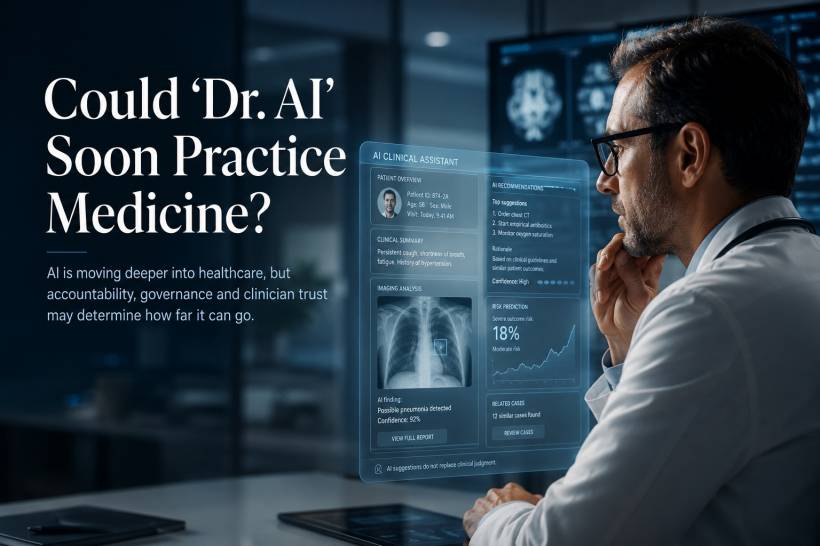
Artificial intelligence is already becoming part of everyday healthcare, helping with patient messages, clinical documentation, image analysis and administrative tasks. The more difficult question is whether AI could eventually move beyond assisting clinicians and begin making medical decisions independently.
That possibility is no longer treated purely as science fiction. Narrow forms of autonomous clinical AI already exist, while conversational systems are becoming increasingly capable of reviewing records, identifying patterns and supporting treatment decisions. Yet the biggest obstacles may not be technical performance alone. Accountability, regulation, privacy, reimbursement and patient trust could determine how far the technology is allowed to go.
Healthcare AI Is Advancing Faster Than Many People Realise
The technical capabilities behind medical AI have improved rapidly.
Earlier clinical decision-support systems often depended on highly structured information. Patient data had to be coded carefully using standard medical classifications before software could analyse it effectively.
Newer AI models can interpret far more complex information, including free-text clinical notes, discharge summaries, consultation records and other forms of unstructured documentation.
This matters because much of healthcare still exists in narrative form. Doctors and nurses do not always record every observation as a clean database field. Important context may be buried inside progress notes, referral letters or previous consultations.
An AI system capable of understanding those records could potentially provide a more complete picture of the patient than older rule-based tools.
However, understanding the record is not the same as being authorised to practise medicine.
The More Realistic Future Is AI-Augmented Care
The strongest near-term case for healthcare AI is not replacing doctors. It is helping them make better and more consistent decisions.
Under this model, clinicians first establish the standards that the system is expected to follow. These may include treatment guidelines, diagnostic criteria, escalation rules and evidence-based pathways for specific conditions.
The AI then compares patient information against those approved standards and highlights possible concerns, missed opportunities or recommended next steps.
That approach keeps clinical authority with the healthcare organisation rather than allowing a language model to invent its own medical policy.
Instead of asking AI, "What should we do with this patient?" the safer question becomes, "How does this patient compare with the guidelines our clinicians have already approved?"
This distinction could make AI easier to govern, audit and defend from both a clinical and legal perspective.
Narrow Autonomous Medical AI Already Exists
Completely autonomous AI may sound futuristic, but limited examples are already in use.
Some authorised systems can analyse specific medical images and produce a screening decision without requiring a physician to review every result first. Diabetic retinopathy screening is one example where tightly controlled autonomous AI has already crossed into clinical practice.
However, this kind of system operates within an extremely narrow boundary.
It focuses on one disease, one type of image and one clearly defined screening task. It does not assess an undifferentiated patient, consider dozens of possible diagnoses, prescribe treatment and accept responsibility for the outcome.
That is very different from a general-purpose "AI doctor."
A system that can independently manage a patient from first complaint through diagnosis, treatment, follow-up and complication management remains much further away. The complexity of real medicine is not only about recognising patterns. It also involves uncertainty, conflicting symptoms, social circumstances, incomplete information and ethical judgement.
Clinical Reasoning Is Only One Part of Medical Practice
Medicine is sometimes described as a process of collecting information and selecting the most likely diagnosis.
In reality, the work is far broader.
A clinician must decide which questions matter, recognise when a patient is withholding information, understand family concerns, explain uncertainty and adapt recommendations to a person's circumstances.
Two patients with the same diagnosis may require very different plans because of age, other medical conditions, financial limitations, caregiving responsibilities or personal preferences.
A capable AI may identify the statistically appropriate treatment, but that does not automatically mean it understands what is practical, acceptable or humane for the person receiving it.
This is one reason healthcare AI is likely to remain supervised even as its reasoning improves.
Someone Must Remain Accountable
The central issue is not simply whether AI can make a recommendation. It is who becomes responsible when that recommendation causes harm.
If a clinician follows an AI-generated decision and the patient suffers an adverse outcome, responsibility could fall across several parties:
Without a clear accountability structure, clinicians may hesitate to rely on AI for high-risk decisions.
Patients also deserve to know who is ultimately responsible for their care. A system cannot simply be treated as an independent professional unless there is a legal framework covering competence, liability, oversight and enforcement.
Healthcare requires named accountability. There must always be a person or organisation capable of explaining the decision, reviewing what happened and taking corrective action.
Clinical AI Needs a Trusted Source of Truth
One proposed safeguard is to prevent AI from producing recommendations unless they are grounded in approved clinical standards.
Before deployment, physicians, nurses, pharmacists and other specialists would define the evidence-based rules the system is expected to apply.
These standards would need to be:
This creates a gating process between the AI model and the final clinical advice.
The model may help interpret the patient record, but it should not be free to recommend anything outside the organisation's approved boundaries without clearly flagging the uncertainty.
That architecture could reduce the risk of confident but unsupported medical suggestions.
AI Models Must Be Tested Like Clinical Tools
Healthcare organisations need reliable ways to compare AI systems before purchasing or deploying them.
At present, medical AI evaluation can feel inconsistent. Vendors may report strong results on selected datasets, but those numbers may not reflect how the system performs with real patients in a specific hospital.
A model that works well in one country, age group or clinical environment may perform differently elsewhere.
Healthcare therefore needs use-case-specific benchmarks that examine more than general accuracy.
Evaluations should consider:
Shared benchmarks would be particularly valuable for smaller healthcare organisations that lack the resources to test every system independently.
AI Performance Can Change Over Time
A clinical model that performs well at launch may not remain equally accurate forever.
Patient populations change. Treatment guidelines evolve. New diseases emerge, documentation practices shift and medical devices are replaced.
This creates the problem of model drift.
If the environment changes while the AI remains frozen, its recommendations may gradually become less reliable.
Healthcare regulators therefore face a difficult balance. Developers need a way to update models without restarting the entire approval process every time, but those changes must still be carefully tested.
A controlled update framework could allow developers to modify approved systems within predefined limits while continuing to demonstrate safety and effectiveness.
This may prove more important than one major product launch because its effects accumulate over time.
Regulation Alone Will Not Guarantee Adoption
Even when an AI system is clinically effective and legally authorised, healthcare providers still need a practical reason to use it.
Hospitals and clinics must consider purchasing costs, integration work, staff training, maintenance and liability.
If reimbursement systems do not recognise AI-supported services, healthcare organisations may struggle to justify the investment.
A technology may reduce workload or expand access, but adoption will remain slow if providers are not compensated for using it.
Payment policy is therefore closely connected to regulation.
A faster approval pathway can bring AI tools to market, but reimbursement determines whether they become part of routine care.
Patient Communication May Be the Safest Early Opportunity
Some of AI's greatest near-term benefits may come from improving communication rather than making independent diagnoses.
Healthcare organisations receive large volumes of patient messages about symptoms, medications, appointments, test results and follow-up concerns.
AI can help organise these communications, identify urgent issues and prepare draft responses for clinicians to review.
This could allow care teams to respond more quickly without removing the professional from the process.
For example, AI may detect that a patient's message describes worsening symptoms and prioritise it for immediate review. It could also summarise a long communication history so the clinician understands the issue faster.
This is lower risk than allowing the system to independently prescribe medication or make a final diagnosis.
AI Could Help Extend Scarce Clinical Resources
Healthcare systems around the world face shortages of doctors, nurses and other professionals.
The problem is often more severe in rural and underserved communities, where patients may wait longer or travel farther for care.
AI could help existing teams manage a broader range of patients by reducing administrative work and providing consistent decision support.
A general practitioner supported by reliable AI may be able to manage conditions that would otherwise require referral, provided the system operates within approved boundaries and specialist support remains available.
AI could also assist nurses, pharmacists and allied health professionals working under established protocols.
The goal would be to extend the reach of the care team, not to remove qualified professionals from the system.
Pharmacists Could Play a Larger Role
One possible model involves using AI to help direct patients with minor or well-defined conditions towards pharmacists.
Pharmacists already have extensive medication knowledge and, in many healthcare systems, operate under approved clinical protocols.
AI could support triage by identifying patients whose symptoms appear suitable for pharmacy-based care while escalating more serious cases to a doctor.
This could reduce pressure on primary care services and allow physicians to focus on complex patients.
However, the boundaries would need to be clearly defined. The AI should not be allowed to minimise symptoms, miss warning signs or send patients to a lower level of care simply because it is more convenient.
Governance Should Be as Formal as Clinical Credentialing
Healthcare organisations do not allow clinicians to practise without checking qualifications, defining their scope and monitoring performance.
AI systems should face a similarly structured process.
Before deployment, an organisation should establish:
This creates a form of digital credentialing.
An AI tool should not receive unlimited access simply because it performs well during a demonstration. Its permissions must match its proven capabilities.
Transparency Must Go Beyond a Simple Explanation
Many AI systems are criticised for behaving like black boxes, producing outputs without making the reasoning easy to examine.
In healthcare, that lack of transparency is especially problematic.
Clinicians need to know which patient information influenced the recommendation, which guideline was applied and how confident the system is.
A stronger model would provide a clear audit trail showing:
This "glass-box" approach does not mean exposing every technical detail of the underlying model. It means making the clinical pathway understandable enough for professionals to review and challenge.
Local Validation Is Essential
A healthcare organisation should not assume that a model proven elsewhere will perform identically in its own environment.
Differences in patient demographics, language, disease prevalence and clinical workflows can affect results.
An AI trained mainly on large urban hospitals may not perform as well in a rural clinic. A system developed using one country's guidelines may recommend tests or treatments that are inappropriate elsewhere.
Before deployment, the model should be evaluated using representative local data.
Ongoing monitoring is also necessary to identify whether performance changes after implementation.
Privacy Must Remain Central
Clinical AI requires access to some of the most sensitive information people possess.
Medical records may contain diagnoses, medications, family history, mental health information, financial details and deeply personal conversations.
Healthcare organisations must understand exactly where patient information is processed, stored and retained.
They should also determine whether data is used to improve the vendor's model, whether it crosses national borders and how it is protected from unauthorised access.
AI adoption should not weaken existing confidentiality obligations.
A system that improves clinical efficiency but creates new privacy risks may ultimately damage patient trust more than it helps.
Patients Need to Know When AI Is Involved
Transparency should extend to the patient.
People may reasonably expect to know whether an AI system helped review their information, prioritised their message or contributed to a recommendation.
The level of disclosure may depend on the role of the technology.
An AI tool used only to format documentation may require less explanation than one that independently interprets a medical image or recommends treatment.
However, hiding significant AI involvement could undermine trust if patients later discover that important decisions were partly automated.
Clear communication allows patients to understand what the system does and what remains under human control.
AI Should Be Easy to Suspend
A healthcare AI system should never become too deeply embedded to stop.
If safety concerns arise, organisations need the ability to suspend its use immediately.
Governance teams should be able to revoke permissions, isolate the system and review affected cases.
This is particularly important for tools operating with partial autonomy.
A technology that cannot be quickly disabled after a harmful event is not ready for critical clinical use.
The Future Is More Likely to Be Collaborative Than Autonomous
The most realistic future is not a virtual doctor replacing every clinician.
It is a healthcare environment where AI works alongside human professionals across many different tasks.
AI may summarise patient histories, identify missing investigations, highlight potential drug interactions, draft communications and compare treatment decisions with approved guidelines.
Clinicians would remain responsible for interpreting that information, discussing options with patients and making final decisions.
As systems become more capable, the boundary may shift. Some narrow tasks could become fully autonomous, while complex care remains supervised.
The transition is likely to happen gradually and differently across specialties.
Final Thoughts
The question of whether AI can practise medicine is becoming less theoretical, but the answer depends heavily on what "practise medicine" actually means.
For narrowly defined tasks, autonomous systems are already part of clinical care. For broad diagnosis, prescribing and long-term patient management, healthcare is still far from handing responsibility to a general-purpose AI doctor.
The main challenge is no longer only whether the technology can reason. It is whether healthcare can establish the governance, accountability, regulation, evidence and trust needed to use that reasoning safely.
AI's most valuable role may ultimately be to make human clinicians more effective rather than replace them.
A successful healthcare AI future will not be measured by how quickly doctors are removed from the process. It will be measured by whether patients receive safer, faster and more consistent care while a qualified professional remains clearly responsible for the outcome.











Comments 0