

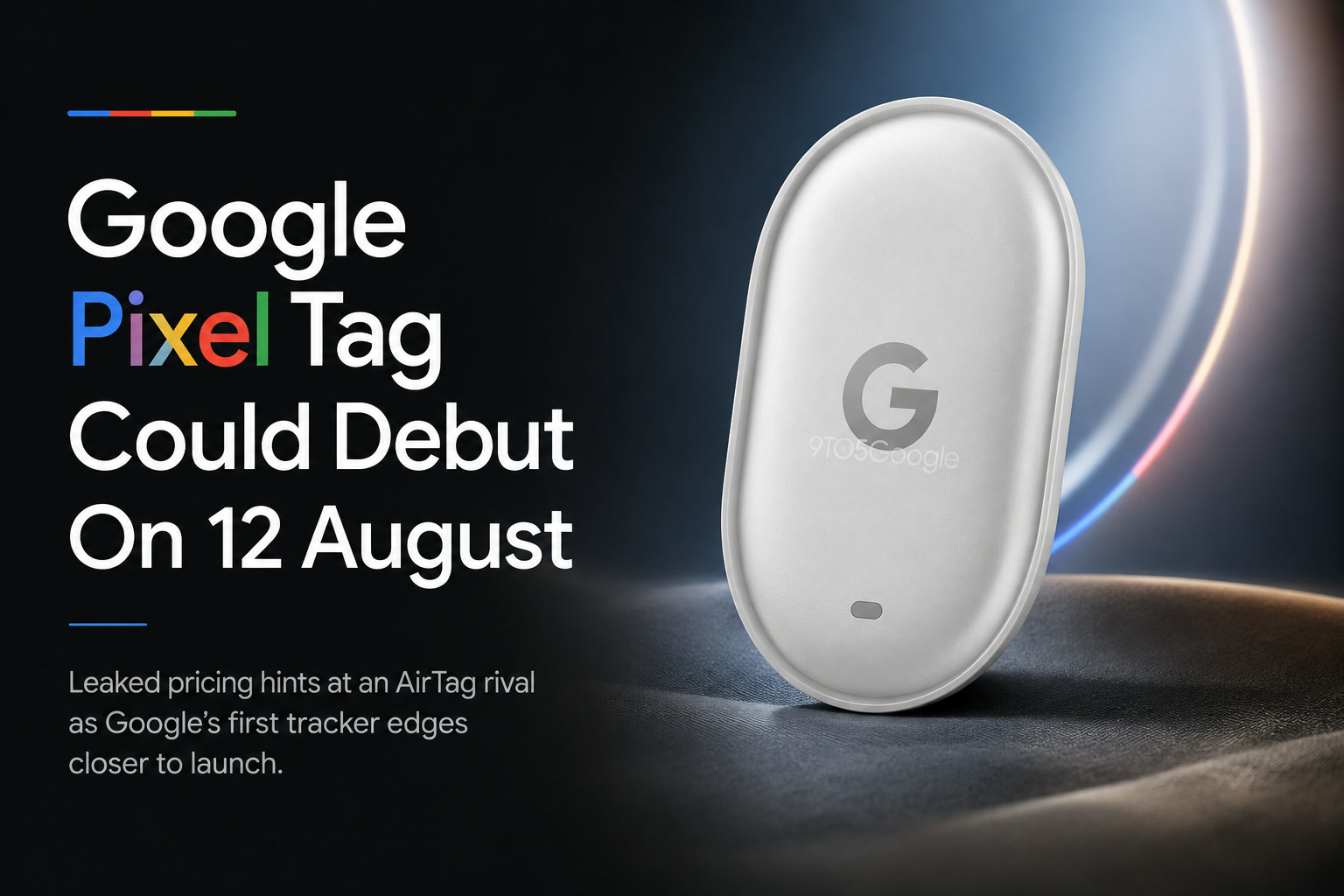
Google may finally be preparing to enter the Bluetooth tracker market with a device reportedly called the Pixel Tag. According to recent leaks, the tracker could be introduced during the upcoming Made by Google event on 12 August, where the company is also expected to reveal its latest Pixel smartphones and wearable devices.
Although Google has not officially confirmed the Pixel Tag, leaked renders, pricing information and reported launch details suggest that the product may be much closer to release than previously expected.
Google May Be Expanding the Pixel Ecosystem
The Pixel brand has grown far beyond smartphones.
Google now offers watches, earbuds, tablets and other connected products designed to work closely with Android. A dedicated item tracker would be a logical addition, especially for users who want to locate everyday belongings such as keys, luggage, backpacks or camera bags.
Bluetooth trackers are small devices that can be attached to valuable objects. When the item is nearby, the owner can usually locate it through Bluetooth or trigger the tracker's built-in speaker. When it is farther away, compatible devices belonging to other users may help report its approximate location through a wider crowdsourced network.
Apple has offered this type of experience through the AirTag for several years. A Pixel-branded alternative could give Android users a more tightly integrated first-party option.
The Pixel Tag Appears to Have a Rounded Oblong Design
Images reportedly shared by 9to5Google show a compact tracker with a rounded, slightly elongated shape.
Google's familiar "G" logo appears in the centre, while a small grille is positioned near the bottom. That opening is believed to belong to a built-in speaker, which could help users locate nearby items by playing a sound.
The design looks simple and understated rather than overly technical. This would make sense for a product intended to be attached to everyday belongings without attracting too much attention.
One important question is whether the tracker will include a built-in hole for keyrings or require a separate accessory. AirTag owners commonly need an additional holder before attaching the tracker to keys or bags, so an integrated attachment point could give Google a practical advantage.
The available image does not provide a clear answer yet.
Only One Colour May Be Available at Launch
The Pixel Tag is reportedly launching in a single colour known as Light Fog.
Based on the name, this is likely to be a pale or neutral grey finish that matches Google's preference for soft, understated colours.
Launching with only one option would be somewhat surprising because Google frequently offers Pixel products in several colours. However, the company may be keeping the initial tracker simple before introducing additional shades later.
It is also possible that colourful cases, keyrings or holders will be sold separately. Accessories could allow users to personalise the tracker without requiring Google to manufacture several different hardware finishes.
For now, Light Fog is the only colour mentioned in the leak.
European Pricing May Match Apple's AirTag
Earlier reports suggested that the Pixel Tag could cost EUR39.99, equivalent to approximately RM188 through a direct conversion.
A newer report now claims that the European retail price will instead be EUR34.99, or roughly RM165.
That would place the Pixel Tag at the same price as Apple's AirTag in France.
Matching Apple's price would position Google's tracker as a direct competitor rather than a cheaper alternative. The company would therefore need to provide a similarly polished experience, including reliable location updates, strong privacy protections and simple integration with Android devices.
European pricing should not be used to predict the exact Malaysian price. Regional taxes, distribution costs and local market strategies can produce significant differences.
Apple's AirTag currently sells for RM129 in Malaysia, but there is no confirmation that Google will match that amount locally—or even launch the Pixel Tag here immediately.
A Malaysian Release Is Still Uncertain
Google's hardware availability remains inconsistent across different markets.
Some Pixel products receive broad international launches, while others are limited to selected countries. Even when Pixel phones are available officially, accessories and smaller ecosystem products may follow a different release schedule.
There is currently no confirmed Malaysian launch date or local price for the Pixel Tag.
If Google treats the tracker as an important part of the wider Android ecosystem, it may aim for broader availability. However, buyers should wait for the company's official announcement rather than assuming that European availability guarantees a Malaysian release.
Local certification records, retailer listings or a direct announcement from Google would provide stronger evidence.
Ultra Wideband Support Could Be the Deciding Feature
One of the largest unanswered questions is whether the Pixel Tag will support Ultra Wideband, commonly shortened to UWB.
Bluetooth can indicate whether a tracker is nearby and estimate general proximity. UWB can provide much more precise directional information when both the tracker and phone support the technology.
Instead of simply showing that an item is somewhere in the room, a compatible phone may be able to indicate its direction and approximate distance.
Apple uses UWB for Precision Finding with compatible iPhones and AirTags. If Google wants the Pixel Tag to compete directly at the same price, buyers will naturally expect a similar capability.
However, UWB hardware would also increase manufacturing costs and could limit full functionality to selected Pixel phones or premium Android devices equipped with compatible chips.
The leaked information does not confirm whether the feature is included.
The Wider Android Network Will Be Just as Important as the Hardware
A tracker's usefulness depends heavily on the network supporting it.
When a lost item is outside Bluetooth range, the tracker needs nearby compatible devices to detect it and securely report its location. The larger and more active that network becomes, the better the chance of recovering the missing item.
Google has a major advantage because Android is used across an enormous number of smartphones worldwide.
A Pixel Tag could potentially benefit from this scale, provided that the wider network works reliably and participating devices are configured to help locate nearby trackers.
The experience must also protect the privacy of both tracker owners and people whose phones help detect lost items. Location reports should be encrypted, anonymous and inaccessible to unauthorised parties.
A huge network is valuable only when users trust how it handles location data.
Unwanted Tracking Protection Will Be Essential
Bluetooth trackers can help people recover lost property, but they can also be abused to follow someone without permission.
Google will therefore need strong protections against unwanted tracking.
A phone should be able to warn its owner when an unfamiliar tracker appears to be travelling with them. The tracker itself may also need to make a sound after being separated from its owner for a certain period.
Users should have a clear way to identify and disable a suspicious device.
These safeguards are not optional extras. They are fundamental requirements for any modern tracker, particularly one expected to operate across a large network of Android devices.
Google will likely need to explain its anti-stalking measures in detail when the Pixel Tag is officially announced.
Battery Design Will Affect Long-Term Convenience
The leaks have not revealed how the Pixel Tag will be powered.
Many Bluetooth trackers use small replaceable coin batteries that can last for months or more than a year. This allows the owner to replace the battery without discarding the entire tracker.
A rechargeable design could reduce the need to buy replacement batteries, but it would require users to remember to charge the tracker periodically. That may be inconvenient for a device expected to remain attached to luggage or keys for long periods.
A replaceable battery is likely, but this has not been confirmed.
Battery-life claims will also matter. A tracker that needs frequent maintenance may become less useful because owners could discover that it has run out of power only after an item goes missing.
The Built-In Speaker Should Help with Nearby Searches
The small grille visible in the leaked render strongly suggests that the Pixel Tag will include a speaker.
This would allow the user to make the tracker emit a sound when an item is nearby but hidden from view.
That feature is especially useful for objects lost inside the home. Keys may be under a cushion, inside a bag or buried beneath clothing. A map location alone cannot identify the exact hiding place, but an audible alert can guide the user towards it.
Speaker volume will be important. The sound must be loud enough to hear through a backpack or beneath furniture without making the tracker excessively large.
Google may also use different tones for normal location searches and unwanted-tracking warnings.
Google Could Offer More Than a Single Tracker
The leaks currently mention a standalone price, but Google may eventually offer multi-pack bundles.
Bluetooth trackers are often more useful when purchased in groups because people may want one for their keys, another for luggage and another for a backpack or equipment case.
A four-pack priced below the cost of purchasing four individual units could make the Pixel Tag more competitive.
Accessories will likely become another part of the ecosystem. Google or third-party manufacturers could offer keyrings, adhesive mounts, luggage holders and protective cases.
None of these options has been confirmed, but they would be natural additions if the Pixel Tag becomes a permanent part of the company's hardware lineup.
The 12 August Event Would Be the Obvious Stage
The Made by Google event on 12 August would provide a logical opportunity to introduce the tracker.
Google is expected to focus on new Pixel phones and wearables, and the Pixel Tag could be presented as another device designed to work seamlessly with that ecosystem.
Launching it alongside new phones would also allow Google to demonstrate any exclusive or enhanced features available on supported Pixel models.
For example, if UWB is included, Google could show how a compatible Pixel phone provides precise directional guidance. The company could also demonstrate integration with its device-finding services and explain its privacy protections.
Still, the product remains unannounced. Even a convincing leak does not guarantee that it will appear at the event.
A Competitive Price Alone Will Not Be Enough
At EUR34.99, the Pixel Tag would compete directly with AirTag rather than trying to win solely through a lower price.
That means buyers will compare much more than the hardware's appearance.
Google will need to deliver:
UWB support could also become a major factor, particularly if Google intends to position the tracker as a premium first-party accessory.
Without precise finding, the Pixel Tag may still be useful, but it could feel less capable than its main competitor at the same price.
Final Thoughts
The reported Pixel Tag could become one of Google's most practical new accessories.
Its leaked design appears compact and simple, while the possible EUR34.99 price would place it directly alongside Apple's AirTag. The expected Light Fog finish also fits comfortably within Google's existing design language.
However, the most important details remain unknown.
Google has not confirmed whether the tracker includes UWB, how long its battery will last, whether the battery can be replaced or which countries will receive it. Malaysian pricing and availability are equally uncertain.
If Google combines strong Android integration with reliable location tracking and proper anti-stalking safeguards, the Pixel Tag could become the first-party tracker that many Android users have been waiting for.
The 12 August Made by Google event is now the most likely place for those questions to be answered. Until then, the name, price and launch timing should still be treated as leaked information rather than confirmed product details.











Comments 0