

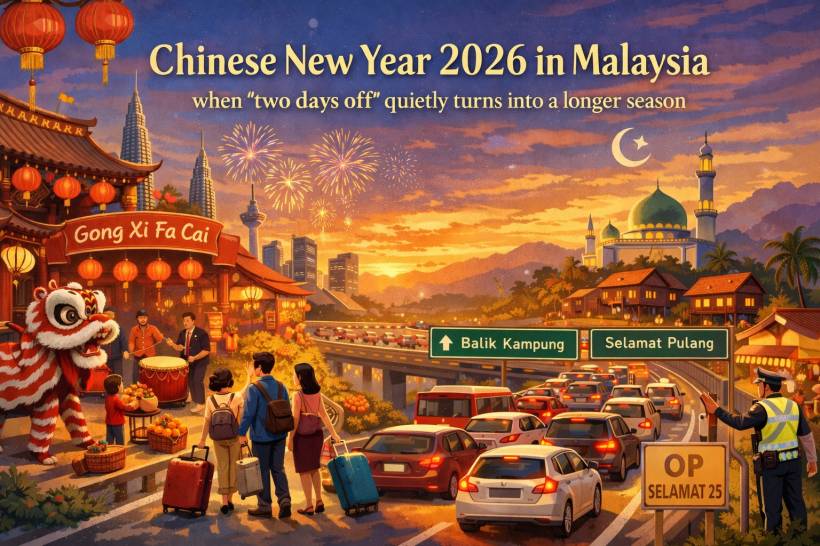
Chinese New Year 2026 lands right in the middle of a very Malaysian calendar moment, where cultures, travel plans, and public holidays all bump into each other in the most predictable way possible: everyone wants to be somewhere else at the same time. For 2026, Chinese New Year falls on Tuesday, 17 February 2026, followed by the second day on Wednesday, 18 February 2026.
The public holiday part (and why some people effectively get three days)
Nationally, Chinese New Year is a public holiday on the first day, and the second day is widely observed too. Now here's where the "bonus day" story happens: Awal Ramadan (the first day of Ramadan) falls on Thursday, 19 February 2026, and it's a state public holiday in Johor, Kedah, and Melaka.
So if you're in those states, the week can feel like:
That's the "three-day" effect people talk about, even though it's coming from a different celebration that happens to sit right after CNY this year.
What the celebration feels like across Malaysia
Chinese New Year in Malaysia isn't just "one night and done." It starts building weeks earlier, peaks around reunion time, and then continues with visits, open houses, and food trails that somehow stretch into "eh, still CNY mood."
The warm-up: malls, markets, and that sudden urge to buy snacks
By early February, you'll see the big wave: lanterns and red decor in shopping malls, CNY music loops you didn't ask for, and pop-up stalls selling cookies, gift boxes, and mandarin oranges. Even people who don't celebrate end up caught in the gravity of it, because Malaysia basically runs on "seasonal vibes + good food."
Reunion dinner and the "everyone returns home" effect
Reunion dinner is one of the emotional anchors of the season. That's why you'll hear "balik kampung" from Chinese families too, not just during Raya. And because 2026 places CNY so close to Ramadan, travel planning becomes extra intense. PLUS has specifically warned that the overlap is expected to intensify both outbound and return traffic flows.
Visiting days: the polite marathon
After Day 1 and Day 2, it becomes a rhythm:
In many places, you'll also get the local flavour: lion dances at shops, community events, temple visits, and neighbourhood celebrations that feel very Malaysian because it's never just one culture in the room.
Traffic in CNY 2026: yes, it's going to be "that kind" of week
If you're driving this season, it helps to accept one truth early: you're not "stuck in traffic," you are traffic.
What the numbers are saying
For the Chinese New Year travel period, Malaysia's highway authority has projected up to 3.27 million vehicles on major highways, with the biggest share expected on PLUS highways.
PLUS has also described congestion arriving in two main waves:
Police operations for road safety are also active during this period. Op Selamat 25 has been reported as running 15–20 February 2026, aimed at reducing accidents and enforcing key offences.
What traffic feels like in real life
In the Klang Valley, you'll usually see two different traffic stories at once:
And because people are moving for multiple reasons this year (CNY travel plus Ramadan approaching), the "two-direction jam" becomes more noticeable: out of the city, then back into the city, then out again for visits.
Simple survival habits that actually help
If you want practical wins:
The "Malaysia" part: open houses, mixed celebrations, and respectful timing
One of the nicest things about celebrating Chinese New Year in Malaysia is how normal it is for friends of different backgrounds to join in. Open houses, office gatherings, and friend-group visits are common, and it's very normal to see the season overlap with other major religious or cultural preparations.
With Ramadan starting immediately after the CNY public holiday window in 2026, you'll also notice a slightly different tone toward the end of the week: some people begin shifting routines, some start travelling earlier, and businesses start planning around both seasons back-to-back.
Final thoughts
Chinese New Year 2026 in Malaysia is one of those years where the calendar creates a "stacked" feeling: two big days of celebration nationwide, and then in certain states, a third day off because Awal Ramadan follows right after. If you're celebrating, it's a great year to slow down and enjoy the full season, not just the first two days. If you're travelling, it's the year to be a bit more strategic, because the traffic story is already loud and clear.











Comments 0