

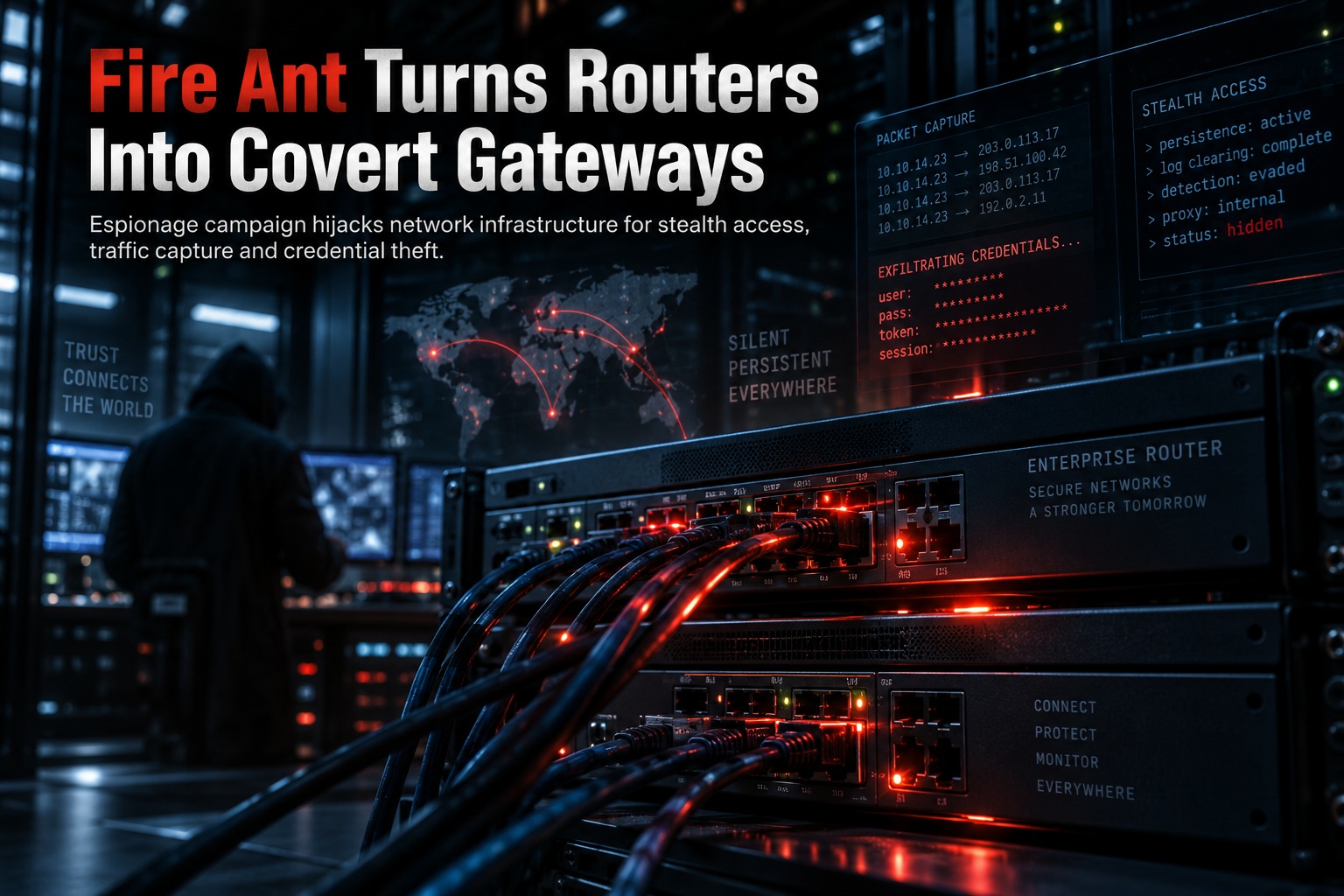
Routers normally sit quietly in the background, directing traffic between systems and networks without attracting much attention. That makes them incredibly useful to defenders—but also extremely valuable to attackers. A sophisticated cyber espionage actor known as Fire Ant has been exploiting that position by compromising Cisco routing infrastructure and turning those devices into covert collection points capable of monitoring network traffic, harvesting credentials and helping attackers move deeper into high-value environments.
The campaign is particularly concerning because Fire Ant is not simply breaking into individual endpoints and stealing files. Researchers say the actor is targeting the infrastructure organisations use to route, authenticate and administer their networks, including Cisco IOS XR routers, TACACS servers and Linux management hosts. Once those systems are compromised, the attackers can potentially observe activity flowing through trusted network paths while simultaneously interfering with the logs defenders rely on to understand what happened.
Fire Ant Is Moving Deeper Into Network Infrastructure
Fire Ant was first identified in 2025 and remains active. Its earlier operations had already involved VMware hypervisors, but the latest activity demonstrates a broader interest in network and management infrastructure. The campaign now extends into routers, authentication systems and the Linux hosts used to administer sensitive environments.
Researchers have assessed with high confidence that the activity resembles UNC3886, a previously documented China-linked cyber espionage cluster. The important point for defenders is not simply the attribution, however, but the type of systems being targeted. These are machines that often sit at privileged points in the network and may be trusted by many other devices.
Compromising an ordinary workstation gives an attacker visibility into one user's activity. Compromising a router can potentially provide visibility into communications from many different systems at once.
Why Routers Make Such Powerful Espionage Targets
Routers occupy a unique position because so much organisational traffic passes through them. If an attacker can control a router, they are no longer limited to monitoring one endpoint or server. They may be able to observe traffic crossing multiple network segments and identify other valuable systems worth targeting.
According to the advisory, Fire Ant used compromised routers to capture network traffic and upload PCAP files to external FTP infrastructure. That effectively changed the router from a device that merely forwards traffic into an intelligence collection platform.
This is what makes infrastructure-level compromise so dangerous. The attacker is positioned within a path users and applications already trust, meaning the activity may blend into normal network operations much more easily than malware running on a visibly compromised workstation.
The Attackers Captured Traffic Across Multiple Routers
Fire Ant did not appear to rely on a single router. Researchers observed traffic captures being generated from multiple router interfaces, with the resulting files then transferred to external FTP servers. The fact that several routers were involved suggests the actor deliberately selected multiple network vantage points rather than simply collecting whatever traffic happened to be available from the first compromised device.
This behaviour matters because a network can look very different depending on where traffic is observed. A router closer to internet-facing systems may reveal different information from one connecting internal management networks or critical services. By positioning itself at several points, an espionage actor can potentially build a much more complete picture of the organisation.
The advisory also notes activity involving command-history locations and traceroute commands directed toward unusual external domains. Taken together, those actions are consistent with an attacker using the router not just for surveillance, but also for network reconnaissance.
Legitimate Administrative Accounts Were Part of the Activity
Another uncomfortable detail is that the observed router activity took place through normal administrative workflows using a legitimate administrative account. That makes detection more difficult because the commands do not necessarily originate from an obviously malicious process or unknown user.
If an attacker steals privileged credentials, their activity can initially look very similar to the work of a network engineer. Capturing traffic, examining interfaces and running diagnostics are all legitimate administrative functions under the right circumstances. The challenge for defenders is identifying when those legitimate capabilities are being used for an illegitimate purpose.
This reinforces the importance of protecting privileged credentials separately from ordinary user accounts. A compromised administrator account can give an attacker access to tools that are already trusted by the network, reducing the need to deploy obviously malicious utilities.
Fire Ant Was Not Relying on a Single Foothold
The campaign extended beyond Cisco routers. On Linux management infrastructure, Fire Ant created what researchers describe as a durable access layer using several persistence techniques, including the Medusa rootkit, custom SSH backdoors, disguised binaries, credential capture and host-level configuration changes.
The objective appears to have been more ambitious than simply compromising one Linux machine. By turning management hosts into reusable operational infrastructure, the attacker could maintain access even if individual components were discovered or removed.
This layered approach is common in sophisticated espionage operations. Rather than betting everything on one compromised server, the attacker establishes several ways back into the environment. Removing one backdoor may therefore not eliminate the intrusion if another persistence mechanism remains active elsewhere.
Management Systems Can Become Attack Infrastructure
Many organisations concentrate security monitoring on employee endpoints and application servers while giving less attention to management systems. Fire Ant demonstrates why that assumption is dangerous.
A Linux host used to administer routers may have access to credentials, configuration files and internal network segments that ordinary systems cannot reach. A TACACS server may sit directly in the authentication path for privileged infrastructure. Hypervisors may provide access to multiple virtual machines at once.
Once these systems are compromised, they stop being merely victims. They can become infrastructure the attacker uses to operate inside the environment.
Credential Theft Amplifies the Damage
Capturing administrative credentials is especially valuable because it allows the attacker to continue using legitimate access mechanisms. Stolen credentials can provide entry into routers, servers and management interfaces without triggering the same alerts associated with malware exploitation.
The advisory indicates that Fire Ant harvested credentials while also manipulating evidence sources and maintaining persistence.
This combination creates a serious incident-response challenge. Even after defenders identify and remove malicious files, compromised credentials may continue to give the attacker a valid path back into the network unless passwords, keys and other authentication material are rotated.
The Attackers Also Targeted the Evidence Defenders Depend On
Perhaps the most troubling part of the campaign is Fire Ant's effort to interfere with visibility. Researchers say the actor suppressed router logging, altered command output, captured administrative credentials, tampered with host logs and deployed several persistent backdoors.
That means investigators cannot simply trust the compromised devices to tell them what happened. A router may appear clean because its logs were suppressed. A management host may contain incomplete evidence because records were modified. Even command output presented to an administrator could potentially have been manipulated.
When the attacker controls both the system and its evidence, traditional forensic assumptions begin to break down.
One Log Source Is No Longer Enough
The advisory makes an important point: investigators could not rely on any single telemetry source to reconstruct the intrusion accurately.
This is exactly why security logging should be centralised outside the devices being monitored. If a router sends authentication events, configuration changes and other security telemetry to an independent system, compromising the router does not automatically give the attacker the ability to erase every historical record.
A strong monitoring architecture therefore assumes that the system generating the logs could eventually become hostile or compromised. Copies of important telemetry should exist somewhere the attacker cannot easily manipulate from the affected device.
The Strategic Impact Goes Beyond the Compromised Router
Fire Ant's positioning inside routing and management infrastructure gave the actor opportunities to collect traffic and credentials, preserve covert access and explore routes toward other high-value environments. The advisory specifically notes potential implications for critical infrastructure, meaning the compromise could extend far beyond the initially affected devices.
This is one of the reasons infrastructure compromises deserve special attention. The first compromised router may not contain sensitive business documents itself, but it may provide visibility into systems that do. It can reveal where valuable servers are located, which administrators connect to them and how traffic flows through the organisation.
The router therefore becomes both an intelligence source and a stepping stone.
Network Infrastructure Needs to Be Treated Like a Security-Critical Endpoint
One of the clearest lessons from Fire Ant is that routers should no longer be treated as passive appliances that only need occasional firmware updates. They are powerful computers with privileged network access, administrative interfaces and valuable configuration data.
The advisory recommends that routers, authentication servers, hypervisors, jump hosts and management appliances be treated as first-class security and forensic assets. These systems should receive the same level of monitoring, hardening and incident-response planning that organisations already apply to conventional endpoints and servers.
That shift is important because attackers increasingly understand that compromising the systems used to manage the network can be more valuable than compromising the systems running on it.
Privileged Access Should Use Dedicated Administrative Paths
One recommended defence is to restrict privileged access to network and management infrastructure through dedicated administrative paths.
In practice, this means administrative activity should be separated from ordinary user traffic as much as possible. Network engineers should not need to manage critical routers from the same unrestricted workstation they use for everyday email and web browsing.
Dedicated jump hosts, tightly controlled management networks and stronger authentication can reduce the number of places from which privileged infrastructure is reachable. The goal is to make stolen ordinary credentials insufficient for accessing the most sensitive systems.
Unexpected GRE and Tunnel Interfaces Deserve Attention
Security teams are also advised to watch for unexpected Generic Routing Encapsulation (GRE) or other tunnel interfaces. Differences between the router's actual operational state and its visible configuration can also indicate that something is wrong.
Tunnels can be legitimate, but they can also provide attackers with covert pathways through a network. An unexpected interface or route should therefore be investigated rather than assumed to be a harmless configuration artifact.
This is especially important in large environments where infrastructure changes happen frequently. Attackers benefit when suspicious changes can disappear into the noise of normal network administration.
Move Critical Telemetry Away From the Devices Being Monitored
The advisory strongly recommends centralising router authentication and network telemetry outside the managed devices themselves.
The reasoning is simple: if an attacker compromises a router and all evidence exists only on that router, the attacker may be able to remove or alter it. Sending logs to independent systems preserves another source of truth.
Organisations should ideally maintain multiple layers of visibility, such as central authentication logs, network telemetry and external monitoring. If one source becomes unreliable, investigators can compare it with others to identify discrepancies.
Routers Should Be Included in Threat Hunting
Threat-hunting programmes often focus heavily on Windows endpoints, Linux servers and cloud environments. Fire Ant shows why network infrastructure deserves equal attention.
Security teams should periodically review privileged router activity, unusual packet captures, outbound transfers and changes to logging behaviour. Unexpected FTP traffic originating from routers, for example, would be unusual enough in many environments to warrant immediate investigation.
Command history can also provide clues, although the campaign demonstrates that local evidence may not always be trustworthy. Correlating activity with central authentication and network records can help validate what actually occurred.
Authentication Servers Are Especially Sensitive
TACACS systems play an important role in controlling administrative access to network infrastructure. If an attacker compromises the authentication system itself, they may gain opportunities to capture credentials or manipulate the process used to authorise privileged users.
This makes authentication infrastructure an attractive target in any campaign focused on persistence and network control. It also means security teams should avoid treating identity infrastructure merely as a supporting service.
Authentication servers effectively sit at the gate to many of the organisation's most sensitive devices. Their compromise can undermine controls that appear strong everywhere else.
Hypervisors and Jump Hosts Belong in the Same Risk Category
The advisory's recommendation to treat hypervisors and jump hosts as first-class assets is equally important. These systems tend to have unusually broad privileges because they exist specifically to manage other resources.
A compromised hypervisor may expose numerous workloads, while a compromised jump host can provide access to an otherwise isolated management network. The attacker does not need to compromise every endpoint individually if they can control the infrastructure administrators already trust.
This is why privileged infrastructure should often receive tighter security controls than ordinary user systems, not merely the same ones.
Fire Ant Shows Why Network Segmentation Still Matters
Segmentation cannot prevent every intrusion, but it can limit how far an attacker can move after gaining access. If management systems, routers and critical environments are separated using clearly defined trust boundaries, a compromise in one area becomes less likely to provide immediate access everywhere else.
Segmentation also improves visibility because traffic crossing those boundaries can be monitored more carefully. Unexpected movement between a router management environment and an unrelated internal system becomes easier to recognise when the architecture is deliberately structured.
The goal is not simply to create more network zones. It is to ensure that each zone reflects meaningful differences in trust and privilege.
Security Teams Need an Independent View of the Network
The Fire Ant campaign highlights a broader defensive principle: organisations should not depend exclusively on the systems being protected to report whether they have been compromised.
If a router says nothing suspicious happened, defenders need another way to verify that statement. If a Linux management server shows no unusual authentication activity, central identity logs should provide independent confirmation.
This approach creates resilience when attackers attempt to manipulate local evidence. It also makes incident reconstruction more reliable because investigators can compare several sources rather than placing complete trust in one potentially compromised device.
The Campaign Reflects a Broader Shift Toward Infrastructure-Level Persistence
Sophisticated threat actors increasingly understand that infrastructure devices can provide unusually durable access. Employee laptops are frequently rebuilt, endpoint security agents watch them closely and users may notice obvious performance problems. Routers, management appliances and authentication servers often change less frequently and may receive considerably less behavioural monitoring.
That makes them attractive long-term positions for espionage operations. Once embedded in the management layer, an attacker can potentially observe activity across a much larger portion of the organisation while remaining further away from everyday endpoint security controls.
Fire Ant's activity is therefore not simply another router compromise. It demonstrates why the network control plane itself has become an important battlefield.
What Security Teams Should Prioritise
The advisory's recommendations can be distilled into several practical priorities:
These controls are valuable even outside the Fire Ant campaign because they address a broader class of threats targeting privileged infrastructure.
Final Thoughts
The Fire Ant campaign provides a useful reminder that the most valuable system in a network is not always the server containing the most sensitive files. Sometimes it is the infrastructure sitting quietly between everything else.
By compromising Cisco routers and related management systems, Fire Ant gained positions from which it could monitor trusted network traffic, collect credentials, conduct reconnaissance and potentially move toward other high-value environments. At the same time, the actor interfered with logging and forensic evidence, making the intrusion much harder to reconstruct.
For defenders, the lesson is broader than any individual threat actor. Routers, authentication servers, hypervisors and jump hosts should no longer sit outside the normal security-monitoring strategy simply because they are infrastructure rather than user endpoints. They hold privileged positions, carry enormous amounts of trusted traffic and can become extremely powerful tools when an attacker controls them.
The safest assumption is that anything capable of managing, authenticating or routing the rest of the environment deserves at least as much protection as the systems it was designed to support.











Comments 0