

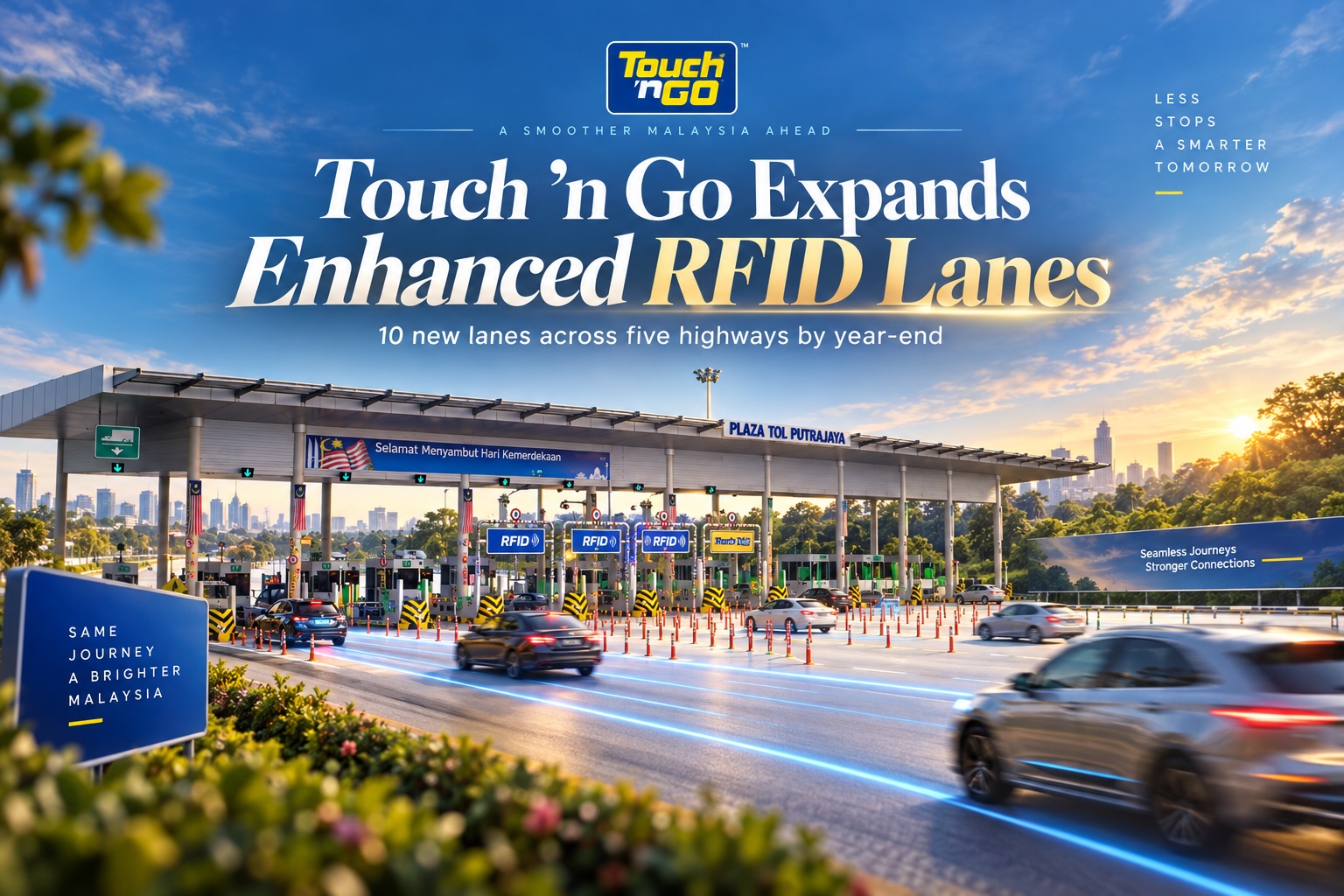
Touch 'n Go is expanding its Enhanced RFID network with 10 additional lanes across five Malaysian highways before the end of the year. The rollout is part of the company's wider effort to support Malaysia's move toward a Multi-Lane Free Flow (MLFF) tolling system, where vehicles can eventually pass toll points without stopping at conventional barriers.
The company believes its existing RFID infrastructure is already well positioned to support that transition. Touch 'n Go COO Liza Woon Yin Yin said the new lanes will provide more opportunities to refine the technology and demonstrate how it can operate in a faster, more barrier-free tolling environment.
Ten New Lanes Across Five Highways
The expansion will introduce two Enhanced RFID lanes at the Putrajaya Toll Plaza on the Maju Expressway (MEX), two at the Sungai Ramal Toll Plaza on the Kajang Dispersal Link Expressway (SILK), two at the Bukit Raja Toll Plaza on the Grand Sepadu Highway, and two at the Bukit Jelutong Toll Plaza on the Guthrie Corridor Expressway (GCE).
The remaining two lanes will be deployed on the East Klang Valley Expressway (EKVE), with one lane each at the Sungai Long and Ampang toll plazas.
Touch 'n Go currently operates only two Enhanced RFID lanes. These are located at the Ampang-bound Dato Keramat Toll Plaza on the Ampang–Kuala Lumpur Elevated Highway (AKLEH) and the Putrajaya-bound Putrajaya Toll Plaza on MEX.
That means the planned rollout represents a substantial expansion of the system within a relatively short period.
Enhanced RFID Is More Than a Standard RFID Lane
The new lanes differ from conventional RFID lanes because they use a more advanced detection setup. Each Enhanced RFID lane combines two RFID antennas with an Automatic Number Plate Recognition (ANPR) camera.
The additional RFID antenna allows the system to detect the vehicle from more than one direction, helping improve transaction accuracy and reliability. Meanwhile, ANPR provides another layer of vehicle identification by reading the number plate.
Touch 'n Go says the combination is intended to make toll transactions more dependable, especially as vehicles move through at higher speeds. This is important because conventional barrier-based tolling gives the system more time to confirm a transaction, while future MLFF systems are expected to operate without requiring vehicles to slow significantly.
Drivers Can Identify the Lanes by a Gold Star
Motorists will be able to distinguish Enhanced RFID lanes from ordinary RFID lanes through a gold star symbol displayed on the lane signage.
That visual marker should make the upgraded lanes easier to identify as the deployment expands to more toll plazas.
For drivers, the practical difference should be a smoother and more consistent drive-through experience. Touch 'n Go says the system is designed to feel closer to what motorists can eventually expect from full MLFF tolling.
A Step Toward Barrier-Free Tolling
Malaysia has discussed MLFF for years as part of efforts to modernise highway toll collection. Instead of requiring motorists to enter dedicated lanes and pass through physical barriers, MLFF is designed to identify and charge vehicles while they continue moving through an open road environment.
That can potentially reduce congestion around toll plazas because traffic no longer needs to funnel into narrow lanes or wait for barriers to open.
Enhanced RFID is not yet the full MLFF experience, but it provides an intermediate step. By testing faster detection, multiple antennas, ANPR and AI-assisted processing in existing toll environments, Touch 'n Go can gather operational experience before larger-scale barrier-free deployment.
Titan Flow Adds AI and Machine Learning
The Enhanced RFID lanes also incorporate elements from Touch 'n Go's locally developed Titan Flow technology stack.
Titan Flow combines RFID with artificial intelligence and machine learning to improve vehicle detection, transaction matching and lane throughput. Instead of relying on a single technology, the system uses several data points to improve the chances of identifying the correct vehicle and completing the correct toll transaction.
That multi-technology approach becomes increasingly important as vehicle speeds increase and traffic conditions become more complex.
A future MLFF system needs to identify multiple vehicles accurately without physical barriers separating them. Using RFID, ANPR and AI together provides a stronger foundation for that kind of environment.
Single Lane Fast Flow Is Also Being Tested
Touch 'n Go also showcased its Single Lane Fast Flow (SLFF) e-RFID technology during the MyASEAN Roads & Traffic Tech Expo 2026 at MITEC in Kuala Lumpur.
SLFF appears to sit between today's conventional toll lanes and the eventual MLFF model. It focuses on allowing vehicles to pass through individual lanes more smoothly while reducing the need for the stop-and-go behaviour associated with traditional toll booths.
The company also demonstrated its MLFF Titan Flow technology and a virtual reality experience showing how it envisions future mobility and tolling.
These demonstrations formed part of Touch 'n Go's 30th anniversary activities and highlighted how much the company's role has evolved from simple stored-value cards into a broader mobility and digital payments ecosystem.
Why Faster Toll Detection Matters
One of the biggest limitations of existing toll systems is the bottleneck created when traffic is forced into specific lanes.
Even RFID, which is already faster than stopping to tap a card, can still experience delays if detection fails or if vehicles need to slow significantly. A queue can form quickly during peak periods when just one or two transactions take longer than expected.
Adding secondary antennas and ANPR gives the system more opportunities to identify a vehicle correctly during the same pass.
If successful, that should reduce failed reads, lower the need for manual intervention and allow vehicles to maintain more consistent speeds through the tolling area.
More Lanes Will Provide Real-World Data
The addition of 10 lanes across several different highways should also give Touch 'n Go a much larger testing environment.
Different toll plazas experience different traffic volumes, vehicle mixes, lane geometries and driving behaviour. A system that performs well at one location may behave differently somewhere with heavier traffic or different road conditions.
Expanding Enhanced RFID across MEX, SILK, Grand Sepadu, GCE and EKVE will therefore provide more realistic operational data.
That experience could help refine the technology before it is eventually deployed on a much wider scale.
Malaysia's Tolling System Is Gradually Changing
The expansion also reflects a broader shift in how Malaysia approaches road payments.
Physical Touch 'n Go cards once dominated highway tolling, followed by SmartTAG and later RFID. Each generation reduced the amount of physical interaction required from motorists.
MLFF represents the next step because it aims to remove the toll barrier itself.
That transition will not happen overnight. The system needs reliable vehicle identification, accurate charging, enforcement mechanisms and strong coordination between highway concessionaires, payment providers and regulators.
Enhanced RFID lanes provide a practical way to test some of those building blocks while the wider infrastructure continues developing.
Final Thoughts
Touch 'n Go's plan to add 10 new Enhanced RFID lanes across five highways shows that Malaysia's move toward barrier-free tolling is gradually becoming more practical rather than remaining only a long-term concept.
The combination of dual RFID antennas, ANPR cameras and AI-powered Titan Flow technology is designed to improve detection accuracy and support faster vehicle movement through toll points. With more lanes operating across different highways, Touch 'n Go will also gain valuable real-world data before MLFF is introduced more broadly.
For motorists, the immediate benefit should be smoother and more reliable RFID transactions.
The bigger picture, however, is the gradual removal of the toll booth experience itself — moving from tap, to RFID, to eventually driving through without stopping at all.











Comments 0