

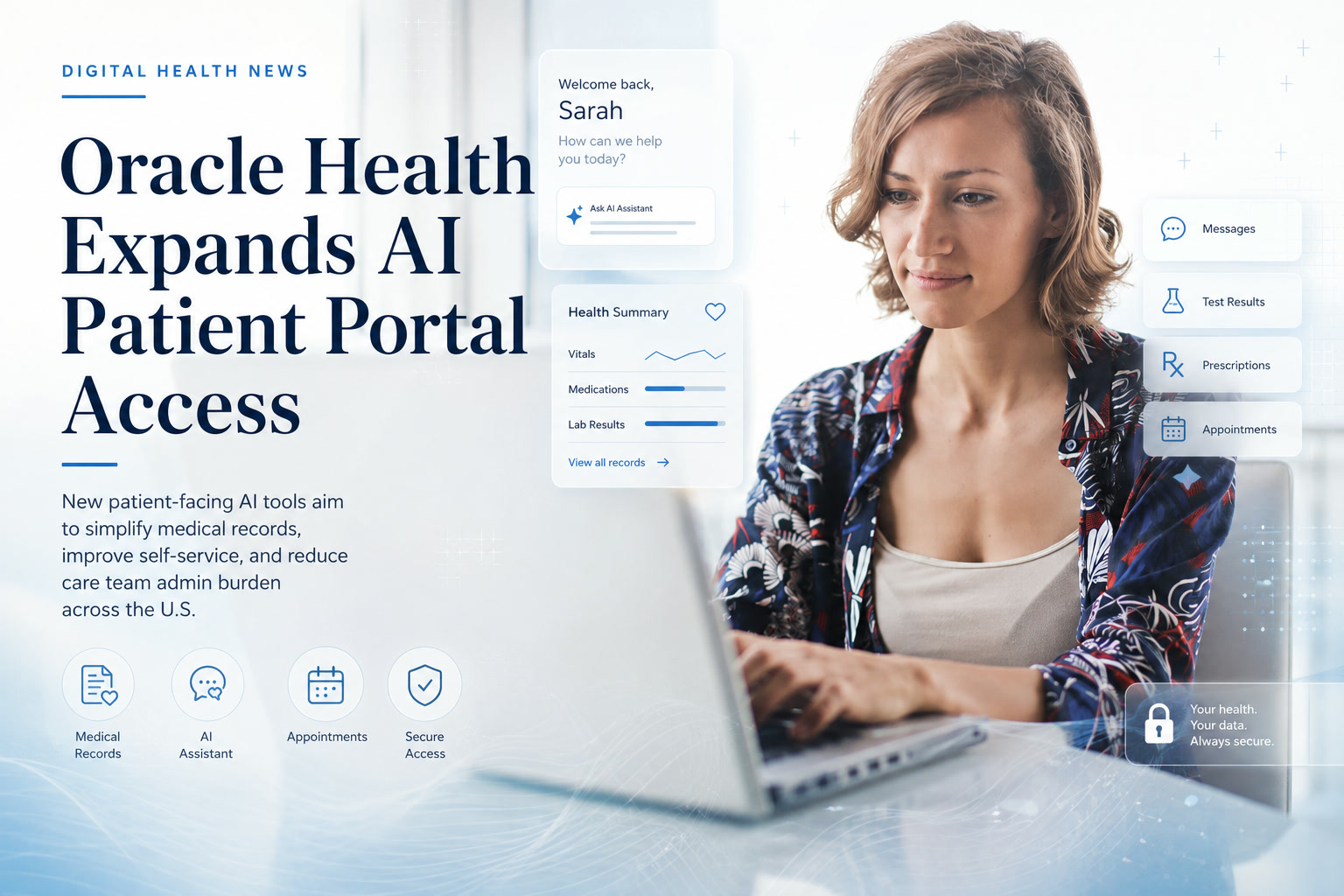
Oracle Health is expanding the role of artificial intelligence in patient engagement, making its AI-powered Patient Portal generally available to Oracle electronic health record customers across the United States.
The platform is designed to help patients better understand their own health information without forcing them to navigate pages of clinical terminology or repeatedly contact care teams for routine questions. Instead, patients can interact with AI directly within the portal to review information from their medical records, understand recent visits, track health trends and manage upcoming care.
For healthcare organisations, the technology could also reduce some of the administrative workload placed on clinical teams by allowing patients to handle more routine enquiries and scheduling tasks themselves.
At the centre of Oracle's approach is an important distinction: the AI is intended to explain and organise information already contained within the patient's health record, rather than act as a replacement for doctors or provide independent medical diagnoses.
AI Brings Medical Records Into Plain Language
Electronic health records contain an enormous amount of useful information, but much of it was originally written for healthcare professionals rather than patients.
Clinical terminology, laboratory values, medication information and diagnostic descriptions can be difficult to interpret without medical knowledge. Even when patients technically have access to their records, that does not necessarily mean the information is easy to understand.
Oracle Health's Patient Portal attempts to bridge that gap.
The AI can summarise information from a patient's health record and present it in more understandable language. This can include details from recent consultations, information about chronic illnesses, current medications and other relevant aspects of the patient's medical history.
Instead of simply displaying the raw clinical documentation, the portal can help explain what the information means in context.
That potentially makes the patient record much more useful as an active health-management tool rather than simply a digital archive of previous appointments.
Patients Can Ask Questions About Their Own Health Data
One of the more interesting capabilities is the ability for patients to ask questions based on information contained within their own electronic health record.
For example, a patient could ask how their cholesterol readings have changed over time, rather than manually comparing results from several laboratory reports.
Someone managing diabetes could ask about trends in their recorded measurements and receive a summary based on information already available within the EHR.
Patients may also be able to ask questions about diagnoses, laboratory tests, medications or treatment information documented by their healthcare providers.
This conversational approach changes how people interact with medical records.
Instead of learning how to navigate complicated menus and interpret isolated values, patients can ask a question in ordinary language and receive an explanation based on their existing health information.
The AI Can Help Patients Prepare for Their Next Appointment
Patient portals are often used primarily for checking appointments, viewing laboratory results or sending messages.
Oracle is trying to make the portal more proactive.
The system can remind patients about upcoming appointments and identify outstanding actions such as laboratory work, follow-up visits or recommended screenings.
That could be especially useful for people managing chronic illnesses, where healthcare often involves multiple tests and appointments over long periods.
A patient may leave a consultation with several instructions but forget some of them weeks later.
By using information already documented in the health record, the portal can surface those actions again when they become relevant.
This moves the patient portal closer toward being a digital care companion, rather than simply a place where medical records are stored.
Scheduling Can Become More Context-Aware
Oracle has also integrated AI into appointment scheduling.
Rather than requiring the patient to search manually through lists of clinicians and available time slots, the portal can use information about previous visits and existing care relationships to provide more relevant scheduling options.
For example, it may recommend clinicians who are already part of the patient's care team and then present suitable appointment times.
The AI can also interpret the context behind a scheduling request.
That may reduce some of the friction that often surrounds booking healthcare appointments, particularly in large organisations where patients may not know which department or clinician they should select.
If implemented effectively, this could make routine scheduling considerably easier while also reducing the number of calls directed toward administrative staff.
Reducing Routine Questions Could Give Care Teams More Time
The benefits are not limited to patients.
Healthcare organisations deal with significant volumes of routine enquiries every day.
Patients call or send messages asking about test results, medications, upcoming appointments, follow-up requirements and information already contained somewhere within the record.
Each question may be relatively simple, but collectively they consume a considerable amount of staff time.
By allowing patients to obtain understandable explanations through the portal, Oracle believes healthcare providers could reduce call volumes and general enquiries.
That does not eliminate the need for clinical communication.
Instead, it may allow doctors, nurses and administrative teams to spend less time repeatedly explaining basic information and more time handling questions that genuinely require professional judgement.
Patient Data Remains Within Oracle's Health Environment
Privacy is understandably one of the biggest concerns whenever AI is introduced into healthcare.
Oracle says patients' medical information remains within the electronic health record environment and is not stored outside Oracle's system or retained within third-party AI models.
That is particularly significant because generative AI normally works by sending information to models that process prompts and produce responses.
Healthcare data is fundamentally different from ordinary consumer information because it may contain diagnoses, medications, laboratory results and other highly sensitive personal information.
Oracle's approach is intended to allow AI capabilities to work with patient data without turning that information into material stored independently by external models.
For healthcare organisations considering patient-facing AI, this type of architecture is likely to be just as important as the conversational features themselves.
The Portal Is Designed to Explain, Not Diagnose
Oracle has also placed explicit limits around what the AI is allowed to do.
Patients may naturally be tempted to ask questions such as whether a particular symptom means they have a disease or whether they should change a medication.
The portal is not intended to answer those questions independently.
Oracle says guardrails prevent the AI from providing diagnoses, personalised medical advice or treatment recommendations.
Instead, when a patient's question requires professional medical judgement, the portal directs them back toward their healthcare provider.
For emergency situations, users are instructed to contact emergency services or visit the nearest emergency department.
This boundary is important.
There is a major difference between explaining information already documented by a physician and independently deciding what treatment someone should receive.
Oracle appears to be positioning its AI firmly on the first side of that line.
AI Transparency Is Built Into the Interface
Another important aspect of Oracle's approach is transparency.
AI-generated information inside the Patient Portal is visually identified rather than being presented as ordinary clinical documentation.
Oracle says AI-generated text is highlighted with a visual indicator and includes citations showing where the information came from.
That gives patients the opportunity to understand whether an explanation was generated by AI and trace it back to the underlying information within their medical record.
Oracle Health Executive Vice President and General Manager Seema Verma has previously compared this philosophy with being asked to "show your work" in mathematics.
The principle is straightforward: if an AI system provides an answer, users should be able to understand the evidence behind it.
This is especially important in healthcare, where a confident but incorrect AI response could have far more serious consequences than a mistake in an ordinary chatbot conversation.
Citations Could Help Build Patient Trust
Generative AI systems have become dramatically better at producing natural-sounding answers, but that fluency creates its own problem.
An incorrect explanation can sound just as confident as a correct one.
Providing source references gives patients another layer of context.
If an AI summary says that a patient's blood pressure has improved, for example, the user should ideally be able to see which recorded measurements support that conclusion.
Similarly, information about medications or chronic illnesses can be linked back to existing clinical documentation.
This does not guarantee that every AI-generated explanation will always be perfect, but it makes the system more transparent than a chatbot that simply produces an answer without showing where the information originated.
Oracle Has Been Building Toward Patient-Facing Generative AI
The wider release follows Oracle's earlier work on bringing generative AI into its healthcare ecosystem.
The company previously discussed plans to let patients use AI to prepare for medical appointments, understand health information and even draft messages to their care teams.
Those capabilities represent a broader shift in healthcare AI.
Much of the industry's early generative AI adoption focused on clinicians.
AI systems have been introduced to help create clinical notes, summarise medical encounters, draft documentation and reduce administrative burden.
Patient-facing AI represents the next stage.
Instead of using AI only behind the scenes, healthcare organisations are beginning to put conversational tools directly into patients' hands.
AI Could Change How Patients Engage With Their Records
Historically, patient portals have largely functioned as self-service gateways.
Users log in to check laboratory reports, view discharge summaries, request appointments or send messages.
The introduction of conversational AI changes that relationship.
Instead of navigating the medical record according to how the software is organised, patients can increasingly interact with it according to what they actually want to know.
A traditional portal might require someone to open multiple laboratory reports and compare values manually.
A conversational interface lets them ask about the trend.
A conventional scheduling system might require someone to search through departments.
AI can potentially understand the reason for the visit and provide more relevant options.
That shift from menu-driven interaction toward conversational interaction could eventually become one of the most significant changes to patient portals in years.
Better Understanding Could Improve Patient Engagement
Medical records are most useful when patients understand them.
If someone does not understand what a laboratory value means, simply giving them access to the number does not necessarily improve their care.
Plain-language explanations can potentially make patients more confident when discussing health issues with clinicians.
Patients may arrive at consultations with better questions because they have already reviewed their records.
Someone managing a chronic condition may also become more aware of trends over time rather than viewing individual results in isolation.
Oracle believes this improved understanding could also support better adherence to treatment plans.
The reasoning is simple: patients are generally better positioned to participate in their care when they understand what is happening and why particular follow-up actions matter.
AI Still Needs Strong Clinical Boundaries
There is nevertheless an important balance to maintain.
The more useful patient-facing AI becomes, the easier it may be for users to treat it as a medical authority.
A system capable of summarising diagnoses, explaining laboratory results and discussing chronic conditions can easily begin to feel like a virtual doctor, even when it is not intended to function that way.
That makes safeguards essential.
Patients need to understand the distinction between:
and actual clinical tasks such as:
The first group can potentially be supported by AI.
The second still requires qualified healthcare professionals.
The Bigger Opportunity Is Reducing Administrative Friction
Healthcare AI often attracts attention for its clinical possibilities, but some of its most immediate benefits may come from solving much simpler problems.
Healthcare systems contain enormous amounts of administrative friction.
Patients struggle to understand records.
Appointments have to be coordinated.
Routine questions generate phone calls.
Follow-up instructions are forgotten.
Care teams spend time answering questions that could potentially be resolved automatically.
Using AI to reduce these small inefficiencies could have a meaningful cumulative effect.
If thousands of routine questions can be handled through a patient portal, administrative staff have more time for complex cases.
If patients can understand laboratory results without repeatedly calling the clinic, nurses spend less time explaining basic information.
If scheduling becomes easier, fewer appointments may require manual intervention.
These improvements may not sound revolutionary individually, but at healthcare scale they can become significant.
Patient-Facing AI Could Become a Major EHR Battleground
Oracle is also operating in an increasingly competitive healthcare technology market.
Electronic health record vendors are investing heavily in generative AI, particularly as healthcare organisations search for ways to reduce clinician burnout and administrative workloads.
Much of the early competition has centred on physician-facing AI, including ambient documentation and clinical summarisation.
Patient-facing AI creates another area of differentiation.
Healthcare providers may increasingly evaluate EHR platforms not only by how well they support clinicians, but also by how effectively they help patients understand and manage their own care.
A portal that can intelligently summarise records, explain results and assist with scheduling could become a meaningful part of that decision.
Final Thoughts
Oracle Health's wider rollout of its AI-powered Patient Portal represents an important evolution of the traditional patient portal.
Rather than simply giving patients access to their medical records, Oracle is trying to make those records easier to understand, easier to navigate and more useful in everyday healthcare management.
Patients can ask questions about their own health information, review trends, receive reminders and obtain plain-language explanations drawn from their electronic health record. AI-assisted scheduling can also help connect them with appropriate clinicians and available appointment times.
Just as importantly, Oracle is placing boundaries around what the technology should not do. The AI is not intended to diagnose conditions or provide independent treatment recommendations, and its generated responses are visibly identified and linked to supporting sources.
For healthcare organisations, the potential benefit is equally significant. If AI can absorb part of the enormous volume of routine questions, appointment requests and administrative interactions that currently reach care teams, clinicians may have more time to focus on work that actually requires human expertise.
The most promising role for patient-facing AI may therefore not be replacing the relationship between patients and healthcare professionals.
It may be making that relationship easier to navigate by helping patients understand their information before they need to ask someone else to explain it.











Comments 0