

Artificial intelligence is moving so fast that every country is now asking the same uncomfortable question: should we depend entirely on foreign AI platforms, or should we build something that understands our own language, culture, rules, and digital future?
That is where ILMUchat enters the picture. On the surface, it may look like another AI chatbot. You type a question, it replies, and the conversation continues. But the bigger story is much more interesting. ILMUchat is being positioned as Malaysia's sovereign AI assistant, built to understand local language patterns, support national data control, and provide a foundation for developers and enterprises that want AI without sending everything through overseas systems.
Imagine typing something like, "Weh, open mic tonight cun tak? Let's lepak later," and the AI does not freeze, misunderstand the tone, or treat the sentence like badly written English. Instead, it understands that this is how Malaysians often communicate: casually, naturally, and sometimes with Malay, English, and Manglish blended together in one sentence.
That local fluency is the real selling point. ILMUchat is not only trying to answer questions. It is trying to understand Malaysia.
Why Sovereign AI Matters In The First Place
For years, most AI users have depended on models built and hosted by foreign technology companies. These systems are powerful, but they are usually trained and optimised around global datasets, English-heavy usage, and overseas infrastructure. That works well for many tasks, but it can feel less natural when the conversation becomes deeply local.
Malaysia has its own language habits, public sector terms, education system, cultural references, legal context, and everyday slang. A chatbot that performs well in American English may still struggle when asked to understand a Malaysian sentence that switches between Bahasa Malaysia, corporate English, and casual local expressions.
This is why sovereign AI is becoming more important. It is not only about national pride. It is about practical control.
A sovereign AI system can potentially offer:
• Better understanding of local language and mixed-language conversations
• Stronger alignment with Malaysian public sector and enterprise needs
• More confidence around data residency and privacy expectations
• Better support for local developers building regional applications
• A foundation for future AI services that are not fully dependent on foreign platforms
That is the bigger context behind ILMUchat. It is part of a wider conversation about whether AI should be treated as ordinary software, or as strategic digital infrastructure.
How ILMUchat Started
The groundwork for Malaysia's sovereign AI effort began on 12 December 2024, when YTL AI Labs released the early prototype engine known as Ilmu 0.1. This was the starting point for a larger AI ecosystem designed around Malaysian language, local context, and national infrastructure.
Over the following months, the project went through further fine-tuning, technical development, and research collaboration, including academic involvement from Universiti Malaya. That part matters because building a Malaysian AI model is not as simple as translating English prompts into Malay. A truly useful local AI system needs to understand how Malaysians actually think, write, ask questions, and mix languages in real life.
The public milestone came on 12 August 2025, when Prime Minister Datuk Seri Anwar Ibrahim officially launched the ILMU foundation model at the ASEAN AI Malaysia Summit. Then, on Malaysia Day, 16 September 2025, ILMUchat was introduced for early access as the conversational assistant built on top of that foundation.
The timing also gave the project symbolic weight. Launching a public AI assistant on Malaysia Day naturally reinforces the idea that this is not only a tech product, but part of a national digital direction.
Not Just A Foreign AI Model With A Malaysian Skin
One of the most important points about ILMUchat is that it is not being presented as a simple wrapper around a foreign chatbot API. Many AI products today are essentially front-end interfaces connected to models hosted by larger global providers. That approach is common, fast, and practical, but it does not really solve the sovereignty question.
ILMUchat is different because it is built around the ILMU foundation model ecosystem. It supports local language understanding, multimodal inputs, developer integration, and agentic workflows. It also maintains OpenAI-compatible APIs, which makes it easier for developers to connect existing applications to the platform without having to redesign everything from scratch.
That is a smart move. Developers are already familiar with OpenAI-style API patterns, so keeping compatibility lowers the barrier to adoption. In simple terms, ILMUchat is trying to offer local AI infrastructure without making developers start from zero.
The Technical Backbone Behind ILMUchat
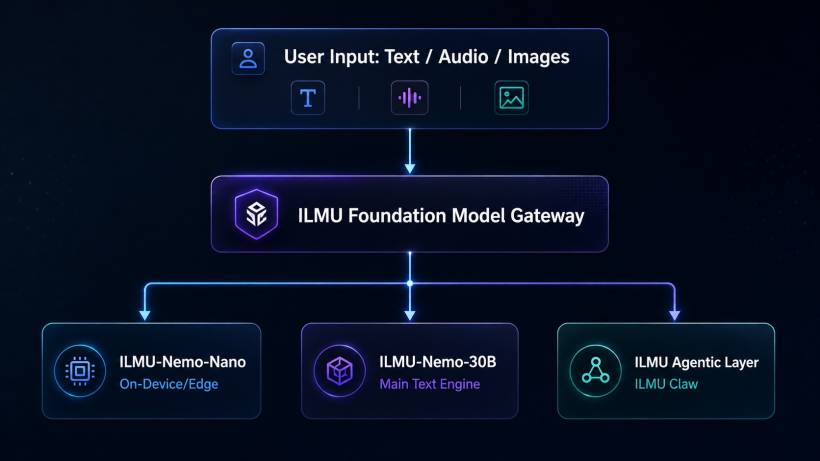
Behind the chatbot interface sits a broader AI ecosystem. ILMUchat is designed to handle different types of input, including text, audio, and images. These inputs are routed through a foundation model gateway, which then directs the request to the most suitable model or system layer.
At a high level, the ecosystem includes three major components:
• ILMU-Nemo-30B, the main text and reasoning engine
• ILMU-Nemo-Nano, the lightweight model for faster and smaller tasks
• ILMU Claw, the agentic layer designed to support more complex workflows
This layered approach is important because not every AI task needs the same amount of power. A quick search-style query, a document summary, a multilingual conversation, and a multi-step automation workflow all require different levels of processing.
By using different specialised components, ILMUchat can potentially balance performance, cost, speed, and capability more effectively.
ILMU-Nemo-30B: The Main Reasoning Engine
The main engine behind ILMUchat is ILMU-Nemo-30B, a 30-billion-parameter dense decoder-only model developed through collaboration with NVIDIA. This model is positioned as the primary workhorse for language understanding, reasoning, and advanced text generation.
The interesting part is not just the model size. It is the local optimisation. ILMU-Nemo-30B is designed to perform strongly in Malay-language and Malaysian-context benchmarks, including MalayMMLU. This matters because global AI models can be very impressive in English but still feel less precise when dealing with local language patterns or culturally specific topics.
For example, a Malaysian user may ask about government services, SPM-level education topics, local regulations, public sector terminology, or mixed-language business communication. These are areas where local training and evaluation can make a real difference.
A powerful AI model should not only sound fluent. It should understand the world its users live in.
ILMU-Nemo-Nano: The Lightweight Side Of The Ecosystem
While ILMU-Nemo-30B handles heavier reasoning tasks, ILMU-Nemo-Nano is designed for speed and efficiency. This smaller model is intended for lower-latency tasks, lightweight processing, edge use cases, and embedding-related workloads.
That may sound less exciting than a large language model, but lightweight AI models are extremely important in real-world applications. Not every AI interaction needs maximum intelligence. Sometimes, what matters most is speed, cost control, and responsiveness.
ILMU-Nemo-Nano could be useful for areas such as:
• Quick classification tasks
• Search and retrieval support
• Embedding generation
• Lightweight mobile or edge workflows
• Faster responses for simpler queries
For developers, having access to both large and small model options gives more flexibility. It allows them to choose the right tool for the right job instead of using a large model for everything.
ILMU Claw: Turning A Chatbot Into An Agent
The most interesting part of the ILMU ecosystem may be ILMU Claw, the agentic layer launched in April 2026. This is where ILMUchat moves beyond ordinary chatbot behaviour.
A normal chatbot responds to prompts. An agentic AI system can potentially plan tasks, call tools, read files, execute workflows, and complete multi-step actions. That changes the role of the AI from a text generator into something closer to a digital assistant.
For example, an agentic system could help with tasks like analysing documents, preparing structured reports, checking files, extracting important information, drafting responses, or triggering business workflows. The real value is not only in what the AI says, but in what it can help users do.
This is especially relevant for enterprises. Businesses do not adopt AI just because it can chat. They adopt it when it saves time, reduces manual work, improves consistency, or helps teams process information faster.
The Secret Ingredient: Understanding Malaysian Language Properly
One of the biggest technical challenges for ILMUchat is language tokenisation. Tokenisation is the process of breaking text into smaller units that an AI model can process.
Many global AI models are optimised mainly for English. When they encounter Malay words, local slang, or blended phrases, they may break them into awkward fragments. This can make processing less efficient and reduce the model's ability to understand the full context.
For example, phrases like "makan dulu gais," "cun tak," or "settlekan benda ni dulu" may look simple to Malaysians, but they can be messy for models that are not tuned for local language patterns.
ILMUchat's advantage comes from custom tokenisation designed around Malay root words, suffixes, and common Malaysian colloquial expressions. This helps the model process local language more efficiently and respond more naturally.
That matters because Malaysians rarely communicate in one perfectly standard language all the time. A typical work conversation might include formal English, Bahasa Malaysia, abbreviations, slang, and industry-specific terms in the same thread. A useful Malaysian AI assistant needs to handle that without losing the plot.
Local Context Is Just As Important As Local Language
Understanding words is only half the battle. The deeper challenge is understanding context.
A Malaysian AI assistant should understand local references, not just local vocabulary. It should be comfortable with national examinations, government services, common public sector language, Malaysian legal concepts, education pathways, local financial aid programmes, and everyday social expressions.
This is why local evaluation matters. The underlying ILMU engine has reportedly been tested against Malaysian educational and contextual benchmarks, including national examination-style material such as SPM and PT3. These tests are useful because they measure more than grammar. They test comprehension, reasoning, and familiarity with Malaysian knowledge structures.
That local grounding could make ILMUchat more useful in areas where global models sometimes feel too generic.
The Infrastructure Story: AI Running On Malaysian Ground
Another major part of ILMUchat's identity is infrastructure. Sovereign AI is not only about the model. It is also about where the system runs and how data is handled.
ILMUchat is positioned around Malaysia-based infrastructure, including YTL's Green Data Center Campus in Johor. The facility is linked with large-scale renewable energy capacity, including solar power. This gives the project an infrastructure story that connects AI development with local data hosting and energy planning.
For ordinary users, this may sound like background technical detail. For enterprises and government agencies, it is much more important.
Local infrastructure can support:
• Better data residency confidence
• Reduced reliance on foreign hosting environments
• Stronger alignment with national digital policy
• More control over compliance-sensitive workloads
• A clearer path for public sector and enterprise adoption
This is one of the main reasons sovereign AI is becoming a serious topic worldwide. AI is no longer just an app. It is becoming part of the digital foundation that organisations may depend on every day.
Data Privacy And The PDPA Question
Data privacy is one of the biggest concerns in AI adoption. Businesses want to know what happens to their prompts, uploaded files, internal documents, and customer data. Are they stored? Are they reused? Are they used to train future models? Are they processed overseas?
ILMUchat's positioning focuses on a strict separation between training and live usage. The idea is that training data is transformed into model weights during pre-training, while user inputs are handled at runtime and not automatically recycled into future baseline model training.
This is important in the Malaysian context because organisations need to consider the Personal Data Protection Act, or PDPA. For sectors like healthcare, finance, education, legal services, and government, AI adoption is not only about convenience. It is also about compliance, trust, and risk management.
A local AI system with clearer data boundaries could make adoption easier for organisations that are cautious about foreign-hosted AI tools.
Why Developers Should Pay Attention
For developers, ILMUchat could become more than just another chatbot platform. Its biggest opportunity is as a local AI infrastructure layer for Malaysian and Southeast Asian applications.
The OpenAI-compatible API structure is especially useful because it means developers may be able to experiment with ILMU without rewriting their entire application logic. This lowers friction and makes it easier to test local AI capabilities against existing workflows.
Possible developer use cases include:
• Customer service chatbots that understand local slang and formal Malay
• Internal enterprise assistants for HR, finance, or IT support
• Government service assistants with local terminology
• Education tools aligned with Malaysian learning contexts
• Document analysis systems for Malay and English content
• Agentic workflows using ILMU Claw for task automation
The key advantage is not just that ILMUchat can respond in Malay. The advantage is that it may understand Malaysian language behaviour more naturally than a general global model.
Why Enterprises May Care Even More
For Malaysian enterprises, the appeal of ILMUchat is not only technical. It is also operational.
Companies are under pressure to adopt AI, but many still worry about data leakage, compliance, staff misuse, inconsistent output, and unclear governance. A sovereign AI platform gives businesses another option, especially if they want AI capabilities while keeping data closer to home.
A bank may want AI that can handle compliance-sensitive documents. A hospital may want internal assistance without exposing patient-related content to foreign systems. A government-linked company may need stronger confidence around data residency. A customer support team may want an assistant that understands how Malaysians actually write.
These are practical needs, not just technical ambitions.
The Bigger Picture: AI As National Infrastructure
ILMUchat reflects a bigger shift happening around the world. Countries are starting to realise that AI may become as important as cloud computing, cybersecurity, digital identity, and telecommunications.
If a country depends entirely on foreign AI systems, it may eventually face challenges around pricing, access, regulation, data control, language coverage, and strategic independence. Sovereign AI projects are designed to reduce that dependency.
For Malaysia, ILMUchat represents an attempt to build a local AI ecosystem before the country becomes too dependent on external platforms. It may not replace every global AI tool, and it does not need to. Its real role may be to provide a trusted local alternative for use cases where language, compliance, and national infrastructure matter most.
Final Thoughts
ILMUchat is more interesting than it first appears. It is not just a chatbot that can speak Malay. It is part of a wider effort to build Malaysian AI infrastructure around local language, local data expectations, local developers, and local enterprise needs.
Its strength lies in the details: understanding Manglish, handling formal and casual Malay, supporting developer-friendly APIs, offering different model sizes, introducing agentic workflows through ILMU Claw, and positioning itself around Malaysian infrastructure.
Of course, the real test will come from usage. Developers will want good documentation. Enterprises will want reliability and clear privacy terms. Users will want fast, accurate, natural responses. Public sector users will want trust, governance, and long-term support.
If ILMUchat can deliver on those expectations, it could become an important part of Malaysia's AI future. Not because it is Malaysian for the sake of being Malaysian, but because it solves a real problem: AI needs to understand the people, language, and environment it is meant to serve.











Comments 0