

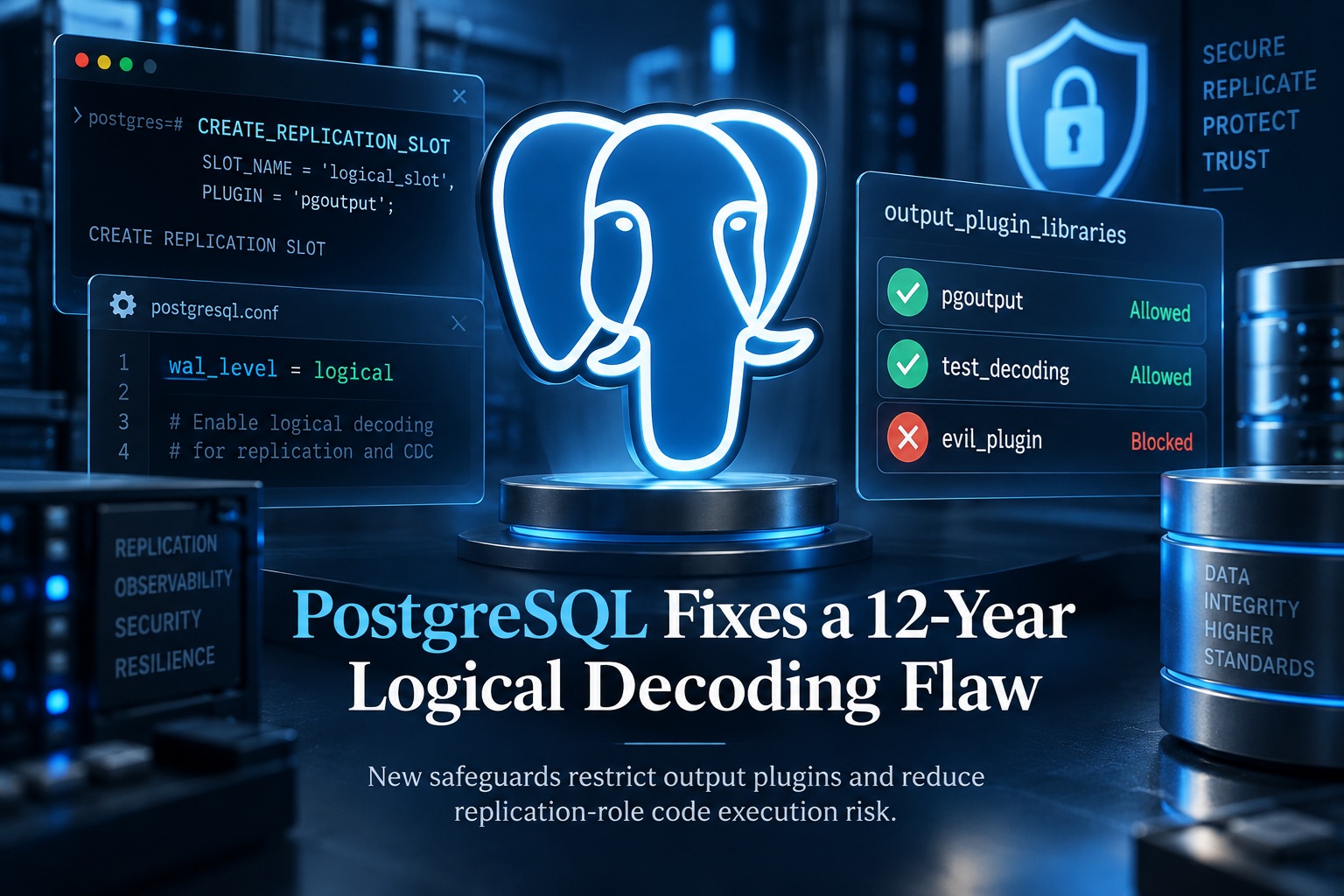
PostgreSQL has patched a long-standing security vulnerability in its logical decoding functionality that could allow an account with the REPLICATION attribute to execute arbitrary code under the operating-system account running the database server. The flaw, tracked as CVE-2026-6471 and rated 7.2 on the CVSS scale, dates back to the introduction of logical decoding in PostgreSQL 9.4 in 2014, meaning the vulnerable behaviour had remained in the software for roughly 12 years.
The issue affects PostgreSQL releases prior to 18.6, 17.11, 16.15, 15.19 and 14.24. Exploitation requires access to a PostgreSQL role that carries the REPLICATION attribute and a database configured with wal_level = logical. Although that requirement limits exposure, replication credentials are not particularly unusual in production environments because backup systems, standby servers, change-data-capture platforms and monitoring tools may legitimately need them.
Why the REPLICATION Role Became More Dangerous Than Expected
PostgreSQL separates privileges so that not every database account has full administrative control. A replication role is normally intended to handle tasks related to replication streams rather than act as a PostgreSQL superuser, which means organisations may have treated such credentials as relatively specialised service accounts.
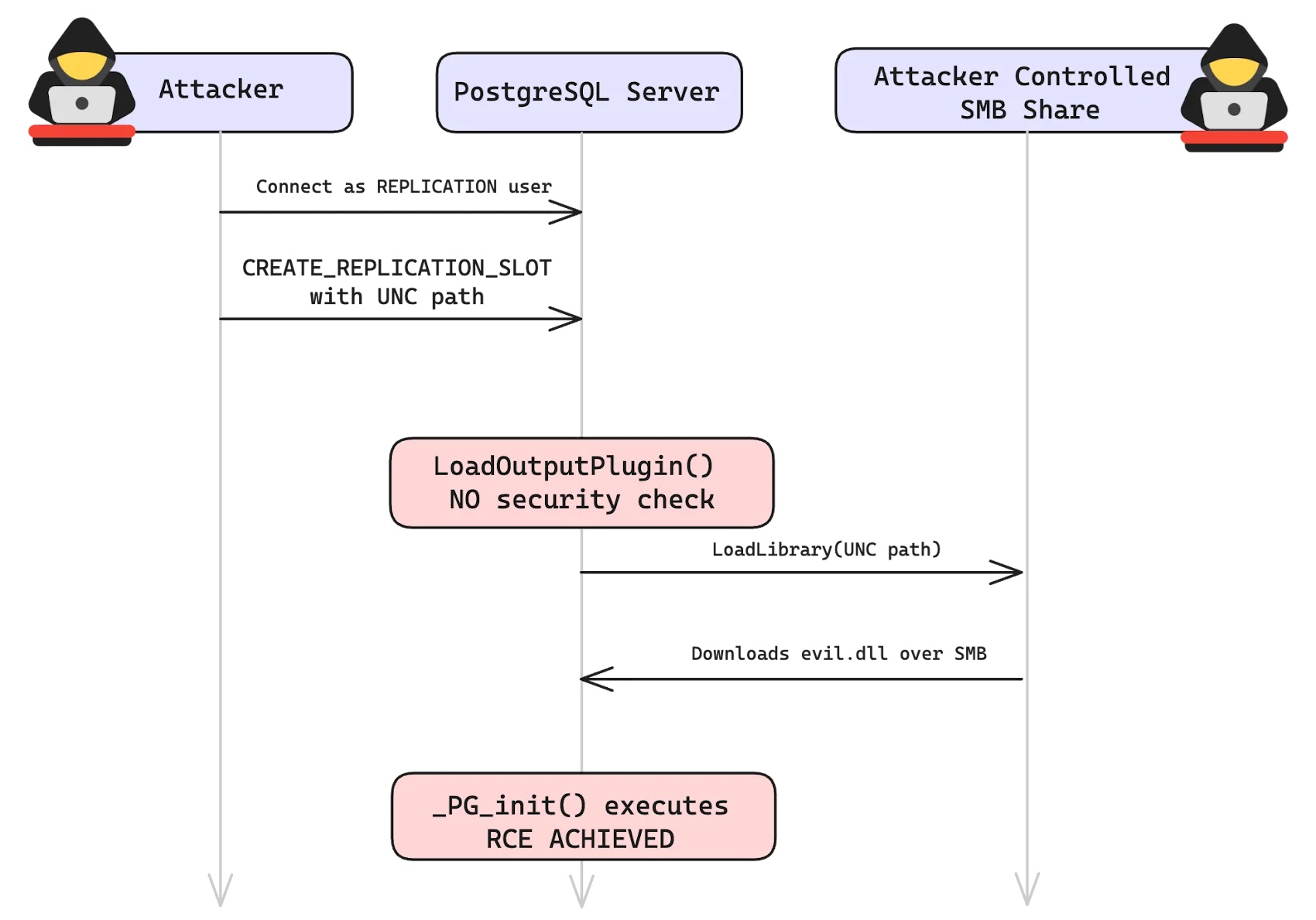
The vulnerability changes that assumption because logical decoding allowed a replication user to specify an output plugin that PostgreSQL would attempt to load. Under the vulnerable behaviour, restrictions that normally limit where non-superusers can load libraries were not consistently enforced along this particular replication path. As a result, a sufficiently positioned attacker with replication credentials could potentially cause the database backend to load unintended code.
Because that code would execute within the PostgreSQL backend process, it would run with the privileges of the operating-system account hosting PostgreSQL, typically the postgres user. This substantially increases the impact of compromised replication credentials because an attacker could move from database-level access into code execution at the server level.
The Vulnerability Has Been Named PostGREShell
Researchers at Cyera disclosed additional technical details about the flaw and refer to it as PostGREShell. PostgreSQL credited Vladimir Tokarev and Yu Kunpeng with reporting the issue, while Tokarev later published an analysis describing how the vulnerable logical decoding path differed from PostgreSQL's existing library-loading protections.
The underlying problem centres on how plugin names supplied during the creation of logical replication slots were handled. The replication protocol allowed values that could reference locations beyond the directory normally intended for loadable PostgreSQL extensions, meaning the existing safeguards applied elsewhere did not fully protect the logical decoding workflow.
The result was essentially a privilege-boundary problem. A capability intended to let replication users select approved logical decoding plugins could, under certain configurations, be abused to load code that an administrator never intended the account to access.
Windows Environments Could Face a Particularly Concerning Scenario
Cyera's testing found that the behaviour could be especially significant on Windows because library references could potentially resolve through network paths. In such a scenario, the PostgreSQL server could attempt to retrieve a library from an external SMB location rather than requiring the attacker to first place the file directly on the database server.
Linux and macOS deployments face somewhat different conditions, with remote loading generally depending on features such as NFS automounting or an existing ability to place a library on the server. The practical exploitability therefore varies considerably by operating system, network configuration and available services.
That difference is important when evaluating risk. CVE severity scores provide a useful general measurement, but the real-world impact for an organisation depends heavily on whether replication accounts exist, whether logical decoding is enabled and whether the database host can reach potentially dangerous network locations.
PostgreSQL Introduces an Explicit Output Plugin Allowlist
Rather than attempting to retrofit the existing LOAD restrictions directly onto logical replication, PostgreSQL introduced a new server configuration parameter called output_plugin_libraries. The setting explicitly defines which libraries are permitted to operate as logical decoding output plugins.
By default, PostgreSQL allows only:
Any additional logical decoding plugin must now be explicitly authorised by an administrator. This changes the model from allowing replication users to request broadly available libraries to requiring administrators to define which plugins are acceptable.
The PostgreSQL Global Development Group explained that this approach was chosen partly to avoid breaking the existing extension ecosystem more severely. Applying the ordinary LOAD restrictions retroactively would have required third-party logical decoding plugins to be installed under a different directory structure, potentially disrupting many existing deployments.
Third-Party Plugins May Need Configuration Changes After Updating
The new security boundary has an important operational consequence: organisations using plugins outside the default list may find logical decoding stops working immediately after the update. Popular examples include wal2json and decoderbufs, both of which are used in change-data-capture and data integration environments.
After upgrading, administrators need to add any required third-party plugin names to output_plugin_libraries. PostgreSQL will reject an unauthorised plugin and record an error in the server log explaining that the library may not be used as an output plugin and pointing administrators toward the new configuration setting.
This means the update is not necessarily a simple install-and-forget security patch for every environment. Database teams should first understand which logical decoding plugins their systems currently depend on so production replication or CDC pipelines are not unexpectedly interrupted.
Administrators Should Inventory Their Replication Slots Before Updating
PostgreSQL recommends checking active logical replication slots before applying the fix. One practical way is to query the replication-slot catalogue and identify the distinct plugin names already associated with existing slots.
That inventory matters because an organisation may have forgotten about a plugin installed years earlier or inherited through a third-party application. Updating without checking could result in a replication process suddenly failing when PostgreSQL refuses to load the previously accepted plugin.
A sensible upgrade workflow therefore includes identifying the plugins currently in use, upgrading PostgreSQL to a patched version, adding any legitimate non-default plugins to the new allowlist and then reloading the server configuration. PostgreSQL says a full restart is not required merely to apply changes to the new parameter.
Supported PostgreSQL Branches Have Received the Fix
The vulnerability has been addressed in the following supported releases:
Equivalent patched packages are also available through several major distributions and managed database platforms, including Amazon RDS, Debian, SUSE and Ubuntu. Organisations using vendor-packaged PostgreSQL should therefore check the advisory associated with their particular operating system or cloud service rather than relying solely on upstream version numbers.
Older unsupported PostgreSQL branches are not covered by the advisory. PostgreSQL 14 is also approaching the end of its support lifecycle, with security fixes scheduled to stop on 12 November 2026, giving organisations still running that branch another reason to begin planning an upgrade.
Distribution Guidance Is Not Completely Uniform
One complication is that different Linux distributions are presenting the fix somewhat differently. Debian explicitly warns that installations using certain extensions may require additional configuration changes and names packages such as wal2json and decoderbufs as examples.
Ubuntu's security notice for supported LTS releases focuses more heavily on installing the updated packages and restarting PostgreSQL, without placing the same emphasis on the new parameter. Administrators should therefore consult both the upstream PostgreSQL advisory and the documentation for the extensions they use rather than assuming their operating-system update notice contains every operational detail.
The wal2json project itself has updated its documentation to mention output_plugin_libraries and the CVE, reinforcing the point that third-party plugin compatibility is one of the main post-update considerations.
Database Upgrades Can Also Be Affected
The new configuration rule has implications for major-version upgrades as well. When migrating from PostgreSQL 17 or newer using pg_upgrade, the target cluster needs to permit the output plugins used by the existing logical replication slots before the upgrade check is performed.
If the required plugins are absent from output_plugin_libraries, the validation can fail even though the plugins themselves were working correctly on the previous installation. This is another example of why security changes can introduce operational side effects even when the underlying fix is relatively straightforward.
Database teams preparing major upgrades should therefore treat the new allowlist as part of their migration checklist, especially in environments with CDC pipelines or third-party replication tooling.
One Edge Case in the Fix Is Still Being Discussed
PostgreSQL developers have also identified a related usability issue involving pg_createsubscriber. The utility creates replication slots using the standard pgoutput plugin, but its dry-run behaviour does not currently validate the new allowlist in exactly the same way as the actual conversion process.
That can result in a situation where a dry run succeeds but the real operation later fails because the plugin is not allowed by the configuration. Fujitsu engineer Hayato Kuroda raised the inconsistency on the PostgreSQL development mailing list, arguing that the mismatch could surprise administrators.
As of 4 September, a corrective patch was under review but had not yet been committed. The issue does not recreate the original vulnerability, but it shows that introducing a new security boundary can expose secondary workflow problems that need to be cleaned up afterward.
There Was No Public Evidence of Active Exploitation as of 4 September
As of 4 September, CVE-2026-6471 had not been added to CISA's Known Exploited Vulnerabilities catalogue, and no public proof-of-concept exploit had been identified in widely available code repositories. That is useful context, but it should not be interpreted as a reason to delay patching.
The vulnerability has now been publicly documented, and the affected code path has existed for many years. Once sufficient technical detail is available, the likelihood of independent researchers or attackers reproducing the issue generally increases.
Organisations running logical replication should therefore approach the patch as preventive security work rather than waiting for evidence of widespread exploitation.
Replication Credentials Deserve More Careful Treatment
The flaw also highlights an important security lesson about specialised service accounts. Replication credentials are sometimes viewed as low-risk compared with full database administrators because they cannot normally perform the same range of SQL operations.
In practice, specialised privileges can still become extremely powerful when a vulnerability exists in the functionality they control. Backup software, CDC connectors and standby servers frequently operate with credentials that are rarely used interactively and may therefore receive less scrutiny than ordinary privileged accounts.
CVE-2026-6471 demonstrates why organisations should review these credentials periodically, restrict where they can connect from and remove privileges when they are no longer required.
Network Controls Can Reduce Exposure Before Patching
For systems that cannot be updated immediately, Cyera recommends several defensive measures to reduce risk. The most important is removing the REPLICATION attribute from accounts that do not genuinely need it, which reduces the number of credentials capable of reaching the vulnerable functionality.
Organisations can also restrict replication connections in pg_hba.conf so that only known systems and network addresses are authorised. Limiting outbound SMB and NFS access from database servers can further reduce the possibility of a database host retrieving unexpected libraries through network shares, while disabling unused automounting services removes another unnecessary path.
These measures should be treated as temporary risk reduction rather than substitutes for installing the patched PostgreSQL releases.
Self-Hosted Database Security Is About More Than SQL Permissions
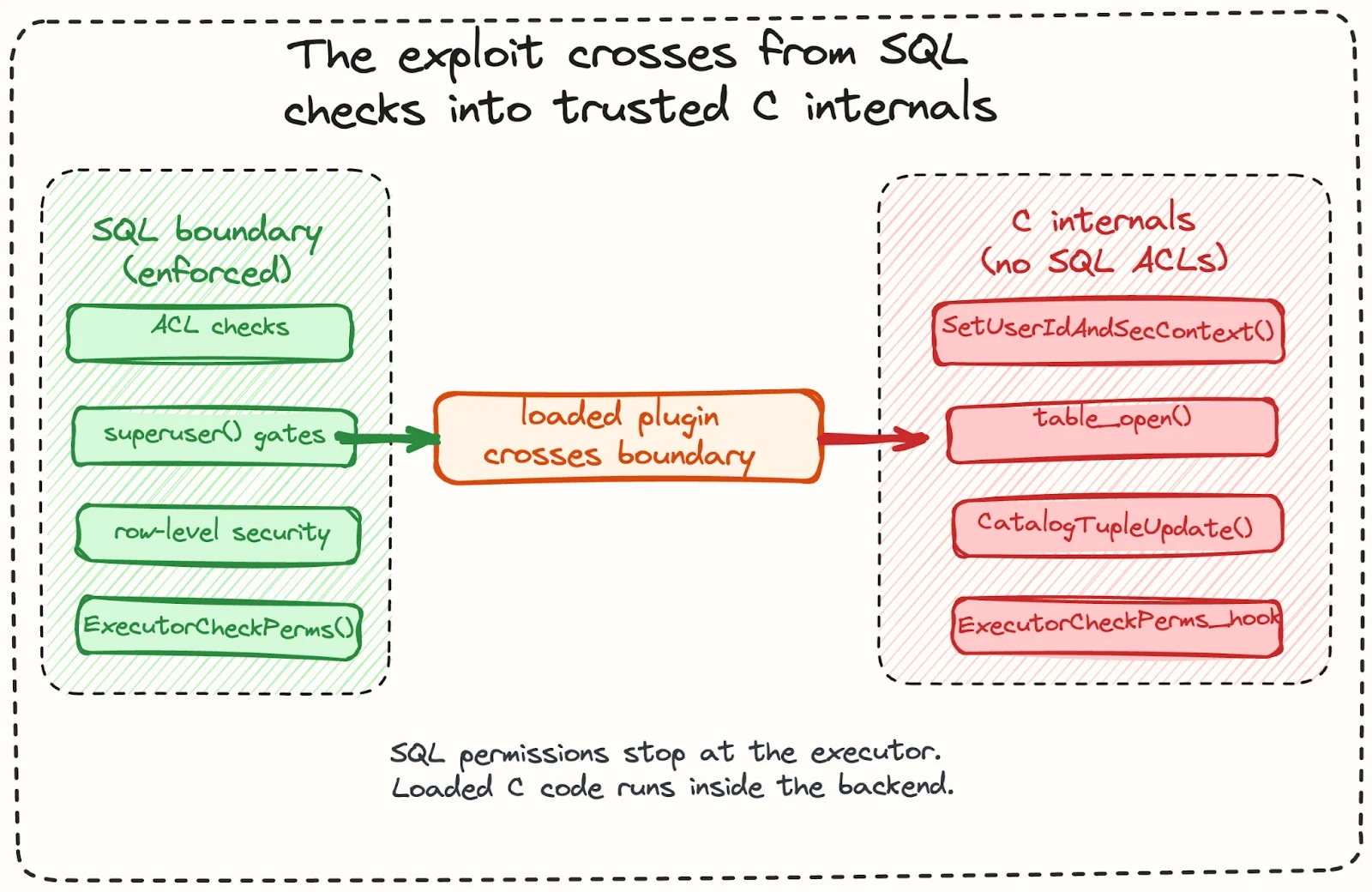
The vulnerability is also a useful reminder that database security cannot be considered separately from operating-system and network security. PostgreSQL may enforce strong role boundaries inside the database while still running as a process capable of accessing files, network resources and operating-system services.
Once an attacker manages to cross that boundary, the consequences extend well beyond the database. Source data, credentials, backup locations and other systems accessible from the database host may all become relevant.
For organisations running PostgreSQL on their own infrastructure, defence therefore needs to include database permissions, host hardening, outbound network restrictions, service-account management and monitoring for unusual replication behaviour.
Logical Decoding Has Become Critical Infrastructure for Modern Data Platforms
The reason this vulnerability matters to so many organisations is that logical decoding is no longer a niche PostgreSQL feature. It sits underneath many modern data architectures, particularly those involving real-time replication and change-data capture.
Platforms may use logical decoding to stream database changes into data warehouses, event systems, analytics platforms or search indexes. Backup products and migration tools may also rely on replication capabilities behind the scenes.
That means an organisation could be exposed without developers consciously thinking of themselves as using logical decoding. A third-party platform may have created the required replication role and slot as part of its installation process years earlier.
The New Allowlist Changes PostgreSQL's Trust Model
The most significant part of the fix is ultimately the introduction of an explicit trust boundary. Previously, PostgreSQL effectively trusted replication users with much broader freedom when selecting output plugins. The new configuration reverses that relationship by requiring administrators to declare what is allowed.
That is generally a stronger security model because it follows the principle of least privilege. A replication account should be able to use the plugins required for its job, but it should not automatically gain access to every library the server may potentially load.
The change may create some upgrade friction for administrators, but that inconvenience is the direct result of tightening a permission boundary that had remained unusually permissive for more than a decade.
Final Thoughts
CVE-2026-6471 is a significant PostgreSQL vulnerability not because anyone with database access can exploit it, but because it turns a specialised replication privilege into something far more powerful than administrators may have expected. In affected configurations, a compromised replication account could potentially cross from logical decoding into arbitrary code execution under the operating-system account running PostgreSQL.
The fix in PostgreSQL 18.6, 17.11, 16.15, 15.19 and 14.24 introduces the new output_plugin_libraries allowlist, giving administrators explicit control over which logical decoding plugins replication users can load. Organisations using third-party plugins should identify them before upgrading and ensure the necessary names are added to the configuration afterward.
The broader lesson is that longstanding functionality can acquire new security significance as infrastructure evolves. Replication accounts that once seemed narrowly privileged may now sit at the centre of backup, CDC and data integration pipelines with extensive access to production systems.
For PostgreSQL administrators, the priority is straightforward: inventory replication roles and logical decoding plugins, apply the patched release, explicitly allow only the plugins that are genuinely required, and tighten the network privileges surrounding database hosts wherever possible.











Comments 0