

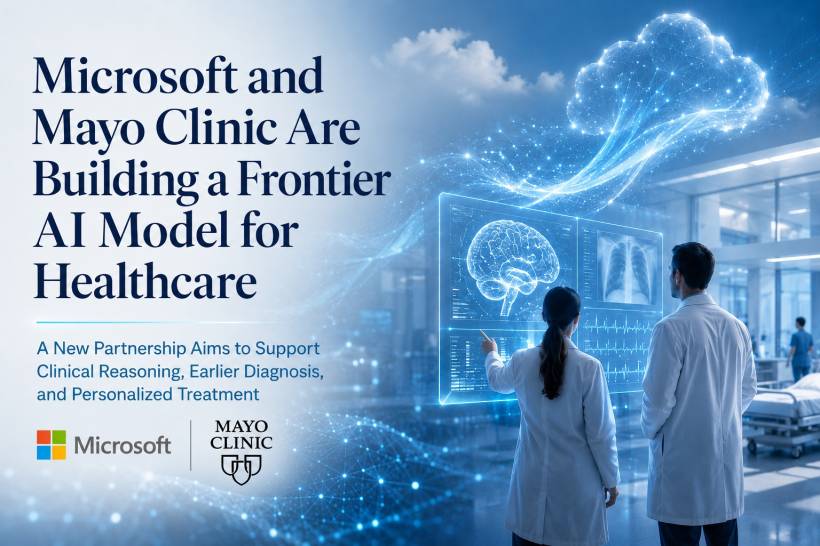
Microsoft and Mayo Clinic are working together on a new frontier AI model designed specifically for healthcare. The partnership brings together Mayo Clinic's clinical expertise and de-identified patient data with Microsoft's AI, cloud, engineering, and advanced computing capabilities.
The goal is ambitious but clear: build an AI model that can support clinical reasoning, help identify conditions earlier, and assist with more personalized treatment decisions. In other words, this is not just another generic AI chatbot being pushed into healthcare. It is intended to be a healthcare-focused model trained and refined around real clinical needs.
For a sector where accuracy, trust, and patient safety matter more than speed or hype, that distinction is important.
Why This Partnership Matters
Healthcare is one of the most promising areas for AI, but also one of the most sensitive. A general-purpose AI model may be useful for summarizing notes or drafting documents, but clinical reasoning requires a much deeper level of context.
Doctors do not make decisions based on one isolated data point. They look at history, symptoms, lab results, imaging, previous treatments, risk factors, and how a patient's condition changes over time. That is where longitudinal clinical data becomes valuable.
Mayo Clinic brings that healthcare depth to the partnership. Microsoft brings the AI infrastructure, engineering talent, cloud platform, and model development capabilities. Combined, the two organizations hope to create something that can support real-world healthcare workflows rather than simply sitting on top of them.
A Model Built Around Clinical Reasoning
According to the announcement, the AI model will combine Mayo Clinic's de-identified clinical data and long-term patient insights with Microsoft's AI technology. The model itself will be owned by Mayo Clinic, which is a significant detail because it places the healthcare institution at the center of the project.
The intended use cases include clinical reasoning, earlier diagnosis, and personalized treatment support. These are areas where AI could potentially help clinicians by identifying patterns, surfacing relevant information, and assisting with decision-making.
That does not mean AI will replace doctors. A more realistic view is that systems like this may become a support layer, helping clinicians process complex information faster and with more context.
In healthcare, even a small improvement in timing or clarity can matter. Earlier diagnosis can affect treatment options. Better personalization can reduce unnecessary interventions. Improved decision support can help clinicians make more informed choices.
Starting Inside Mayo Clinic First
The model will first be deployed within Mayo Clinic itself. This makes sense because healthcare AI needs careful testing before wider use. A controlled clinical environment allows the model to be evaluated, refined, and improved based on real-world usage.
This internal deployment stage is important. It gives Mayo Clinic the opportunity to study how the model performs in practice, how clinicians interact with it, and where the technology needs further adjustment.
Healthcare AI cannot be judged only by benchmark scores or lab testing. It must be tested against practical clinical realities, including workflow, safety, reliability, and whether it actually helps medical professionals.
By starting within Mayo Clinic, the model can be improved in an environment where clinical oversight and feedback are built into the process.
Eventually Coming to Azure Foundry APIs
While the model will initially be used inside Mayo Clinic, Microsoft is expected to make it available later through Azure Foundry APIs. This could eventually allow other healthcare organizations, developers, and clinical technology platforms to build healthcare AI solutions around the model.
That wider availability could be a major step if the model proves reliable and useful. Instead of every healthcare provider trying to build its own AI system from scratch, a healthcare-specific foundation model could become part of a broader ecosystem.
However, this also raises important questions around governance, data privacy, validation, and how the model will be used across different healthcare settings. A model developed and refined in one world-class institution may still need careful adaptation before being applied elsewhere.
Mayo Clinic's Larger AI Strategy
This partnership is not happening in isolation. Mayo Clinic has been steadily building its AI strategy for years.
The organization previously launched Mayo Clinic Platform, which focuses on using de-identified data to support healthcare innovation in a safe and patient-centered way. The idea is to move healthcare from a traditional pipeline model into a platform model, where data, tools, and collaboration can accelerate research and clinical improvement.
Mayo Clinic president and CEO Dr. Gianrico Farrugia described the new partnership as another step in bringing Mayo Clinic's expertise to more patients. His message is that AI can help extend clinical knowledge and improve care when it is built on a trusted data foundation.
That is the bigger picture here. The project is not only about creating one AI model. It is part of a longer effort to build digital healthcare infrastructure that can support new discoveries, better diagnosis, and more personalized care.
Previous Work With Microsoft and Cerebras
Mayo Clinic has already worked with Microsoft Research and AI chip company Cerebras on generative AI for healthcare. That earlier collaboration focused on accelerating diagnostic time and personalizing patient care.
The partners developed foundation models trained on multimodal radiology images, including CT scans and MRIs, along with genomic sequencing data from Microsoft Research.
That matters because modern healthcare data is not just text. It includes images, lab results, genetic information, clinical notes, medication history, and many other forms of structured and unstructured data. The more effectively AI can connect these different data types, the more useful it may become in clinical settings.
The new Microsoft and Mayo Clinic frontier model appears to build on that broader direction: AI that can reason across complex medical information rather than only summarizing documents.
Microsoft 365 Copilot in Healthcare
Mayo Clinic was also the first healthcare organization to deploy Microsoft 365 Copilot in 2023. That rollout focused more on productivity than direct clinical reasoning. The organization tested whether generative AI tools could help doctors, healthcare workers, and clinical staff improve everyday work processes.
This is another important part of the AI healthcare story. Not every healthcare AI use case needs to diagnose disease. Some of the earliest wins may come from reducing administrative burden, summarizing documents, preparing drafts, helping with communication, and freeing clinical staff from repetitive tasks.
Healthcare workers often face heavy documentation and coordination workloads. If AI can reduce some of that burden safely, it can indirectly improve patient care by giving clinicians more time and focus.
The Promise and the Caution
There is a lot of promise in healthcare AI, but it needs to be approached carefully. Medical decisions are high-stakes, and any AI system used in clinical environments must be tested thoroughly.
The potential benefits are clear:
• Faster access to relevant clinical information
• Earlier identification of possible conditions
• More personalized treatment support
• Better use of longitudinal patient data
• Reduced administrative workload for healthcare teams
• Stronger decision support for complex cases
At the same time, healthcare AI must deal with serious risks, including bias, hallucinations, overreliance, privacy concerns, and inconsistent performance across different patient groups.
That is why partnerships like this matter. A healthcare AI model should not be developed only by technologists. It needs deep clinical involvement, careful governance, and continuous real-world validation.
Final Thoughts
The partnership between Microsoft and Mayo Clinic signals another major step toward specialized AI models for healthcare. Instead of relying only on general AI tools, the focus is shifting toward models built with clinical context, healthcare data, and real patient care workflows in mind.
If successful, this model could support doctors with better reasoning tools, help detect conditions earlier, and contribute to more personalized care. But the real test will not be the announcement itself. It will be how safely and effectively the model performs in real clinical environments.
AI in healthcare should not be treated as a shortcut or replacement for medical expertise. Its best role is as a trusted support system that helps clinicians work with more information, more clarity, and better timing.
Microsoft brings the technology. Mayo Clinic brings the medical depth. If both sides get the balance right, this could become an important example of how AI can be developed responsibly for healthcare.











Comments 0