

A lot of people hear "health-tech" and picture futuristic gadgets that feel a bit far-off. But in Singapore right now, the focus is much more down-to-earth: tools that help patients recover function sooner, avoid invasive procedures, and catch disease earlier.
That's the idea behind Healthcare InnoMatch 2025, a global innovation challenge presented by Temasek Foundation and supported by Singapore's Ministry of Health. The winning start-ups are being set up to trial their solutions inside Singapore's three public healthcare clusters: NHG Health, National University Health System (NUHS), and SingHealth.
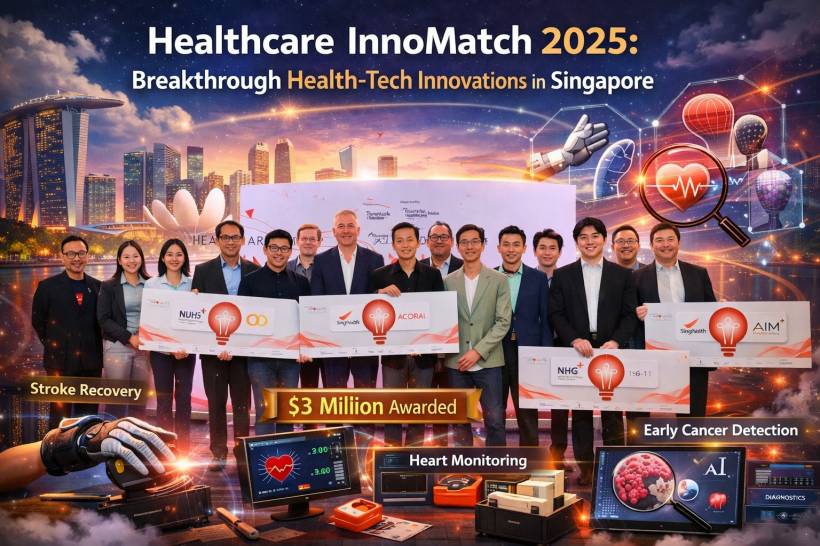
This year, the winners are sharing a total of $3 million to support real-world test-bedding of their technologies, from stroke rehabilitation to heart monitoring and early cancer detection.
Why These Trials Matter More Than "Cool Demos"
A pilot in a hospital isn't the same thing as a tech showcase. The point is to see whether an innovation:
• Fits into clinical workflows without creating extra chaos
• Produces evidence strong enough for wider adoption
• Can scale beyond a single department or hospital
Singapore is often described as an ideal test environment because it has strong healthcare infrastructure, robust data governance, and the ability to run pilots and scale-up quickly.
Since the challenge launched in 2021, the programme has supported multiple test beds across AI, robotics, and digital health, with thousands of patients benefiting across areas like mental health and diabetes.
Stroke Recovery: When "Small Movements" Become Big Wins
It's easy to forget how many daily tasks depend on fine motor control until you lose it.
Holding a spoon, lifting a cup of kopi, buttoning a shirt — for stroke survivors, these can be the exact movements that feel hardest to get back. That's why one of the standout innovations this year focuses on rebuilding the brain-to-body connection using a Brain-Computer Interface (BCI).
Lifescapes and BCI Therapy
Lifescapes, a Japanese start-up, developed a therapy built around neuroplasticity — the brain's ability to rewire and form new pathways. The concept is: if the brain can learn new routes, recovery may still be possible even years after stroke or spinal cord injury.
Here's how the approach is described:
• Those signals are reinforced and paired with mild electrical stimulation to nerves and muscles
• The system creates a feedback loop that helps "reconnect" intention, nerve activity, and movement
One highlighted example described a stroke patient who had been unable to open his hands for years, but regained the ability to unclench and grasp objects after just two weeks of therapy.
Clinical data referenced from Japan involved more than 900 patients, with many showing significant improvements in around two weeks — notably shorter than traditional multi-week rehab programmes.
Why It Could Change Rehab Outcomes
The value here isn't only medical, it's emotional too. Regaining the ability to do basic tasks can be a huge confidence boost, which can improve motivation and help recovery stick.
There's also a system-level impact: faster functional recovery can mean less time in hospital settings, earlier return to normal routines, and reduced long-term dependence on institutional care — which eases pressure on caregivers and healthcare resources.
Singapore Trial Plans
Lifescapes is set to work with National University Hospital (NUH) to optimise and validate the technology for Singapore's clinical setting, with the aim of meeting local standards and patient needs. The long-term goal is broader accessibility, including potential use in home or community-based rehabilitation.
Heart Care Without Needles: A Non-Invasive Alternative to Catheters
Heart failure monitoring often depends on accurate cardiac pressure readings. The problem is that the gold-standard method can involve catheterisation — invasive, time-consuming, and not something patients want to repeat frequently.
A Swedish start-up called Acorai is trying to make that step dramatically simpler.
Acorai's "On-the-Chest" Cardiac Pressure Measurement
The device is described as handheld and placed on the patient's chest for about four minutes. It uses a mix of sensors that capture multiple types of signals, including:
• Acoustic
• Visual
• Electric
Machine learning, trained on data from more than 2,000 patients globally, then produces readings quickly on a touchscreen — reportedly in a way that nurses or trained patients can use confidently.
Why That Matters in Practice
If non-invasive readings are accurate enough for real care decisions, the benefits are straightforward:
• Easier bedside or clinic monitoring
• Better chance of detecting issues earlier, before emergencies
• More flexible care, potentially reducing avoidable admissions
In Singapore, heart failure is described as a major health burden and a significant contributor to cardiac admissions, so anything that improves proactive monitoring has a clear role.
Singapore Trial Plans
Acorai has been paired with both NHG Health and SingHealth.
• Discussions are ongoing to potentially trial at the National Heart Centre Singapore under SingHealth
Clinicians involved emphasise that solutions like this can support right-siting of care (managing patients in more appropriate settings outside acute hospitals), reduce avoidable admissions, and fit into workflows without heavy disruption.
The Bigger Picture: Singapore as a Real-World "Proving Ground"
What ties these innovations together is not just clever engineering. It's the push to make care:
• Safer
• Less invasive
• More accessible
• Easier to integrate into everyday hospital operations
And importantly, the programme's intent is that if the trials show meaningful patient benefit, the solutions should be made accessible broadly — not only to those who can afford premium care.
Final Thoughts
What's happening here is a good reminder that meaningful healthcare innovation doesn't always look dramatic. Sometimes it's the difference between a patient being able to hold a spoon again, or a heart failure patient being monitored without needles and sedation.
Healthcare InnoMatch 2025 is basically taking promising ideas and putting them where they matter most: into real clinics with real patients, where evidence, workflow fit, and outcomes decide what stays.











Comments 0