

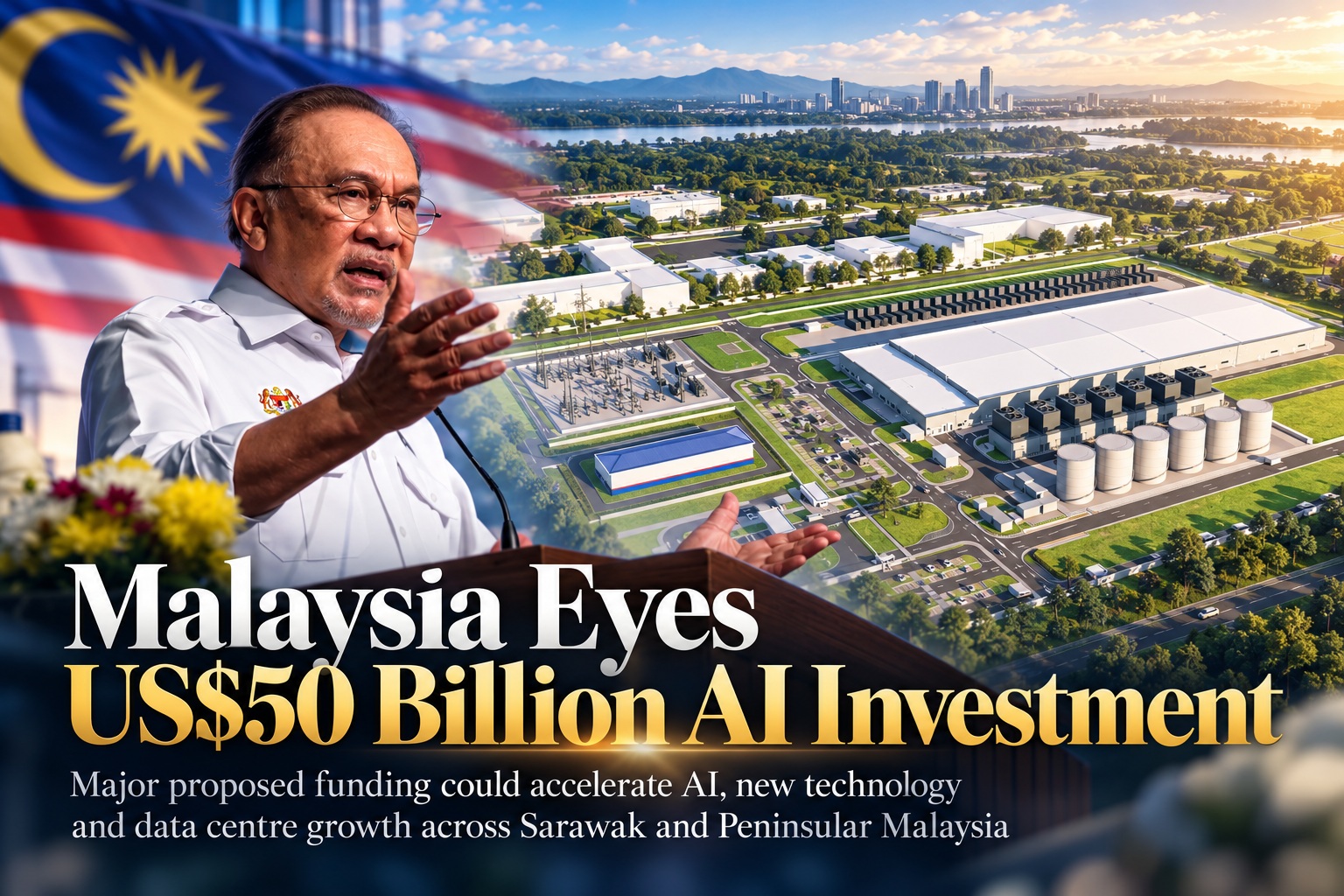
Malaysia could be on the verge of securing one of the largest technology investments ever announced in the region, after Prime Minister Datuk Seri Anwar Ibrahim revealed that an unnamed global investor is planning to invest US$50 billion, or roughly RM204 billion, into the country's artificial intelligence, advanced technology and data centre sectors. The proposed investment is expected to cover both Kuching in Sarawak and locations across Peninsular Malaysia, although the identity of the investor has not yet been disclosed.
Global Investor Plans Massive US$50 Billion AI And Data Centre Investment In Malaysia
Malaysia could be on the verge of securing one of the largest technology investments ever announced in the region, after Prime Minister Datuk Seri Anwar Ibrahim revealed that an unnamed global investor is planning to invest US$50 billion, or roughly RM204 billion, into the country's artificial intelligence, advanced technology and data centre sectors. The proposed investment is expected to cover both Kuching in Sarawak and locations across Peninsular Malaysia, although the identity of the investor has not yet been disclosed.
Anwar said the investor communicated its intention during a video conference with him last Tuesday. He described the proposed commitment as one of the biggest in the region and said it could create significant new employment opportunities, particularly for younger Malaysians preparing to enter the workforce.
Investment Could Span AI, Data Centres And New Technology
The planned US$50 billion commitment is expected to cover several major technology segments rather than focusing on a single development. These include AI infrastructure, data centres and other emerging technologies that are becoming increasingly important to Malaysia's digital economy.
The scale of the proposed investment immediately places it far above most individual technology projects announced in Malaysia so far. If fully realised, it could significantly expand the country's computing infrastructure while strengthening Malaysia's position as a regional hub for AI, cloud services and data-intensive industries.
At this stage, however, there are still many unanswered questions. The investor has not been identified, specific project locations have not been announced and there is no detailed timeline for when the investment would be deployed.
Kuching And Peninsular Malaysia Are Expected To Benefit
Anwar indicated that the investment would include Kuching, Sarawak, as well as areas in Peninsular Malaysia. This suggests the development could involve multiple sites rather than one enormous data centre or technology campus.
Sarawak has increasingly attracted interest from technology and energy-intensive industries because of its access to renewable energy and available land. Peninsular Malaysia, meanwhile, already hosts a rapidly expanding concentration of data centre projects, particularly in Johor, Selangor and the Greater Kuala Lumpur region.
A multi-location investment would allow the investor to take advantage of different regional strengths while spreading infrastructure and employment opportunities across more than one part of the country.
Investor Identity Remains Unknown
The identity of the company behind the planned US$50 billion investment has not been revealed. Given the scale involved, speculation will naturally focus on major global technology companies with the financial capability to support such a large programme.
Meta is one possible name that may come to mind, although there is currently no confirmation linking the company to the announcement. It is equally possible that the investment could involve another global hyperscaler, semiconductor company, AI infrastructure provider or an expansion by a company that already has operations in Malaysia.
Until the government or investor provides further details, any attempt to identify the company remains purely speculative.
Malaysia Has Already Attracted Billions From Global Tech Giants
The proposed investment would add to a growing list of major technology commitments already announced in Malaysia. Several of the world's largest technology companies have committed billions of dollars to cloud infrastructure, AI platforms and data centre developments in recent years.
Oracle, for example, has committed around US$6.5 billion, or RM26.6 billion, to establish a public cloud region in Malaysia. Amazon Web Services has separately pledged approximately US$6.2 billion, or RM25.4 billion, to expand its cloud and data centre infrastructure in the country.
These investments reflect growing demand for computing infrastructure as companies increasingly move workloads to the cloud and adopt more data-intensive AI applications.
NVIDIA And YTL Are Building AI Infrastructure In Johor
NVIDIA has also become a major participant in Malaysia's technology expansion through its partnership with YTL Power International. The companies are developing AI infrastructure and data centre capacity in Johor under a project valued at approximately US$4.3 billion, or RM17.6 billion.
The initial phase alone is reportedly worth around US$2.36 billion, or RM9.7 billion. The project is expected to provide advanced AI computing infrastructure that can support model development, enterprise workloads and other high-performance applications.
Johor has emerged as one of the most important locations for data centre investment in Southeast Asia, benefiting from its proximity to Singapore, relatively large land availability and access to infrastructure.
Microsoft Has Committed US$2.2 Billion
Microsoft is another major technology company expanding its presence in Malaysia. The company has announced an investment of approximately US$2.2 billion, or RM9 billion, to develop new cloud and data centre infrastructure.
These facilities are expected to support Microsoft's growing cloud operations and AI services in the Malaysian market. Local infrastructure allows businesses to access cloud platforms with lower latency while also helping organisations meet regulatory and data residency requirements.
The investment forms part of a broader regional strategy as Microsoft increases infrastructure spending throughout Southeast Asia.
ByteDance Continues Expanding Local Digital Infrastructure
ByteDance has also invested heavily in Malaysia's digital infrastructure. The company has committed more than US$2.1 billion, with the reported value exceeding RM29.5 billion, to expand local digital and data infrastructure.
The TikTok owner has been steadily increasing its infrastructure footprint as demand for video processing, content delivery and AI-related computing grows. Malaysia's location and expanding data centre ecosystem make it an increasingly attractive destination for these workloads.
Large investments from companies such as ByteDance also demonstrate that Malaysia's data centre growth is not limited exclusively to traditional cloud providers.
Google Is Building Its First Malaysian Data Centre And Cloud Region
Google parent Alphabet has committed an initial US$2 billion, or approximately RM8.2 billion, to establish its first Malaysian data centre and Google Cloud region at Elmina Business Park in Greater Kuala Lumpur.
The project represents a significant milestone for Google's local infrastructure strategy. A domestic cloud region gives Malaysian businesses and government organisations greater access to Google Cloud services while potentially improving performance and supporting local data requirements.
Google has also been linked to additional infrastructure developments in Port Dickson, indicating that its Malaysian investment could eventually expand beyond the initial Elmina project.
Malaysia Is Becoming A Regional Data Centre Hub
The sheer number of large projects announced over the past few years has transformed Malaysia into one of Southeast Asia's fastest-growing data centre markets. Johor has attracted particularly strong interest, but investments are increasingly spreading into other states and regions.
Several factors have contributed to this growth, including relatively competitive operating costs, available land, improving connectivity and proximity to Singapore. Malaysia also offers a rapidly expanding ecosystem of telecommunications, energy and technology services needed to support large-scale data centre operations.
The proposed US$50 billion investment would significantly accelerate that trend if it proceeds as announced.
AI Demand Is Driving Infrastructure Investment
Artificial intelligence is one of the biggest factors behind the current global expansion in data centre construction. Training and operating modern AI models requires enormous amounts of computing power, particularly specialised GPU infrastructure.
This has increased demand for advanced data centres capable of supporting high-density computing environments. Traditional enterprise workloads may operate comfortably with conventional server infrastructure, while large AI clusters can require significantly higher power, cooling and network capacity.
Malaysia's ability to attract AI-focused infrastructure will therefore depend not only on investment incentives but also on whether the country can provide enough electricity, water, connectivity and technical expertise.
Anwar Says Young Malaysians Should Prepare For New Opportunities
Anwar said the proposed investment could generate significant employment opportunities for Malaysians, particularly younger people currently studying in schools, colleges and universities. He encouraged students to prepare themselves for the kinds of jobs emerging from AI, digitalisation and advanced technology investments.
The employment opportunities created by large technology projects can extend well beyond traditional software development. Data centres require engineers, networking specialists, cybersecurity professionals, electrical technicians, mechanical engineers and operations teams.
AI projects also require expertise in areas such as data engineering, machine learning, cloud architecture and specialised hardware.
Skills Development Will Be Critical
Attracting billions of dollars in technology investment is only part of the challenge. Malaysia also needs a sufficiently skilled workforce capable of filling the higher-value jobs these projects create.
Anwar emphasised the importance of workforce training and skills development if Malaysia wants to move further up the technology value chain. The country has historically been strong in areas such as semiconductor manufacturing, testing and packaging, but the government wants more Malaysians involved in higher-value activities.
These include chip design, AI development, cloud engineering, advanced manufacturing and other middle- and front-end technology functions.
Malaysia Wants To Move Beyond Back-End Technology Work
Malaysia already has decades of experience in electronics and semiconductor manufacturing, but much of that activity has traditionally focused on backend processes. These roles remain economically important, but design, research and advanced engineering generally offer higher value and stronger intellectual property opportunities.
The government has increasingly promoted initiatives aimed at expanding local capabilities in semiconductor design, AI and digital technology. Partnerships with companies such as Arm are intended to help accelerate this transition.
Large AI and data centre investments could complement those efforts by creating more demand for high-skilled technology roles within Malaysia.
Technology Investments Must Create Real Benefits For Malaysians
Anwar also stressed that investment figures alone should not be considered the ultimate measure of economic success. Large projects need to create tangible benefits for Malaysians through better jobs, higher incomes and improvements in living standards.
This distinction is important because data centres can involve enormous capital expenditure while creating fewer direct jobs than labour-intensive industries. Governments therefore need to ensure that surrounding industries, local suppliers and technical workers also benefit from the investment.
Training programmes, local procurement and partnerships with Malaysian companies can help increase the wider economic impact.
Data Centre Expansion Also Creates Infrastructure Challenges
While large data centre investments bring significant economic opportunities, they also create challenges involving electricity and water consumption. Modern AI facilities can consume enormous amounts of energy because thousands of high-performance processors need to operate continuously.
Malaysia has already begun examining how large energy users such as data centres should contribute towards electricity costs. The government has discussed potential user-pay tariff structures that could differentiate major industrial consumers from ordinary households.
Future projects will therefore need to balance rapid industry growth with sustainable energy planning.
Sarawak Could Offer An Energy Advantage
Including Kuching in the proposed investment could be particularly interesting because Sarawak has substantial renewable energy resources, especially hydropower. Access to relatively abundant renewable electricity could make the state attractive for power-intensive AI infrastructure.
Global technology companies are under increasing pressure to reduce the environmental impact of data centre operations. Locations capable of providing reliable lower-carbon electricity may therefore become more competitive.
If Sarawak can combine energy availability with improved international connectivity and skilled talent, it could potentially become another important Malaysian data centre location.
US$50 Billion Would Be On A Completely Different Scale
The proposed US$50 billion investment is extraordinary when compared with other individual technology commitments already announced in Malaysia. It is several times larger than Oracle's US$6.5 billion plan and AWS's US$6.2 billion expansion.
That does not necessarily mean the entire amount would be spent immediately. Large infrastructure investment announcements are often spread across many years and multiple phases, depending on demand and project progress.
Even so, the scale would make it one of the most significant technology investment programmes Malaysia has ever attracted.
More Details Will Be Needed Before The Full Impact Is Clear
For now, several important questions remain unanswered. The identity of the investor, exact locations, project phases, construction timeline and expected number of jobs have not been disclosed.
It is also unclear how much of the proposed US$50 billion will go directly towards physical data centre infrastructure versus AI platforms, cloud services or other advanced technology projects.
Further announcements will therefore be necessary before the economic and infrastructure implications can be properly assessed.
Final Thoughts
The proposed US$50 billion, or roughly RM204 billion, investment in Malaysia's AI, advanced technology and data centre sectors could become one of the largest technology commitments ever announced in the region. With projects expected to cover Kuching and Peninsular Malaysia, the investment could significantly strengthen the country's position as an emerging Southeast Asian digital infrastructure hub.
Malaysia has already attracted billions from Oracle, AWS, NVIDIA, Microsoft, ByteDance and Google, showing that global technology companies increasingly see the country as an important location for cloud and AI infrastructure. The new proposal, however, would operate on an entirely different scale.
The identity of the investor remains unknown, so speculation about which technology giant may be involved should be treated cautiously until additional information is released. What is clear is that Malaysia is rapidly becoming part of the global competition for AI infrastructure and advanced computing investment.
The bigger challenge will be making sure that this growth translates into something meaningful for Malaysians. New data centres and AI infrastructure are valuable, but the long-term success of these investments will ultimately depend on whether they create high-skilled jobs, strengthen local technology capabilities and improve living standards rather than simply adding another impressive number to the country's investment statistics.











Comments 0