

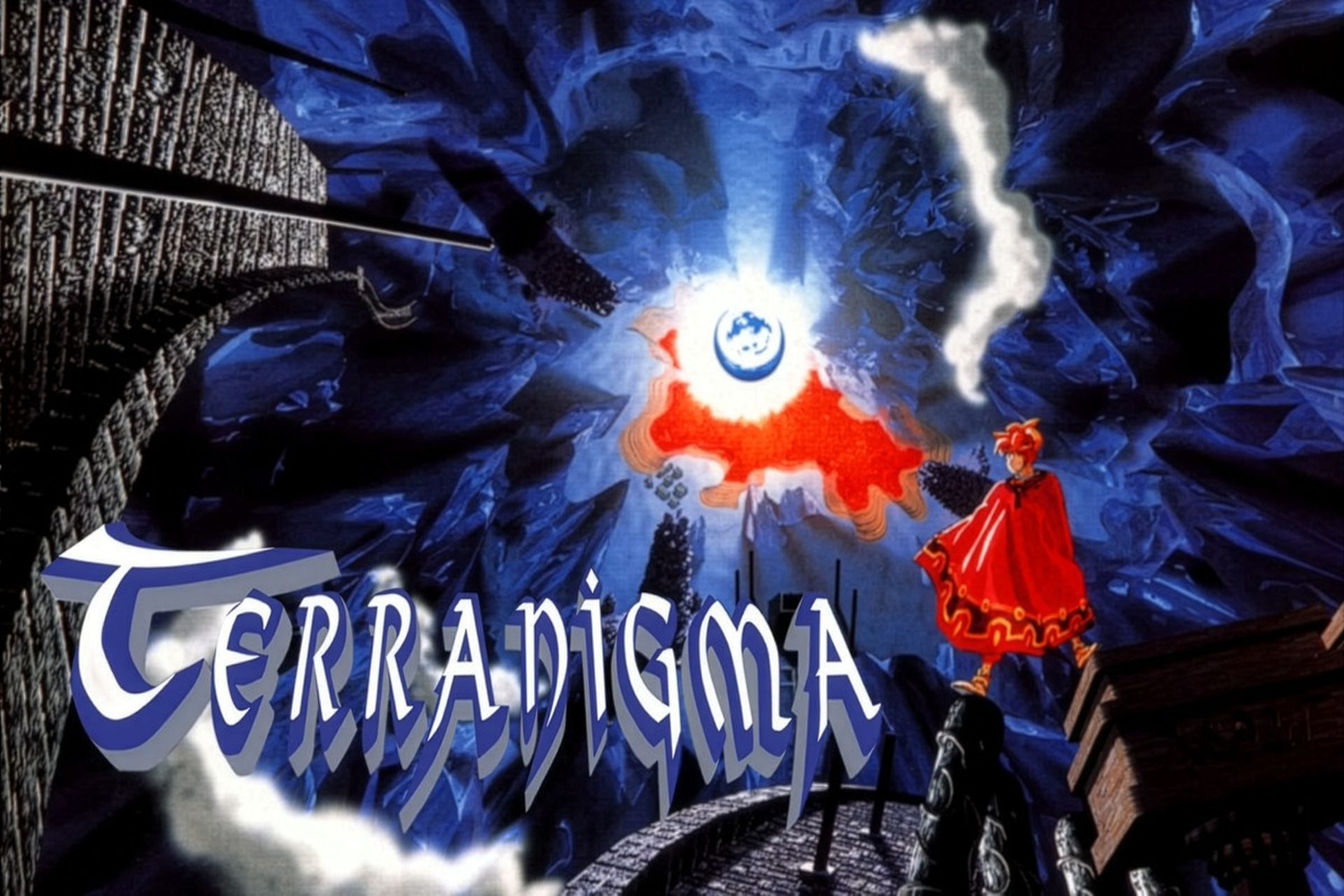
Terranigma begins with a deceptively small premise: a restless young man named Ark lives in the isolated village of Crysta, a peaceful settlement hidden deep within an underworld where seemingly nothing ever changes. That quiet existence ends when Ark opens a forbidden door and discovers a mysterious box, triggering events that freeze many of Crysta's inhabitants and force him to leave the village in search of a solution. What follows is far larger than a simple rescue mission, eventually becoming a journey about restoring continents, reviving nature, rebuilding human civilization, and confronting the forces responsible for shaping the world itself. Few action RPGs from the 16-bit era attempt anything on quite the same scale.
Developed by Quintet and originally released in 1995, Terranigma combines fast real-time combat with exploration, environmental puzzles, character progression, town development, and a surprisingly philosophical storyline built around cycles of creation and destruction. Ark travels from the underworld to the surface, watching the planet gradually return to life as plants, animals, and humanity are resurrected. Entire towns can evolve because of the player's actions, while optional quests encourage revisiting earlier locations long after their immediate story purpose has been completed. The result is an adventure where progression is not limited to Ark becoming stronger—the entire world visibly changes around him.
Now playable online through Lemon Web Games, Terranigma brings Ark's remarkable journey of restoration directly into the web browser, allowing players to experience its real-time battles, expansive exploration, evolving settlements, atmospheric soundtrack, and emotional story without relying on the original console hardware. Players can travel between the underworld and the revived surface, explore ruins and dungeons, develop towns, uncover optional events, and gradually piece together the truth behind Ark's role in the world's resurrection. The browser-playable experience provides an accessible way to discover one of the most acclaimed action RPGs of its generation, particularly for players who never encountered it during its original release. Terranigma remains a game where every major accomplishment feels connected to something much larger than defeating another boss.
Ark Begins as an Unlikely Hero
Ark is not introduced as a noble warrior, chosen prince, or legendary adventurer. He is a mischievous young man whose curiosity and tendency to cause trouble frequently frustrate the people of Crysta. His closest relationship is with Elle, a young woman who cares deeply about him despite his impulsive behavior. This ordinary beginning makes the enormous responsibility eventually placed on Ark feel even more dramatic.
Opening the forbidden door beneath the Elder's house leads Ark toward Pandora's Box, releasing a strange creature named Yomi and triggering the disaster that freezes many of Crysta's residents. The Elder instructs Ark to travel beyond the village and restore what has been lost. His initial motivation is straightforward: repair the damage and help his people. He has no idea that the journey will eventually involve the resurrection of an entire world.
Ark's personality remains important throughout the story because he never completely becomes a conventional solemn hero. He can be impatient, curious, sarcastic, and occasionally confused by the strange situations surrounding him. Yet his willingness to continue moving forward becomes increasingly significant as the consequences of his mission grow. The game develops him gradually rather than immediately presenting him as someone prepared to carry the fate of civilization.
Crysta and the Mysterious Underworld
Crysta exists within a strange underworld beneath the surface of the planet, surrounded by enormous towers and a seemingly endless expanse. The village feels peaceful but also strangely isolated, with its residents living largely unchanged lives under the guidance of the Elder. Ark's journey begins by exploring the towers surrounding this hidden world. Each tower is connected to something that has disappeared from the surface.
Completing these early towers causes major geographical changes far above. Continents begin reappearing one after another, gradually restoring the basic shape of the planet. The player can watch this transformation occur through dramatic sequences after clearing each tower. It immediately establishes that Ark's actions have consequences far beyond the dungeon currently being explored.
These early areas also introduce the game's combat and platforming systems without overwhelming the player. Enemies, switches, moving platforms, and environmental puzzles gradually become more complicated as additional towers are explored. By the time the surface is ready to be reached, players already understand the basic movement and fighting mechanics. The adventure then expands dramatically.
Resurrecting the Continents
One of Terranigma's most memorable ideas is that the world itself serves as a progression system. Instead of simply travelling across an already complete map, Ark gradually restores the continents that once existed on the surface. Each successful resurrection expands the world and visually demonstrates the scale of the mission. Geography becomes something the player actively helps create.
This produces a very different feeling from ordinary RPG exploration. Reaching another continent does not merely mean unlocking the next region; it means restoring something that had effectively ceased to exist. The game constantly reminds players that the surface world is returning because of Ark's actions. Progress becomes both personal and planetary.
The gradual reconstruction also supports the game's themes of cycles and renewal. The world is not being discovered for the first time but brought back from destruction. Ancient forces exist beneath the surface, and the reasons behind the world's disappearance become increasingly important as the story develops. What initially appears to be a heroic act of restoration gradually becomes much more complicated.
Plants Are the First Life to Return
After the continents have been restored, the surface remains strangely lifeless. Ark's next major task involves bringing vegetation back to the world. Forests, flowers, and other plant life begin returning, transforming previously empty landscapes into environments capable of supporting more complex life. The progression follows a deliberate ecological order.
The resurrection of plants is especially effective visually because the world begins changing from barren terrain into something recognizable and alive. Areas that once appeared empty become filled with greenery, creating an immediate sense of accomplishment. The player is not simply told that nature has returned; they can see the consequences directly.
These events also deepen the game's unusual perspective on life and civilization. Humanity is not treated as the starting point of the world. Plants and ecosystems need to exist first, followed by animals and eventually human society. Terranigma spends considerable time establishing this progression rather than jumping directly toward traditional towns and kingdoms.
Animals Return to the Surface
Animal life follows the restoration of vegetation. Ark becomes involved with creatures across the world and temporarily gains the ability to communicate with animals, creating some of the adventure's most memorable sequences. Lions, birds, and other wildlife become characters rather than merely enemies or background decoration. Their return gives the world another layer of personality.
One major storyline involves the lion cub Leim, who must complete a dangerous trial before becoming capable of leading his pride. Ark assists him through the ordeal, reinforcing the idea that restoring life is not simply a magical event that automatically solves every problem. Newly revived creatures still need to survive and establish their place within the world. Resurrection is only the beginning.
This section also demonstrates Terranigma's willingness to slow the story down and focus on smaller characters. The fate of the planet remains important, but individual relationships still matter. Helping an animal survive can feel as meaningful as defeating another major monster. These quieter moments contribute significantly to the emotional tone.
Humanity Returns and Civilization Begins Again
Human resurrection marks another major turning point. Towns and settlements gradually appear, bringing merchants, inventors, travelers, political leaders, scientists, and ordinary citizens back into the world. Unlike plants and animals, humans quickly begin changing their surroundings. Civilization starts expanding almost immediately.
Ark becomes directly involved in that development. His actions can influence whether certain towns grow from small villages into larger commercial centers. Helping individuals establish businesses, transporting goods, and connecting communities can visibly transform settlements. The world continues evolving after its initial resurrection.
This system is one of Terranigma's most distinctive RPG mechanics because development is reflected visually and economically. Buildings appear, populations increase, shops improve, and towns take on new identities. Players who revisit settlements can see direct evidence that their optional actions mattered. Few games from the era make side quests feel this visibly consequential.
Town Development Rewards Exploration
Several settlements can expand if Ark completes specific optional tasks. These quests may involve helping merchants, connecting inventors with opportunities, carrying special goods between regions, or supporting local development. The rewards are not limited to money or equipment. Entire towns can physically change.
A small settlement might eventually gain larger buildings, improved stores, and more residents. This encourages players to revisit earlier locations rather than assuming that completed regions have nothing left to offer. The world behaves more like an evolving place than a static sequence of RPG towns. Progress becomes something visible in architecture.
These development quests also reinforce the broader theme of civilization rebuilding itself. Ark may have resurrected humanity, but humans determine what they do with their second opportunity. Some communities flourish through trade and innovation, while others face conflict or stagnation. The player becomes involved in that growth without completely controlling it.
Real-Time Combat Keeps the Adventure Moving
Terranigma uses real-time action combat rather than traditional turn-based battles. Ark fights primarily with spear-like weapons, allowing him to attack enemies directly while moving freely around the environment. Battles happen within the same spaces used for exploration rather than transitioning to separate combat screens. This keeps dungeons fast and responsive.
Basic attacks can be combined with movement to produce different techniques. Standing attacks, running thrusts, sliding strikes, jumping attacks, and other variations allow players to respond according to enemy position. Understanding these techniques becomes increasingly important as enemies begin attacking from multiple directions. The combat system rewards movement rather than simply pressing the attack button repeatedly.
Ark can also block certain attacks, creating opportunities to avoid unnecessary damage when aggression would be dangerous. Some enemies have obvious openings, while others require more careful positioning. Boss encounters in particular encourage players to study patterns. The combat remains accessible but provides enough variety to stay engaging throughout the long adventure.
Spear Techniques Give Ark Plenty of Mobility
Ark's weapons are closely connected to movement. Running attacks allow him to cover distance quickly, while jumping strikes can hit enemies positioned awkwardly or bypass certain hazards. Sliding attacks provide another aggressive option that can pass through spaces or strike enemies before they react. This makes combat feel unusually mobile for a 16-bit action RPG.
Different enemies reward different techniques. A slow creature might be easily overwhelmed by repeated close attacks, while a dangerous ranged opponent may be safer to approach with a running thrust. Flying enemies often require careful use of jumping attacks. Players who rely on only one move can make later battles unnecessarily difficult.
The movement system also helps dungeon exploration feel active. Ark can dash through open areas and combine platforming with combat without the game pausing between actions. Dungeons rarely feel like passive corridors connecting enemy encounters. Traversal itself is part of the gameplay.
Leveling Makes a Major Difference
Ark gains experience by defeating enemies and becomes significantly stronger as his level increases. Statistics such as health, strength, and defense improve naturally through progression. The difference between being appropriately leveled and entering an area too early can be dramatic. A boss that initially appears almost impossible may become manageable after gaining only a few levels.
This gives combat a noticeable RPG component beneath the action mechanics. Skill remains important, but character development matters just as much. Players who avoid too many enemies may eventually discover that later areas punish underleveling severely. Fighting ordinary monsters therefore has practical value beyond clearing the path.
The progression system also provides a satisfying sense of power growth. Returning to earlier enemies after several levels reveals how much stronger Ark has become. Creatures that once required careful fighting can eventually be defeated quickly. That change reinforces the scale of his journey.
Armor and Weapons Shape Ark's Strength
Equipment provides another major source of improvement. New weapons increase offensive power, while armor reduces incoming damage and can sometimes provide additional benefits. Shops in developing towns frequently offer stronger gear as civilization progresses. Exploration can also reveal valuable equipment unavailable through ordinary purchases.
Because level progression and equipment both have substantial effects, preparation matters before difficult areas. Purchasing a better weapon may dramatically shorten encounters, while stronger armor can turn a dangerous boss attack into something survivable. Players need to manage money carefully rather than treating equipment as cosmetic. Upgrades frequently feel meaningful.
The weapon selection also fits the game's combat style well. Ark primarily uses polearms rather than switching between unrelated weapon categories. This keeps the movement system consistent while still providing stronger equipment throughout the adventure. Players become increasingly powerful without needing to relearn the controls.
Magic Uses Magirocks and Rings
Terranigma includes a magic system built around Magirocks, which can be found while exploring the world. These special stones can be exchanged or converted into magical rings and pins that produce offensive or supportive effects. Unlike unlimited spell systems based purely on magic points, Terranigma treats magic as a more limited resource. Players need to consider when a spell is worth using.
Magic can be particularly useful against enemies resistant to ordinary physical attacks or during difficult situations where additional damage is needed quickly. Different elemental effects provide options beyond Ark's spear techniques. However, many players still spend most of the adventure relying heavily on physical combat because the spear system is consistently useful. Magic functions more as another tactical tool than the entire foundation of battle.
Searching for Magirocks also rewards exploration. Some are hidden in dungeons or optional locations, giving completion-focused players another reason to inspect suspicious areas. The system connects exploration directly to combat preparation. Players who search thoroughly gain more magical flexibility.
Dungeons Mix Combat with Environmental Puzzles
Terranigma's dungeons are more than collections of enemies. Switches, moving platforms, climbing sections, hidden passages, and environmental puzzles regularly interrupt combat. Players may need to manipulate machinery, find keys, activate mechanisms, or understand the structure of a location before progress becomes possible. This helps each major area develop its own identity.
Some dungeons emphasize vertical exploration, while others use hazards or maze-like layouts. Movement abilities such as running and jumping frequently matter just as much as fighting. The game rarely allows players to treat exploration as an automatic process between battles. Attention remains important.
Bosses usually appear after these longer dungeon sequences, providing a clear climax. Reaching the final room often requires mastering the environmental ideas introduced earlier. The pacing between puzzle solving and combat helps prevent either mechanic from becoming repetitive.
Boss Battles Test Both Skill and Preparation
Major bosses vary considerably in size and attack style. Some fill large portions of the screen, while others move rapidly and force Ark to chase openings. Projectile attacks, environmental hazards, and changing phases can all appear during these confrontations. The game frequently expects players to observe before attacking recklessly.
Character level can dramatically affect these fights. An underleveled Ark may inflict very little damage while receiving enormous punishment in return. Spending additional time gaining experience can transform the same encounter completely. This makes preparation especially important during difficulty spikes.
At the same time, leveling does not remove the need to learn attack patterns. Even a strong Ark can take heavy damage by standing in the wrong place repeatedly. Successful battles combine statistics with movement and timing. The action RPG systems work together rather than replacing one another.
The World Map Changes Because of the Player
One of Terranigma's most impressive visual ideas is that the world map itself changes repeatedly. Continents rise, vegetation appears, settlements grow, and transportation networks expand as the story progresses. The player can revisit familiar regions and see evidence of previous accomplishments. The world feels like a record of the entire adventure.
This creates a stronger sense of scale than many RPGs where progress is represented primarily through story dialogue. Ark is literally reshaping the world. Even the availability of routes between regions evolves as civilization develops. Travel becomes easier because humanity itself is advancing.
The changing map also encourages curiosity. A location that appeared empty earlier may contain new activity after another major event. Players are rewarded for remembering unexplored places. The world never feels completely finished until very late in the story.
Technology and Civilization Begin to Advance
Humanity does not remain at a medieval level after returning. As towns develop and inventors receive assistance, technology begins progressing. Transportation, commerce, industry, and communication gradually improve. The game effectively compresses large periods of civilizational development into the player's journey.
Ark can become involved with inventors whose work changes the world. Supporting innovation can create new forms of travel or contribute to the expansion of cities. These developments provide practical gameplay benefits while also reinforcing the theme of humanity rebuilding itself. Civilization becomes another system rather than only background lore.
This progression gives the later portions of the game a very different atmosphere from the early wilderness sections. Ark begins surrounded by ancient towers and lifeless continents, then eventually moves through active towns and technologically developing societies. The contrast makes the world restoration feel complete.
The Story Questions Whether Progress Is Always Good
Terranigma does not treat civilization's return as an uncomplicated victory. As humans become more powerful, conflict, greed, political ambition, and exploitation also reappear. The world becomes richer and more advanced, but it also becomes more complicated. Ark begins seeing consequences that were absent when only plants and animals existed.
This gives the story a surprisingly reflective tone. Resurrection is not automatically the same thing as improvement. Bringing humanity back means restoring both its creativity and its destructive tendencies. The game allows players to celebrate growing towns while also questioning what progress actually means.
These themes become increasingly important during the second half. Ark gradually learns that the forces guiding his mission may have motives he never fully understood. The resurrection of the world begins looking less like a straightforward heroic destiny. The adventure becomes much more morally complicated.
Elle Exists on Both Sides of Ark's World
Elle is one of the most important figures in Ark's story, but the game gradually reveals that her role is more complicated than the childhood friend introduced in Crysta. Ark eventually encounters another Elle on the surface, creating a strange parallel between the underworld and the world above. Their similarities raise questions about the nature of the two realms. The relationship becomes central to the story's emotional development.
The surface Elle has her own history and responsibilities, meaning she is not simply a duplicate of the person Ark remembers. Interacting with her forces Ark to confront how much his journey has changed him. The world he restored contains familiar faces in unfamiliar circumstances. Identity becomes another recurring theme.
The relationship also gives the larger cosmic storyline a personal emotional center. Ark may be responsible for civilizations and continents, but his strongest motivations remain connected to individual people. Terranigma consistently balances enormous concepts with personal relationships. This is one reason its later story carries so much weight.
Yomi Is More Important Than He Initially Appears
Yomi begins as a strange creature released from Pandora's Box and accompanies Ark throughout much of the adventure. At first, he appears to function primarily as a helpful companion and source of occasional humor. His design is cute and almost toy-like, creating little reason for suspicion. The player naturally becomes accustomed to his presence.
As the story develops, however, Yomi's significance becomes increasingly complicated. His connection to Ark's mission and the forces behind the underworld is much deeper than the early adventure suggests. This gradual shift transforms a seemingly harmless companion into an important part of the larger mystery. The revelation works precisely because players have spent so much time treating him as familiar.
Terranigma frequently uses this technique, presenting something simple before gradually revealing another layer beneath it. Characters, locations, and objectives can all change meaning once additional information becomes available. The game rewards players who remember details from earlier chapters.
The Elder's Role Becomes Increasingly Questionable
The Elder initially appears to be Crysta's wise and authoritative leader. He instructs Ark to restore the continents and guides much of the early journey. Because his advice directly helps undo the disaster caused by Pandora's Box, there is little reason to question his intentions at first. Ark simply follows the mission.
Over time, contradictions begin appearing. The consequences of resurrection do not always match the heroic narrative Ark was originally given. Questions about the underworld, the surface, and the forces controlling both realms gradually make the Elder's guidance seem less straightforward. Ark eventually needs to reconsider why he was sent on the journey.
This shift gives the storyline much greater depth. The hero is not simply following instructions until the final boss appears. He begins questioning the purpose of his own actions. Terranigma turns what looked like a conventional chosen-hero story into something much more complicated.
Creation and Destruction Are Central Themes
Terranigma repeatedly presents creation and destruction as connected forces rather than simple opposites. Worlds can die and return, civilizations can rise and collapse, and life can exist through recurring cycles. Ark becomes deeply involved in this process without initially understanding its full meaning. The story gradually reveals that restoration always has consequences.
This theme appears at every level of the game. Continents rise from nothing, forests return, animals repopulate ecosystems, and human civilization begins developing again. Later events then show destruction appearing alongside that progress. The world is never completely stable.
The idea gives the adventure a philosophical quality unusual for many action RPGs of the era. Players are encouraged to think about whether creating something guarantees that it should continue forever. Terranigma does not provide simplistic answers. Its emotional impact comes partly from allowing those questions to remain uncomfortable.
The Quintet Connection Gives Terranigma Historical Importance
Terranigma was developed by Quintet, the studio behind several distinctive action RPGs built around themes of souls, resurrection, civilization, and the relationship between humans and nature. It is often considered the thematic third entry in an unofficial trilogy alongside Soul Blazer and Illusion of Gaia. The games are not direct narrative sequels in the conventional sense, but they share ideas and design sensibilities. Terranigma represents perhaps the most ambitious expression of those themes.
Players familiar with Quintet's earlier games may recognize the recurring interest in rebuilding worlds and examining how human progress affects the environment. Terranigma expands those concepts to a planetary scale. Instead of restoring one town or region, Ark resurrects entire forms of life and civilization. The scope feels like the culmination of ideas the studio had been exploring for years.
This historical connection also helps explain why Terranigma feels so unusual compared with many other RPGs from the period. Its priorities are different. Combat and equipment matter, but the world itself is always the central subject. The player's greatest accomplishment is not simply becoming powerful.
A Game Many North American Players Never Saw Originally
Terranigma had an unusual release history. It launched in Japan and later received an English-language release in PAL territories, but it was never officially released in North America during the original Super Nintendo era. This significantly limited its visibility among English-speaking RPG fans at the time. Many players only discovered it years later through imports, emulation, or retro gaming communities.
The lack of a North American release is especially notable because the mid-1990s produced tremendous interest in Japanese RPGs. Terranigma contains the kind of action combat, emotional storytelling, and detailed world-building that could easily have attracted a broader audience. Instead, it developed something closer to cult-classic status. Word of mouth gradually expanded its reputation.
Today, the game is frequently discussed alongside more widely distributed 16-bit RPGs despite having reached a smaller original audience. Its reputation has grown because players continue discovering it long after release. That delayed recognition has become part of Terranigma's story.
The Pixel Art Creates a Beautiful World
Terranigma features detailed sprite artwork that remains visually impressive decades later. Ark's animation is particularly fluid, with running, sliding, jumping, climbing, and attack movements giving him far more physical expression than many RPG protagonists of the era. Enemies and bosses receive equally careful treatment. Combat feels responsive partly because every movement is communicated clearly.
Environmental artwork changes dramatically throughout the adventure. The underworld uses darker and more mysterious imagery, while revived forests and surface landscapes become increasingly colorful. Towns contain distinct architecture suited to their region, and later developed cities look noticeably different from the small settlements seen earlier. The changing world is reflected directly through the art.
Dungeon backgrounds also provide strong visual variety. Ancient towers, caves, castles, technological facilities, and natural environments all appear during the journey. The game rarely relies on one repeated visual theme for too long. Exploration remains visually rewarding.
The Soundtrack Gives the Adventure Emotional Weight
Terranigma's soundtrack is one of its most celebrated qualities. Music changes dramatically between Crysta, the underworld, surface exploration, towns, dungeons, battles, and major story events. Several tracks have a melancholy quality that complements the themes of death and resurrection. Others create a sense of wonder as the world returns to life.
The overworld themes are particularly effective because players spend considerable time travelling between newly restored regions. Music helps communicate whether an area feels hopeful, mysterious, or dangerous before anything significant happens. The soundtrack makes exploration feel larger than the hardware limitations would suggest. It gives the world emotional scale.
Later story sequences benefit enormously from quieter compositions. Terranigma is willing to allow emotional moments to unfold without immediately returning to action. The music gives those scenes room to breathe. This contributes greatly to the game's lasting reputation.
Difficulty Comes from Both Combat and Preparation
Terranigma is generally approachable during ordinary exploration, but several bosses and late-game enemies can become surprisingly demanding. Character level matters greatly, meaning players who rush through earlier areas may eventually encounter sharp difficulty spikes. Spending time fighting ordinary enemies can make a dramatic difference. Preparation remains important.
Equipment also influences survivability significantly. Entering a difficult dungeon with outdated armor can make ordinary attacks far more dangerous than necessary. Visiting shops and checking newly developed towns for better equipment is therefore worthwhile. The evolving civilization often brings practical combat benefits.
The action system still requires player skill even with strong statistics. Boss patterns need to be understood, and movement must be used intelligently. Terranigma balances traditional RPG preparation with direct mechanical execution. Neither side completely replaces the other.
Optional Content Rewards Curious Players
Terranigma contains numerous optional activities beyond the main storyline. Town-development quests, hidden Magirocks, side characters, special equipment, and other discoveries encourage players to investigate thoroughly. Some activities can permanently influence settlements or unlock additional opportunities later. Missing them does not necessarily prevent story completion, but the world becomes richer when they are discovered.
Several quests involve transporting information or items between distant regions. These tasks reinforce the idea that the world is becoming increasingly connected. A merchant in one town may benefit from contact with another community far away. Ark becomes an unofficial link between developing civilizations.
Optional content also gives the player more reasons to revisit earlier regions after new forms of transportation become available. Places that once seemed isolated can become accessible from another direction. The world continues opening even after the basic geography has been restored. Exploration remains relevant throughout the adventure.
Transportation Evolves with Civilization
Early travel is relatively limited, forcing Ark to move through local regions on foot. As civilization develops, new transportation methods gradually become available. Ships, aircraft, and other advances allow the player to cross distances that were previously impossible. This creates another direct connection between world development and gameplay convenience.
The change feels earned because transportation technology does not simply appear from nowhere. Human society needs to progress far enough to create it. Ark may even contribute to the circumstances that make those inventions possible. The player's optional actions can therefore influence how connected the world becomes.
This development makes later exploration feel dramatically different from the opening hours. A world that initially consisted of isolated regions gradually becomes something the player can traverse freely. Civilization has changed not only the appearance of the map but how Ark interacts with it.
The Story Becomes Increasingly Emotional
The opening chapters emphasize adventure and curiosity, but Terranigma gradually becomes much more emotional. Ark's relationships, the true nature of his mission, and the consequences of resurrection all begin carrying greater weight. The player is forced to reconsider assumptions established many hours earlier. The story becomes more introspective as it approaches the ending.
Several characters experience loss or difficult choices as civilization develops. Not every problem can be solved through combat. Ark may possess enormous influence over the world, yet he cannot guarantee happiness for everyone living in it. This gives the later story a bittersweet quality.
The ending is especially remembered because it refuses to provide a purely conventional heroic celebration. Ark's role in the world has consequences that cannot simply be ignored after the final battle. The conclusion reflects the game's recurring themes of cycles and impermanence. It leaves players with something to think about after the credits.
Why Terranigma Still Feels Unique
Very few RPGs allow players to watch the entire world develop in such a visible sequence. Continents return, plants grow, animals appear, humanity is resurrected, towns expand, technology progresses, and global transportation becomes possible. These developments are not confined to dialogue. Players repeatedly see the results of their actions.
The combat also gives the game a faster identity than many traditional RPGs from the same generation. Running, sliding, jumping, blocking, and spear attacks keep dungeons active. Yet the game still includes levels, equipment, magic, exploration, and substantial storytelling. It sits comfortably between action adventure and role-playing game.
Most importantly, Terranigma is willing to explore themes that extend far beyond saving a kingdom from an obvious villain. It asks what happens after the world is restored and whether progress always produces something better. Ark's journey becomes as much about understanding creation as performing it. That ambition remains impressive.
Playing Terranigma Online Today
Through Lemon Web Games, Terranigma can now be played directly in your web browser with no downloads or setup required. Features of the web-based version include:
Playing Terranigma through a browser provides a convenient way to experience an action RPG that many players never had the opportunity to purchase during its original release. The combat remains quick and responsive, while the gradual world restoration gives the campaign a sense of progression rarely matched by other 16-bit adventures. Players can concentrate on the main story or spend additional time developing towns and searching for optional discoveries. Both approaches reveal different sides of the world.
Returning players can revisit Crysta and watch the surface return to life once again, while newcomers can discover why Terranigma developed such a strong reputation despite its limited original distribution. The game begins modestly but continually increases its scope. By the time civilization has been restored, the opening village feels incredibly distant. That sense of growth remains one of its greatest achievements.
Who Should Play Terranigma
Terranigma is particularly suitable for players who enjoy RPGs where exploration has consequences beyond finding another treasure chest. Restoring life, developing towns, and helping civilizations connect creates a sense that Ark is genuinely changing the world. Optional quests often produce visible outcomes rather than simple numerical rewards. Players who enjoy revisiting locations to see what has changed will find the game especially rewarding.
It is equally appealing to players who prefer action-oriented combat over traditional turn-based systems. Ark's movement is fast, and combining running, jumping, sliding, blocking, and spear attacks makes battles feel highly active. Character levels and equipment still matter, preserving the progression expected from an RPG. The balance gives Terranigma a distinctive rhythm.
Play Terranigma Online Now
Terranigma begins with one young man leaving an isolated village and eventually becomes an adventure about restoring an entire planet. Ark resurrects continents, helps plant life return, brings animals back into the world, restores humanity, and watches civilization grow from small settlements into increasingly advanced societies. Along the way, players fight through dungeons, develop towns, discover new technology, collect Magirocks, upgrade equipment, and gradually uncover the truth behind the forces guiding Ark's mission. The enormous scale of the story is matched by surprisingly personal relationships and emotional consequences.
Through Lemon Web Games, players can experience this remarkable action RPG directly through a modern browser and discover why its reputation has continued growing long after its original release. The combat remains accessible, the pixel artwork retains its charm, and the world-development systems still feel unusually ambitious. Every revived continent and expanding settlement contributes toward the feeling that progress actually matters. For players seeking a classic RPG that combines action with thoughtful storytelling and visible world transformation, Terranigma remains an exceptional adventure.
Final Thoughts
Terranigma is one of the most ambitious action RPGs of the 16-bit era because it makes the restoration of the world itself the center of progression. Ark does not simply defeat enemies and watch statistics increase. His actions bring continents back from nothing, restore ecosystems, resurrect humanity, and influence how civilization develops afterward. Towns grow, transportation advances, and the world gradually becomes more connected because of events the player directly participated in. Few games make progression feel this large.
The gameplay supports that ambition with fast real-time combat, responsive movement, varied spear techniques, equipment upgrades, magical items, exploration, and dungeon puzzles. The world is enjoyable to traverse even before the deeper story begins revealing its true meaning. Optional development quests add another layer by allowing players to influence communities that would otherwise remain small. The result is a game where the main narrative and side activities continually reinforce the same theme of rebuilding.
What ultimately makes Terranigma unforgettable is the way it gradually questions the very mission the player has spent so long completing. Creation brings beauty and possibility, but it also restores conflict, ambition, and destruction. Ark's journey becomes increasingly personal as he discovers that resurrection is part of a much larger cycle and that his own place within that cycle carries consequences. Through Lemon Web Games, players can experience this remarkable journey directly in their browser and discover why Terranigma remains one of the most distinctive, emotional, and thought-provoking action RPGs of its generation.











Comments 0