

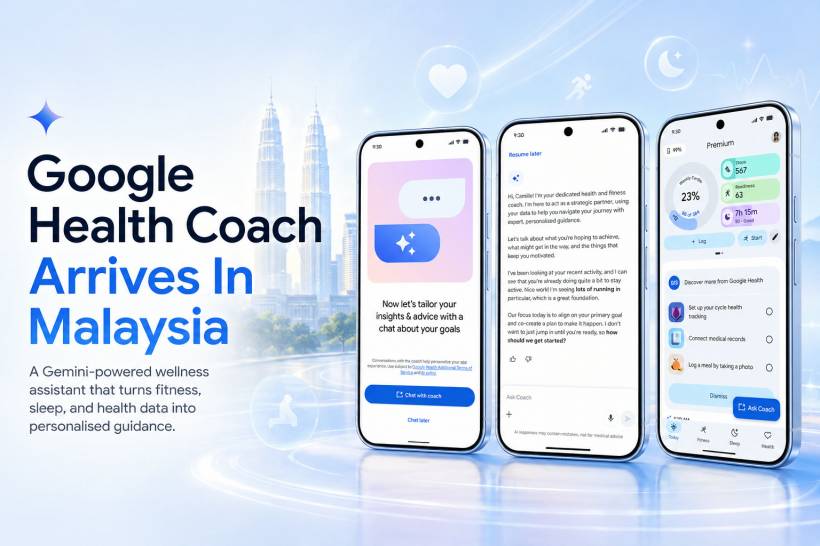
Google has launched Health Coach in Malaysia as part of the global rollout of its updated Google Health experience. Powered by Gemini, the feature is designed to act like a personalised wellness assistant that helps users make better sense of their fitness, sleep, and health-related data.
Instead of simply showing raw numbers such as steps, heart rate trends, sleep duration, or workout activity, Health Coach aims to turn that information into more useful recommendations. The idea is to help users understand what they can do next, whether that means improving their workout routine, sleeping better, tracking meals more consistently, or managing general wellness goals.
This is another sign of how AI is moving deeper into everyday health and fitness apps. Fitness tracking used to be mostly about collecting data. Now, companies like Google are trying to use AI to interpret that data and provide guidance that feels more personal and practical.
A More Personal Way To Understand Health Data
Health Coach is built around natural language interaction. That means users can ask questions or request guidance in a more conversational way instead of digging through menus or manually comparing charts.
For example, a user could ask for a workout plan based on their schedule, fitness goal, available equipment, and current routine. Google says the system can also consider contextual information such as local weather when suggesting activities. That could make the advice feel more realistic, especially for users who exercise outdoors or need recommendations that fit into a busy day.
The goal is not just to tell users what happened yesterday. It is to help them decide what to do today.
That shift matters because many people already collect plenty of health and activity data through smartphones, smartwatches, fitness apps, and connected devices. The problem is that the data can be overwhelming. Having an AI assistant that summarises patterns and turns them into understandable suggestions could make health tracking feel less technical and more useful.
How The Onboarding Process Works
Before Health Coach starts giving recommendations, users go through an onboarding process. During this setup, the app asks about personal goals, daily routines, available exercise equipment, and any injuries or physical limitations.
This step is important because wellness advice should not be one-size-fits-all. A person who wants to improve sleep, a person training for better stamina, and someone trying to build a simple home workout routine may all need very different guidance.
By collecting this information early, Health Coach can provide recommendations that are more relevant to the user's actual lifestyle. Users can also update their goals later by speaking to Health Coach conversationally, which makes the system more flexible as routines change.
For example, someone may start with a goal to exercise three times a week, then later shift towards improving sleep quality, tracking meals, or preparing for a more structured fitness routine. The app is designed to adjust around those changing priorities.
The Today Tab Becomes The Main Wellness Dashboard
One of the central parts of the updated Google Health app is the Today tab. This section brings together health insights, activity information, and personalised recommendations in one place.
Instead of jumping between separate screens for fitness, sleep, nutrition, and other health metrics, users can view a more complete snapshot of their day. This makes the app feel more like a dashboard for personal wellness rather than just another tracker.
Google organises the AI-powered insights under three main areas:
• Fitness
• Sleep
• Health
Beyond those categories, the app also supports broader well-being features such as Cycle Tracking, Nutrition, and Mental Wellbeing. It also includes guided workouts and expanded health-tracking tools, making the platform more comprehensive than a basic fitness app.
It Is Not Limited To Google Devices
One important detail is that Health Coach is not restricted only to Google hardware. Google says the updated app can work as a centralised data hub through Health Connect, Apple Health, or Google Health APIs.
This means users may be able to bring together data from different platforms and third-party services, including fitness and wellness apps such as Peloton or MyFitnessPal. For users who already have data spread across multiple apps, this could be useful.
In reality, many people do not live inside one health ecosystem. Someone may use a smartwatch from one brand, a nutrition app from another, and a workout platform from somewhere else. A central dashboard that can combine selected data from multiple sources makes the experience more practical.
However, the usefulness will depend on how well the integrations work and how much data each third-party service allows users to share.
Gemini Can Also Help With Nutrition Tracking
Another interesting addition is photo-based nutrition tracking. Users can log meals by taking a picture of their food, and Gemini will analyse the image to estimate nutritional information.
This could make meal logging easier for users who find manual entry too time-consuming. Traditional nutrition tracking often requires searching for food items, entering portion sizes, and adjusting details manually. That process can be tedious, which is why many people stop tracking after a while.
With photo-based logging, Google is trying to reduce friction. Users take a picture, Gemini estimates the nutrition details, and the information is recorded inside the app.
Of course, photo-based nutrition tracking should be seen as an estimate rather than a perfectly accurate measurement. Food portions, ingredients, sauces, cooking methods, and hidden calories can be difficult for any AI system to judge precisely from an image. Still, for general awareness, it may be useful enough for many everyday users.
Privacy Will Be A Major Concern
Because Health Coach deals with sensitive personal information, privacy will naturally be one of the biggest concerns. Fitness data, sleep patterns, health records, nutrition logs, and wellness habits can reveal a lot about a person's lifestyle.
Google says health and wellness data collected through the app will not be used for advertising purposes, including Google Ads. That is an important reassurance, especially because users may be uncomfortable with the idea of health-related data being used to target advertisements.
Still, users should always review what data they choose to share, which services are connected, and what permissions are enabled. A personalised health assistant can only become useful when it has enough context, but that also means users need to be comfortable with the level of data involved.
For Malaysians who are becoming more aware of digital privacy, this will likely be an important part of whether they choose to adopt the feature.
Health Coach Is Available In Malaysia, But It Is Not Free
Health Coach is available in Malaysia, but it is not offered as a standalone free service. Instead, Google includes it under the Google Health Premium subscription, priced at US$9.99 per month, which is roughly around RM40.70 depending on exchange rates.
However, users who already subscribe to Google AI Pro or Google AI Ultra will receive access to Health Coach at no additional cost.
This means the feature is probably aimed more at users who are already paying for Google's AI ecosystem or those who are serious enough about wellness tracking to justify another monthly subscription. For casual users, the price may feel a little steep, especially when many basic fitness and sleep tracking features are already available through free or cheaper apps.
The real value will depend on how personalised and useful the recommendations are in daily use.
What This Means For Users In Malaysia
For Malaysian users, Health Coach could be useful because it combines AI, health tracking, and daily lifestyle planning into one app. Malaysia's weather, work routines, commuting patterns, eating habits, and fitness culture can all affect how practical a wellness recommendation feels.
A good health assistant should not simply suggest generic routines. It should understand whether someone has limited time, prefers home workouts, has access to gym equipment, exercises outdoors, or needs lighter recommendations due to physical limitations.
If Google can make Health Coach feel local, practical, and genuinely adaptive, it could become more than a fancy AI feature. It could become a useful wellness companion for users who want guidance without hiring a coach or manually interpreting every data point.
Final Thoughts
Google Health Coach shows where consumer health apps are heading. The future is not just about collecting more data, but about making that data easier to understand and act on.
By using Gemini, Google is trying to turn the Google Health app into a more conversational and personalised wellness platform. Users can ask for workout guidance, review sleep and fitness insights, track meals through photos, and bring data together from different ecosystems.
The biggest questions will be accuracy, usefulness, privacy, and pricing. If the recommendations are practical and the privacy controls are clear, Health Coach could be genuinely helpful. But if the advice feels too generic or the subscription cost feels too high, many users may continue relying on existing fitness apps and wearable dashboards.
For now, its arrival in Malaysia is still worth watching. It shows that AI-powered wellness is becoming more mainstream, and Google clearly wants Gemini to play a bigger role in how people manage their daily health routines.











Comments 0