

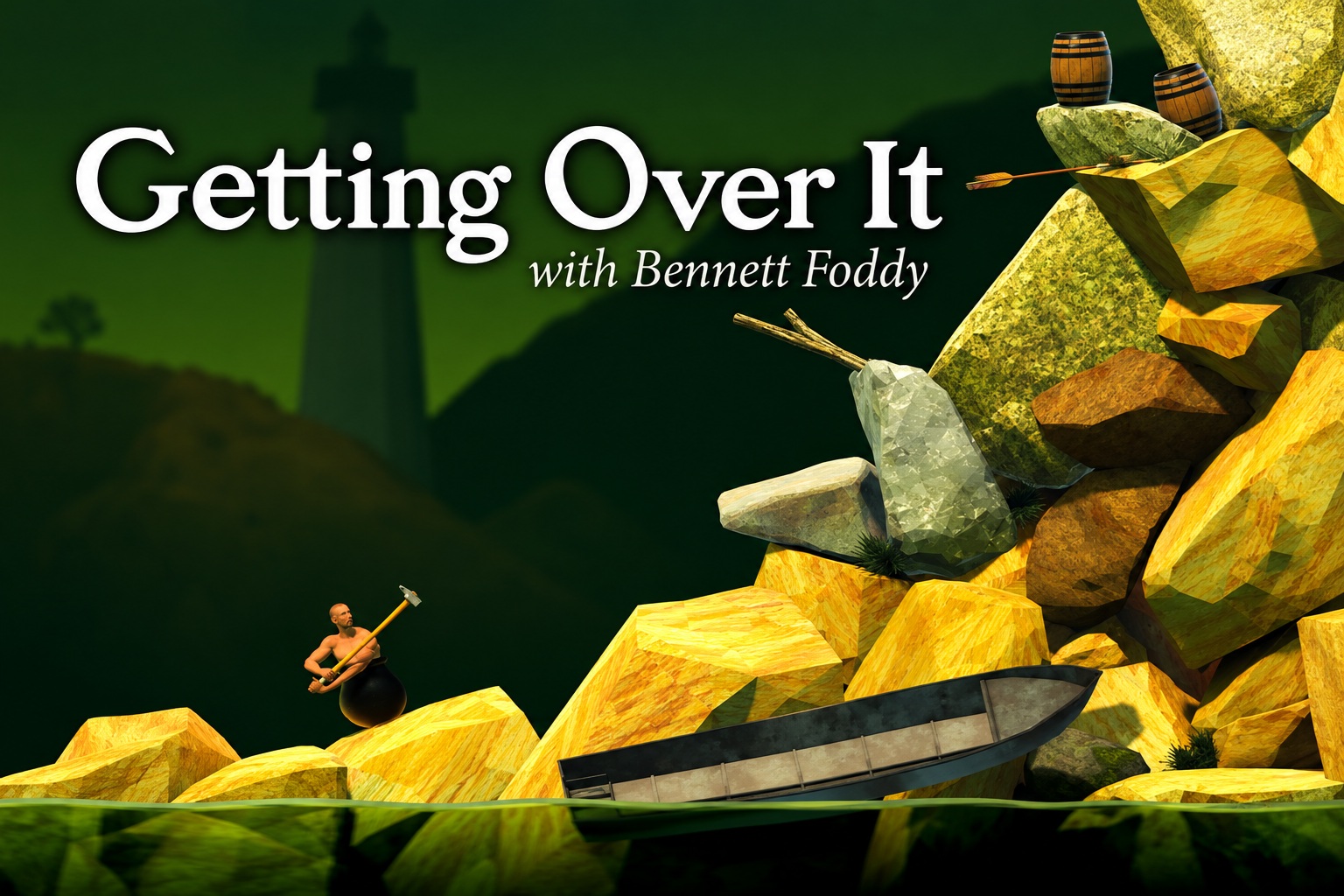
Getting Over It with Bennett Foddy takes an almost absurdly simple idea and turns it into one of the most recognizable tests of patience in modern gaming. Players control Diogenes, a man permanently sitting inside a metal cauldron who must climb an enormous mountain using nothing but a long sledgehammer. There are no conventional walking controls, no jump button, no checkpoints, and almost nothing preventing a single bad movement from undoing a huge amount of progress. The entire experience depends on learning how to push, pull, hook, swing, and launch the hammer against increasingly awkward surfaces.
Released in 2017 and created by Bennett Foddy, the game became famous not because it offers an enormous world or complicated progression system, but because it asks players to master one highly unusual physical control scheme under deliberately unforgiving conditions. The mountain is assembled from rocks, trees, furniture, buildings, pipes, construction materials, household objects, and strange arrangements that often seem specifically designed to punish overconfidence. Progress can feel incredibly satisfying when a difficult obstacle is finally conquered, yet that satisfaction can disappear instantly when Diogenes slips and falls several sections downward. The constant possibility of losing progress makes every successful movement feel important.
Now playable online through Lemon Web Games, Getting Over It with Bennett Foddy brings its physics-driven climbing, punishing falls, distinctive narration, and unforgettable obstacle course directly into the web browser. Players can attempt the entire mountain using only the hammer, learning how momentum, leverage, surface angles, and controlled mouse movement determine whether Diogenes climbs higher or falls back toward earlier sections. The game remains mechanically simple from beginning to end, but mastering those mechanics can take considerable time. For anyone who enjoys difficult games built around precision, persistence, and genuine player improvement, Getting Over It remains one of the clearest examples of how a single mechanic can create an entire experience.
Diogenes Can Only Move Through the Hammer
Diogenes does not walk normally, jump with a button, or grab ledges automatically. His sledgehammer is effectively his entire movement system. The player swings the hammer around his body, hooks it onto surfaces, pushes against the environment, and uses the resulting force to move the cauldron.
This creates movement that initially feels awkward because the player is not controlling Diogenes directly. Instead, they are controlling the tool that influences where his body goes. A small mouse movement can create a careful adjustment, while a large swing can launch him across a gap or completely ruin a stable position.
The relationship between hammer and body gradually becomes intuitive. Players begin understanding how much pressure different surfaces can support and how far the cauldron will move after a push. The game becomes much more manageable once the hammer stops feeling like an obstacle and starts feeling like an extension of the player.
The Physics Are the Real Opponent
There are no conventional enemies in Getting Over It. The primary challenge comes from gravity, momentum, collision angles, and the shape of the environment. Every object on the mountain becomes either a tool for climbing or a possible reason to fall.
Flat surfaces can provide reliable leverage, while rounded rocks and narrow ledges require much greater control. Some objects allow the hammer to hook securely, while others provide only enough contact for a quick push. Learning how each surface behaves is essential.
The physics can also create moments that feel almost unpredictable until the player understands them better. A strong swing may launch Diogenes farther than expected, while a cautious movement may fail because the hammer loses contact. Practice gradually turns apparent randomness into something much more understandable.
There Are No Checkpoints
One of the most famous aspects of Getting Over It is the complete absence of traditional checkpoints. If Diogenes falls, he lands wherever the physics take him. A mistake near the top can potentially erase an enormous amount of progress.
This changes the emotional meaning of every obstacle. Reaching a difficult section does not guarantee that it has been permanently conquered. Players may need to complete the same climb several times after later mistakes send them downward.
The lack of checkpoints is harsh, but it also creates the game's strongest sense of mastery. Eventually, sections that once required many failed attempts become easy enough to repeat almost automatically. The player does not keep progress through save markers; they keep it through learned skill.
Falling Is Part of the Design
Most games treat losing progress as something to minimize. Getting Over It makes it central to the experience. Falling is expected, and the emotional reaction to that fall is part of what Bennett Foddy wants the player to confront.
The first large setback can be especially painful. A player may spend twenty minutes climbing carefully only to slip from one object and return almost to the beginning. That moment can feel completely unfair even though the game has followed its physics consistently.
Over time, falling can become less devastating because the player knows how to recover. The mountain has not become easier, but previously difficult sections can be climbed much faster. Failure becomes proof of how much skill has already been gained.
Mouse Movement Determines Everything
Getting Over It is controlled through continuous mouse movement rather than conventional directional buttons. The hammer follows the player's input around Diogenes, making precision extremely important. Fast movements create power, while slower movements allow careful positioning.
This means sensitivity and control style matter greatly. Players often need time to discover how quickly they prefer the hammer to respond. Too much movement can create accidental launches, while too little may make larger jumps difficult.
The best play combines both. Slow adjustments are useful when balancing on small surfaces, while powerful swings become necessary for larger transitions. Mastery comes from knowing when to be careful and when to commit.
Hooking Onto Surfaces Creates Stability
The hammer can be used like a hook when its head catches onto a ledge or object. Once secure, players can pull Diogenes upward or rotate around the attachment point. This is one of the safest ways to gain height when a reliable edge is available.
However, the hammer does not magically lock into place. Poor angles can cause it to slip, especially on rounded or narrow surfaces. The player must maintain control during the movement.
Good hooking technique becomes increasingly important higher on the mountain. Many obstacles provide only tiny points where the hammer can catch. Learning to trust those positions without overcorrecting is a major part of progression.
Pushing Creates Powerful Jumps
The hammer can also be planted against a surface and used to push the cauldron away. With enough force, this effectively launches Diogenes through the air. Many large gaps and vertical jumps require this technique.
The challenge is controlling the direction of the launch. If the hammer is positioned slightly incorrectly, the push may send Diogenes sideways instead of upward. Large movements therefore need both confidence and accuracy.
Successful launches are among the most satisfying moments in the game. When the hammer catches exactly where intended and Diogenes lands safely on the next object, the movement feels earned. The player knows the result came from control rather than an automatic animation.
Momentum Can Save or Destroy a Run
Momentum is constantly affecting Diogenes, especially during larger swings. A well-timed movement can carry him past an obstacle that would be difficult to climb slowly. Too much momentum can send him flying beyond the intended landing point.
This makes speed both useful and dangerous. Experienced players often use faster movements because they understand how much distance each push will create. Beginners generally benefit from more cautious approaches.
The mountain frequently places safe-looking objects beside large drops, making excessive momentum especially risky. The game constantly asks whether another powerful swing is actually necessary. Restraint can be just as important as confidence.
The Mountain Is Built From Absurd Objects
The climbing route is not a realistic mountain. Rocks are mixed with furniture, construction equipment, buildings, pipes, household items, and other objects stacked together in increasingly strange ways. The environment often feels like an enormous pile of discarded things assembled specifically to create difficult climbing problems.
This visual absurdity gives the game much of its personality. Players can move from natural rock formations onto chairs, boxes, metal structures, or completely unexpected objects without explanation. The world does not need realistic geography because the challenge itself is the focus.
The strange construction also helps individual sections remain memorable. Players do not simply remember "the next rock." They remember specific obstacles because each has its own shape and movement problem.
The Devil's Chimney Tests Early Precision
One of the first sections that seriously challenges new players is the narrow vertical area commonly known as the Devil's Chimney. Diogenes needs to push between two walls while controlling the hammer carefully enough to gain height without slipping back down.
The space is tight, making large movements dangerous. Players need to use controlled pushes and avoid accidentally sending the hammer outside the useful surfaces. It is one of the earliest places where precision matters more than brute force.
Once mastered, the Devil's Chimney becomes relatively easy to repeat. That transformation is a perfect example of Getting Over It's progression system. The obstacle does not change; the player does.
Furniture Creates Some of the Strangest Climbing
Several sections use furniture and household objects as platforms, producing awkward surfaces that behave very differently from rocks. Chairs, tables, boxes, and other objects may provide narrow edges that the hammer can barely catch.
These obstacles often require delicate movements because one overly aggressive swing can knock Diogenes away from the available contact point. The player must understand how the hammer head interacts with small corners.
Furniture also contributes to the game's surreal atmosphere. Climbing a mountain using a hammer is already unusual, but scaling piles of household objects makes the world feel even more deliberately absurd.
Orange Hell Became Infamous for Good Reason
The section commonly called Orange Hell is one of the most recognizable parts of the mountain. Narrow surfaces, awkward ledges, and the possibility of losing substantial progress make it a psychological barrier for many players.
The challenge is not only mechanical. By the time players reach this area, they have already invested significant effort into the climb. Every small movement therefore feels more dangerous because the potential setback is greater.
Orange Hell demonstrates how Getting Over It creates difficulty through context. A ledge is not frightening because it is complicated by itself. It is frightening because the player understands exactly how far they could fall if something goes wrong.
The Bucket Tests Advanced Control
Another memorable obstacle involves a hanging bucket that can swing when contacted. Unlike static parts of the mountain, the bucket introduces movement that needs to be anticipated. The player must control both Diogenes and the reaction of the object.
This changes the timing of the climb. The hammer may need to catch while the bucket is moving, and the player must avoid generating too much uncontrolled momentum. Patience is valuable.
The obstacle feels especially difficult because the physics remain consistent while the platform itself refuses to stay still. It tests whether the player can adapt previously learned techniques to a changing surface.
Bennett Foddy Talks Directly to the Player
Throughout the climb, Bennett Foddy provides spoken commentary about frustration, perseverance, failure, digital culture, and the experience of losing progress. His narration gives Getting Over It an identity completely different from most precision games.
Sometimes the commentary feels supportive. At other moments, it can feel almost painfully well timed, especially after a major fall. The narrator may discuss disappointment while the player is still processing the loss of hard-earned progress.
This relationship between narration and failure is intentional. The game does not merely challenge movement skill; it wants players to think about why losing progress feels so upsetting. Frustration becomes part of the subject matter.
The Narration Makes Failure Feel Personal
A normal game might simply reset the player after a mistake. Getting Over It lets the fall continue naturally while Bennett Foddy speaks about what just happened or reflects on failure more generally. This gives setbacks unusual emotional weight.
The commentary can sometimes make players more frustrated because it arrives at exactly the wrong moment. Yet it can also create perspective after repeated attempts. The game acknowledges the emotional experience instead of pretending it is irrelevant.
This makes the narrator feel like part of the challenge. He cannot physically knock Diogenes from the mountain, but the timing of his words can influence how the player reacts. Maintaining concentration becomes psychological as well as mechanical.
There Are No Upgrades to Make the Game Easier
Diogenes never unlocks a stronger hammer, improved grip, double jump, or checkpoint ability. The character at the top of the mountain has exactly the same mechanical capabilities as the character at the bottom. Nothing about the avatar improves.
All progression happens inside the player. Mouse control becomes more accurate, difficult surfaces become familiar, and once-frightening obstacles eventually become routine. Knowledge and muscle memory replace traditional upgrades.
This makes completion especially satisfying. There is no question that the player improved. The game provided almost nothing except the controls and the mountain.
Muscle Memory Becomes the Real Save System
After enough repetition, players can climb early sections dramatically faster than they could during their first attempt. Movements that once required careful thought become automatic. The body begins remembering what the mouse needs to do.
This effectively becomes a form of invisible progress. A large fall may return Diogenes to an earlier physical location, but the player is not truly back at the beginning. They can recover much faster.
That distinction is essential to understanding the game's design. Progress is not the current height alone. Progress is how reliably that height can be regained after failure.
Patience Usually Beats Panic
The most dangerous moments often occur immediately after something goes wrong. A hammer slips, Diogenes starts falling, and the player instinctively makes a huge desperate mouse movement. That panic can transform a small setback into a catastrophic one.
Experienced players learn to respond more calmly. Even during a fall, there may be opportunities to catch another surface and stop the descent. Controlled recovery can preserve enormous amounts of progress.
This lesson extends beyond individual mistakes. The game rewards players who accept setbacks and continue deliberately. Emotional control becomes another mechanical skill.
Fast Play Comes After Mastery
Watching experienced players climb can make Getting Over It look incredibly fast. Large sections can be crossed through powerful swings and precise launches that would be extremely dangerous for a beginner. Speed is possible because those players already understand the physics.
Trying to imitate that style too early usually produces spectacular falls. New players benefit from stability and controlled positioning before attempting aggressive techniques. Efficiency comes later.
This creates a satisfying mastery curve. Careful play eventually becomes confident play, and confident play naturally becomes faster. The mountain begins feeling much smaller once its difficult sections are understood.
The Game Became Famous for Rage Reactions
Getting Over It quickly became associated with frustration videos, livestreams, speedruns, and dramatic reactions to enormous falls. The lack of checkpoints creates exactly the kind of moments that audiences immediately understand. Someone can lose half an hour of progress in seconds.
These reactions helped make the game widely recognizable. Even people who never played it often understand the image of a man in a cauldron desperately swinging a hammer around a mountain.
Yet focusing only on rage misses part of the design. The game is not simply trying to annoy players. It is interested in what happens after frustration. The real challenge is deciding whether to try again.
Repeated Play Can Become Surprisingly Relaxing
Once the controls are mastered, early sections can feel almost meditative. The player already knows where to place the hammer and how much force is needed. Movements flow together with very little conscious effort.
This creates a completely different experience from the first playthrough. The same mountain that once produced constant stress can become familiar terrain. Difficulty gradually turns into rhythm.
That transformation demonstrates how strongly the game depends on skill rather than randomness. Mastery genuinely changes the emotional experience. Confidence replaces fear.
Speedrunning Reveals the Depth of the Physics
Getting Over It has developed a dedicated speedrunning community because the movement system allows extremely efficient techniques once understood deeply. Players can launch across multiple obstacles, maintain momentum, and use surfaces in ways that beginners would never attempt.
Speedruns show that the physics are not merely chaotic. They are consistent enough for expert players to reproduce precise movements at enormous speed. What appears impossible becomes repeatable through practice.
Even players with no interest in competitive times can appreciate this depth. Watching advanced movement reveals how much possibility exists inside the simple hammer control system. The ceiling for mastery is remarkably high.
The Lack of Conventional Rewards Is Intentional
There are no frequent loot drops, skill points, cosmetic unlocks, or mission rewards encouraging players upward. The climb itself is the reward. Getting past an obstacle that previously seemed impossible provides enough motivation.
This design can feel unusual in an era where games frequently provide constant progression feedback. Getting Over It trusts the player to value improvement without external rewards.
That simplicity also makes every success more personal. The game does not need to announce that a difficult section was impressive. The player already knows how many attempts it required. Satisfaction comes from experience.
Reaching the Top Feels Genuinely Earned
Completing Getting Over It can take radically different amounts of time depending on the player. Some become comfortable quickly, while others may spend many hours repeating the same sections. The game does not adjust itself to guarantee eventual victory.
That makes reaching the summit unusually meaningful. Every obstacle was crossed using the same mechanics available from the opening seconds. There was no shortcut created through character progression.
The final achievement represents patience as much as mechanical skill. The player had countless opportunities to stop after a frustrating fall and chose to continue. Finishing therefore feels like proving something to yourself rather than simply completing another campaign.
Playing Getting Over It with Bennett Foddy Online Today
Through Lemon Web Games, Getting Over It with Bennett Foddy can now be played directly in your web browser with no downloads or setup required. Features of the web-based version include:
New players should focus on learning controlled hammer movement before attempting powerful launches. Slow mouse inputs are often enough for precise positioning, while larger swings should be reserved for obstacles that genuinely require momentum. If a movement begins going wrong, avoid immediately making another huge correction because panic often turns a small slip into a major fall.
It is also helpful to treat repeated sections as practice rather than lost progress. Every fall provides another opportunity to make earlier movements more reliable. Once the first half of the mountain can be climbed consistently, major setbacks become much less intimidating. The real goal is not simply reaching higher once, but learning how to reach that height again whenever necessary.
Who Should Play Getting Over It with Bennett Foddy
Getting Over It is particularly suitable for players who find satisfaction in mechanical mastery. There is no hidden equipment upgrade that eventually solves difficult sections automatically. If a climb becomes easier, it is because the player genuinely learned how to control the hammer more effectively. That makes improvement extremely visible.
It is less suitable for anyone who strongly dislikes losing progress. Large falls are not rare accidents outside the intended design—they are central to the experience. The game expects frustration and deliberately refuses to protect the player from it. Enjoying Getting Over It requires accepting that failure is part of learning.
Play Getting Over It with Bennett Foddy Online Now
Getting Over It with Bennett Foddy turns one man, one cauldron, one sledgehammer, and one enormous pile of obstacles into a complete test of precision and persistence. Players must hook onto ledges, push against rocks, swing around furniture, launch through difficult gaps, and maintain enough control to prevent one small mistake from becoming a huge fall. There are no enemies to defeat and no upgrades to unlock. The mountain itself is the challenge.
Through Lemon Web Games, players can experience Getting Over It directly in a modern browser and discover why such a mechanically simple game became one of the most famous difficult games ever created. Every section becomes easier through familiarity, yet the possibility of falling never completely disappears. The controls provide all the freedom required to succeed and all the freedom required to fail spectacularly.
Final Thoughts
Getting Over It with Bennett Foddy remains memorable because it removes almost every conventional form of progression and leaves only the relationship between the player and the controls. Diogenes does not become stronger, the hammer never improves, and the mountain never lowers itself to accommodate repeated failure. The only thing that changes is the player's understanding of movement.
That simplicity gives every mistake unusual weight. Falling can erase visible progress, but it cannot erase muscle memory, knowledge, or improved control. A section that once required twenty minutes may eventually take less than one, making recovery increasingly manageable. The game quietly proves that learning itself can function as progression even when the screen appears to show otherwise.
Through Lemon Web Games, Getting Over It can now be played directly in the browser as a brutally simple but deeply rewarding physics challenge. It can produce frustration, laughter, concentration, anger, and genuine satisfaction within the same session. For players willing to accept the falls and keep swinging the hammer anyway, reaching the top remains one of gaming's clearest demonstrations that sometimes the hardest part of progress is simply deciding not to quit.











Comments 0