

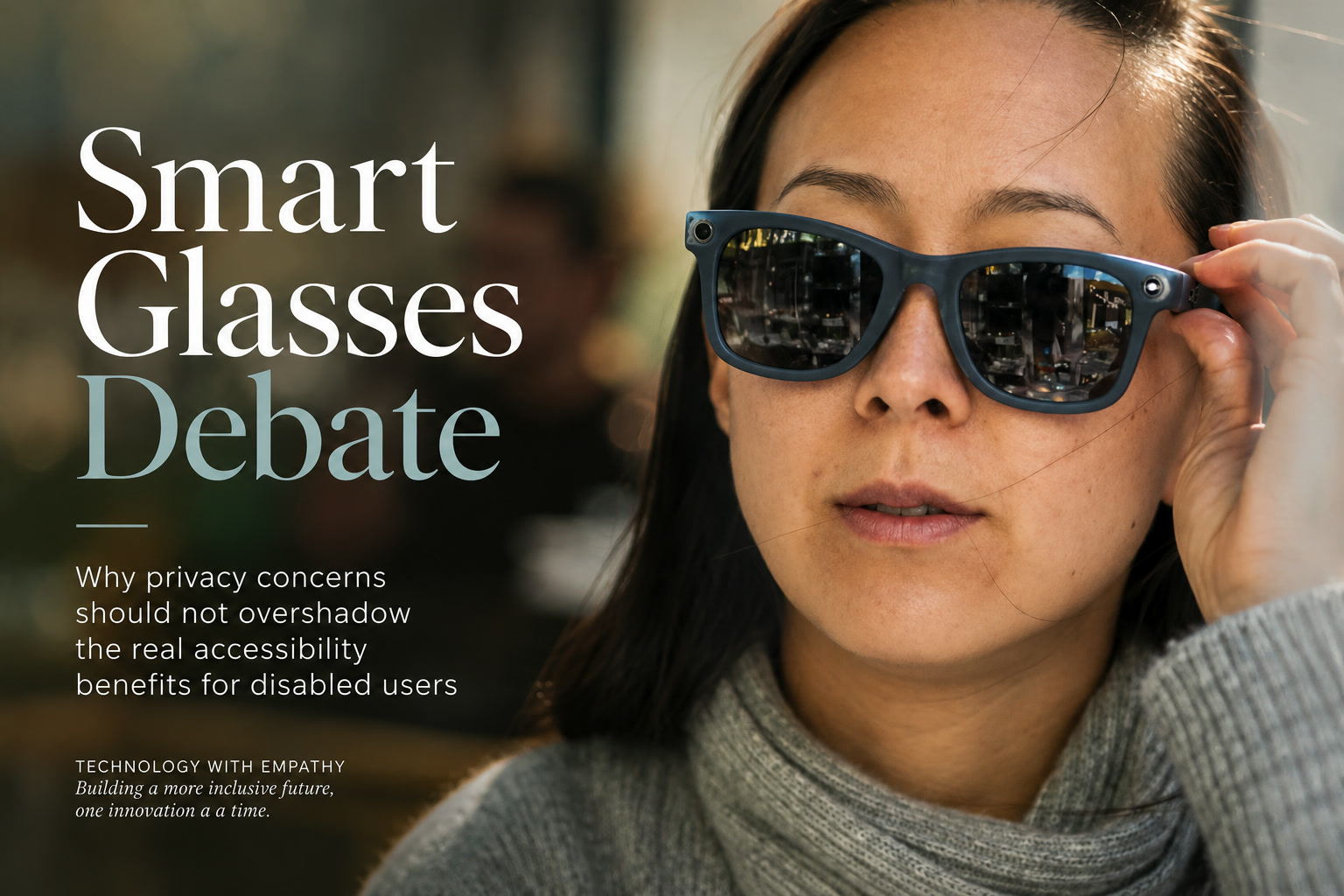
Smart glasses have become one of the most controversial categories of wearable technology. Devices such as Ray-Ban Meta combine a familiar pair of glasses with cameras, microphones, speakers and AI-powered features, making it possible to take photos, record video, make calls, send messages and ask questions without reaching for a smartphone.
That convenience has also created an obvious privacy debate.
Critics worry that people can be filmed without noticing, venues are beginning to question whether camera-equipped glasses should be allowed, and labels such as "spy glasses" have increasingly appeared in public discussion.
Those concerns deserve serious attention. But there is another side of the conversation that can easily become buried beneath the controversy: for some blind, visually impaired and physically disabled people, smart glasses are not novelty gadgets. They are accessibility tools that can provide genuine independence.
The challenge is therefore not deciding whether privacy or accessibility matters more. It is finding a way to protect both.
Smart Glasses Can Do Far More Than Record Video
Much of the public discussion around smart glasses focuses on the camera.
That is understandable because recording people without permission is the most obvious concern. But focusing entirely on the camera ignores many of the features that make these devices useful to people with disabilities.
For someone with limited vision, smart glasses can potentially help with everyday tasks such as:
For people with severe physical disabilities, the hands-free nature of the device can be equally important.
Someone who cannot comfortably pick up or operate a smartphone may still be able to make calls, send WhatsApp messages, take photographs or begin a video call using voice commands.
These are ordinary activities for most smartphone users.
For someone with limited mobility, however, being able to perform them independently can represent a significant improvement in quality of life.
For Some Users, the Technology Removes Everyday Barriers
One optometrist who has worked with visually impaired customers described being initially reluctant to stock Ray-Ban Meta glasses because of concerns surrounding Meta and Luxottica.
That opinion reportedly changed after seeing how customers actually used them.
Many buyers at the practice had visual impairments or learning difficulties. One customer who struggled considerably with reading was able to use the glasses to have text around him read aloud.
That kind of use is easy to overlook when smart glasses are discussed primarily as consumer electronics.
For visually impaired people, something as simple as leaving home can involve navigating unreadable street signs, shop labels, transport information and unfamiliar surroundings.
A device capable of reading or describing those things through voice interaction can remove some of that uncertainty.
It does not cure the disability.
It simply makes an environment designed largely for fully sighted people easier to navigate.
The Stigma Around Smart Glasses Creates a New Problem
The problem is that users benefiting from these accessibility features can become caught in the backlash surrounding the technology.
If smart glasses become widely associated with covert recording or predatory behaviour, someone wearing them for accessibility may suddenly be viewed with suspicion.
That creates a strange situation.
A visually impaired person might rely on smart glasses precisely because they make going outside easier, only to become more anxious because strangers assume the device is being used to secretly record them.
This is where the language surrounding the technology matters.
Calling camera-equipped glasses "spy glasses" may sound harmless in a headline, but broad labels can eventually become attached to everyone wearing them regardless of how the device is actually being used.
Disabled users should not have to explain or defend themselves simply because a technology that helps them can also be misused by someone else.
Privacy Concerns Are Still Completely Legitimate
Acknowledging the accessibility benefits does not mean ignoring the privacy problem.
People have a reasonable expectation that they should not be secretly recorded in inappropriate situations.
A camera positioned at eye level can also be more difficult to notice than someone openly holding a phone.
Manufacturers therefore have a responsibility to make recording obvious.
Smart glasses typically include a visible indicator light when recording, but critics have questioned whether these indicators are noticeable enough and whether they can be altered or obscured.
There are several practical improvements manufacturers could make:
Regulators should also establish clearer rules around where and how wearable cameras can be used.
Accessibility should not become an excuse for weak privacy protections.
But privacy concerns should not become an excuse for eliminating useful assistive technology either.
Smart Glasses Are Not the First Cameras in Public Spaces
There is another inconsistency in the debate worth recognising.
Society has lived with portable cameras for decades.
Smartphones are everywhere. CCTV cameras monitor shops, streets and public transport. Doorbell cameras record visitors and sometimes passers-by. Dashcams continuously capture roads and surrounding activity.
People frequently take photos and videos in public places with other people appearing in the background.
None of this means privacy concerns should be dismissed.
But it does raise a reasonable question: Why should smart glasses automatically be treated as uniquely suspicious when so many other camera-equipped devices are already accepted?
Smartphones have also been misused for covert filming, yet the response has generally been to punish the behaviour rather than label every smartphone owner as a potential offender.
Smart glasses should be approached with the same principle.
Regulate misuse.
Do not automatically criminalise or stigmatise ordinary use.
Blanket Bans Could Disproportionately Affect Disabled People
Some venues have started considering or implementing restrictions on smart glasses because of recording concerns.
There may be environments where restricting cameras is entirely appropriate.
Changing rooms, medical areas, confidential workplaces and certain private venues obviously require stronger privacy protections.
But banning the entire device can create unintended accessibility consequences.
A visually impaired person may need smart glasses to read signage or navigate unfamiliar surroundings.
Someone with limited hand movement may depend on them for communication.
Preventing that person from wearing the glasses could effectively remove an accessibility aid simply because the same device contains a camera.
A more proportionate policy would be to restrict recording rather than automatically prohibit wearing the device.
That is similar to how smartphones are handled in many sensitive environments.
People may be allowed to carry a phone while being instructed not to photograph or record.
The same approach could work for smart glasses where practical.
Accessibility Features Are Often Treated as Secondary
Technology discussions frequently celebrate accessibility when a product launches, but those benefits can quickly disappear from the conversation once controversy begins.
That appears to be happening with smart glasses.
The privacy questions dominate because they generate stronger reactions.
Stories about someone quietly gaining independence because their glasses can read a menu or make a phone call are less dramatic.
Yet these everyday improvements can matter enormously to the people experiencing them.
For someone who has always been able to operate a smartphone, voice-controlled messaging may feel like a convenient extra.
For someone who physically cannot use a touchscreen, it may provide access to communication they previously needed another person to manage.
That distinction deserves much more attention.
Hands-Free Technology Can Be Transformative
One of the strongest arguments for smart glasses as accessibility tools is that they move computing away from the hands.
Most modern digital services assume the user can see a screen, hold a device and interact with a touchscreen.
That assumption excludes people with certain visual and physical disabilities.
Smart glasses provide another interface.
Instead of:
the interaction becomes:
For some users, that is not simply a more convenient interface. It is an interface they can actually use independently.
As AI capabilities improve, this could become even more powerful.
Glasses may eventually help users identify objects, navigate environments, understand text, remember locations or receive contextual information about what is happening around them.
These are precisely the kinds of applications where AI can provide meaningful accessibility improvements.
Manufacturers Need to Design Accessibility and Privacy Together
The strongest future for smart glasses is not one where accessibility wins and privacy loses.
Both need to be designed into the product.
Manufacturers should assume from the beginning that wearable cameras will raise legitimate concerns.
Recording needs to be obvious.
Data handling needs to be transparent.
Privacy controls need to be understandable.
At the same time, accessibility functions should not depend unnecessarily on recording or storing video.
For example, some visual analysis could potentially happen temporarily without keeping permanent recordings.
Designing around those principles could make smart glasses easier for society to accept while preserving the capabilities disabled users rely upon.
Regulation Needs to Be More Precise Than Fear
Regulators will almost certainly need to pay closer attention as smart glasses become more common.
But good regulation should distinguish between legitimate accessibility use and abusive behaviour.
Rules could focus on actions rather than devices.
Secretly recording someone in a protected or intimate environment should be addressed regardless of whether the camera is inside a phone, pair of glasses or another device.
Similarly, deliberately disabling a recording indicator could carry consequences.
That approach is more targeted than simply declaring all smart glasses unacceptable.
Technology tends to become increasingly integrated into clothing and everyday objects. Trying to regulate each physical form separately will become more difficult over time.
Behaviour-based rules may ultimately be more sustainable.
Disabled Users Need a Stronger Voice in the Debate
Perhaps the biggest issue is that disabled people themselves are not always sufficiently represented in conversations about technologies they rely upon.
Debates about smart glasses are often dominated by manufacturers, privacy advocates, journalists and regulators.
All of those voices matter.
But people who use the devices as accessibility tools need to be included as well.
They are the ones who can explain which features actually provide independence, what happens when a venue bans the glasses and how public stigma affects their willingness to use assistive technology.
Designing policy without those perspectives risks solving one problem while creating another.
Final Thoughts
Smart glasses unquestionably create new privacy challenges.
A camera that can be operated hands-free needs strong safeguards, transparent indicators and clear rules against non-consensual recording.
But the public debate becomes distorted when that is treated as the entire story.
For blind and visually impaired users, smart glasses can read information that would otherwise be inaccessible. For people with severe physical disabilities, they can provide hands-free access to messaging, calls, photography and communication.
Those are not trivial conveniences.
They are tools for independence, accessibility and participation in everyday life.
The answer should therefore not be to dismiss privacy concerns, nor should it be to demonise everyone wearing smart glasses.
Manufacturers should build stronger safeguards. Regulators should target misuse. Venues should create sensible recording policies. And disabled users should be part of the conversation from the beginning.
People should not have to choose between their privacy and someone else's independence.
Good technology policy should be capable of protecting both.











Comments 0