

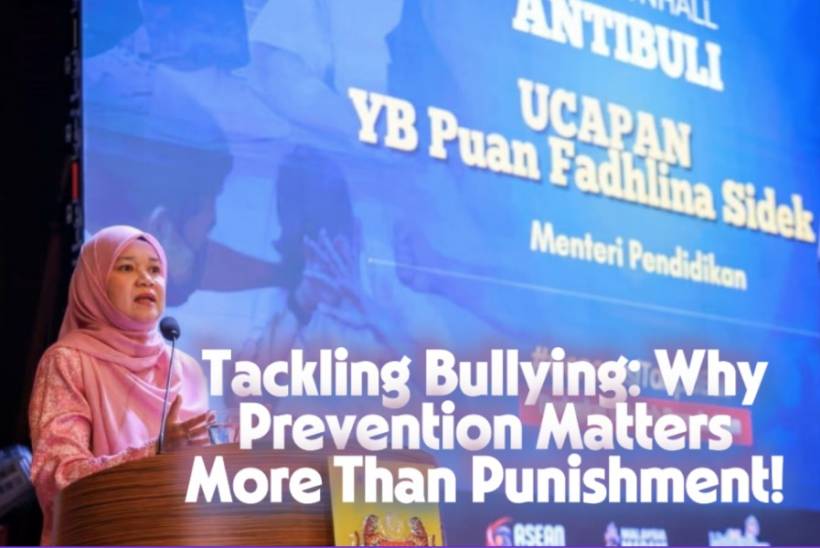
Bullying has long been a troubling issue in Malaysian schools and communities, but recent statements by government leaders are drawing renewed attention to how the nation should address it. Instead of relying solely on punishment, both Education Minister Fadhlina Sidek and Minister for Women, Family and Community Development Datuk Nancy Shukri are urging a shift toward preventative measures, community responsibility, and stronger victim support systems.
Why Punishment Alone Falls Short
For years, the go-to response for bullying incidents has been disciplinary action: suspension, warnings, detention, or even expulsion. While these actions can temporarily stop an aggressor, they don't solve the underlying problem.
Fadhlina emphasized that punishment is reactive—it happens after the harm has already been done. Worse, it may create resentment rather than change. True progress comes from prevention, which includes awareness campaigns, school-wide anti-bullying programs, counseling, and equipping teachers and parents to detect early signs of bullying.
International studies back this approach. Countries that implement comprehensive anti-bullying frameworks—such as Finland's KiVa program—have seen significant reductions in bullying cases because they target not just the bully and the victim, but also the bystanders who can intervene.
Bullying in Malaysia: No Longer "Isolated"
Datuk Nancy Shukri raised an important concern: bullying in Malaysia is no longer a handful of isolated cases but a growing trend. Reports of violent bullying videos circulating online, cyberbullying on social media, and ragging in universities reveal a disturbing shift.
"These are not just incidents we can dismiss," she said. "They are patterns that reflect deeper issues in our society."
A recent survey by UNICEF Malaysia found that nearly 1 in 3 Malaysian students aged 13 to 17 reported being bullied in school, highlighting the urgency of this issue. Cyberbullying adds another layer, as children can now be harassed at home, in what should be their safe space.
Ragging: More Than Just a "Tradition"
One of the most striking points Nancy raised was about ragging, which some institutions see as a "rite of passage." She firmly rejected this view, stating that ragging is simply another form of bullying that should not be normalized.
The scars it leaves—both physical and emotional—can last well into adulthood. Victims of ragging often describe long-term trauma, loss of confidence, and difficulty trusting peers. The minister's call for zero tolerance aims to reframe ragging from a tolerated tradition to an unacceptable abuse.
Society's Role: Breaking the Culture of Silence
Both ministers emphasized that bullying cannot be tackled by schools and government alone. Society plays a crucial role, and silence can be just as harmful as the act of bullying itself.
Too often, bystanders stay quiet, teachers underreport, or parents dismiss incidents as "kids being kids." But ignoring the problem allows bullies to grow bolder. Nancy urged communities to speak up, intervene, and report cases promptly.
As she put it: "If you see a child being bullied, your silence makes you part of the problem."
Support Systems and Resources
Victims of bullying often feel isolated, which is why access to immediate help is critical. Nancy reminded Malaysians of the Talian Kasih hotline (15999), where victims and their families can seek advice, counseling, and direct intervention.
Schools and workplaces can also play a part by strengthening peer support groups, providing confidential reporting systems, and ensuring mental health services are available. When victims know they are not alone, recovery becomes more achievable.
Policy Recommendations: What More Can Be Done?
To create lasting change, Malaysia may need to adopt a multi-layered approach:
By combining these efforts, Malaysia can move from reacting to bullying to preventing it altogether.
Conclusion: Prevention Is Protection
Both Fadhlina and Nancy have sent a strong message: bullying is not just a disciplinary issue but a societal one. Punishment alone may stop an incident, but prevention can stop a pattern. By addressing bullying at its roots, rejecting harmful practices like ragging, and ensuring support for victims, Malaysia can build safer schools, stronger communities, and a future where children grow without fear.
The responsibility lies not only with the government but with every parent, teacher, and citizen. Silence is complicity, but action is protection.











Comments 0