

If you've ever tried to open a 10-year-old DVD, a forgotten USB stick, or an old external hard drive and discovered it's basically a fancy paperweight now, you already understand the problem Microsoft is chasing: long-term storage is fragile.
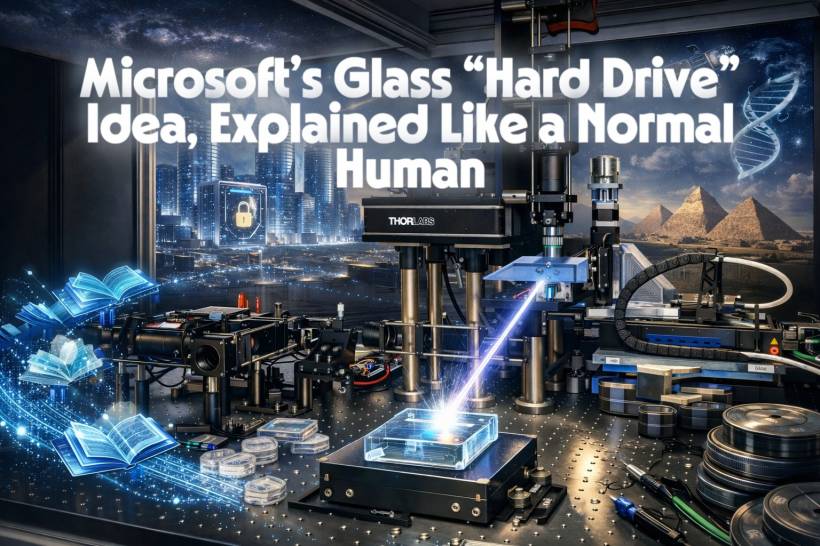
Microsoft Research has been working on a project called Silica, and the headline is wild but surprisingly grounded: they've demonstrated a way to write data into ordinary glass so it can be read back later, potentially for more than 10,000 years. The team also claims a palm-sized, thin square of glass could hold roughly two million books' worth of data.
This isn't about replacing your SSD at home. It's about something more boring but more important: archival storage. The kind of storage used by governments, hospitals, film studios, big research labs, and cloud providers who need to keep data safe for decades (or longer), without constantly migrating it to new media.
Why We Even Need "10,000-Year Storage"
Most digital storage today is built for speed and convenience, not longevity.
Hard drives have moving parts, and even when they're not spinning, they're still aging. Magnetic tape is decent for archives, but it isn't immortal and it demands careful environmental control plus periodic rewrites. Even if the media survives, you still need hardware and systems that can read it years later.
Now scale that up to the modern world where we generate enormous amounts of data: medical imaging, scientific datasets, legal records, satellite imagery, media libraries, and all the internal history that big companies keep for compliance and security reasons.
So the dream is simple: a storage medium that is:
• Extremely stable
• Low maintenance once written
• Resistant to environmental decay
Glass, surprisingly, checks a lot of those boxes.
The Core Trick: Writing Data with Tiny Bursts of Light
Silica uses ultrashort laser pulses to mark information inside glass. These pulses are so short they're measured in femtoseconds, which is 10^-15 seconds. That's not "very fast" in the normal sense. That's "your brain doesn't have a metaphor for it" fast.
Here's the important part: the laser light is a wavelength that typically passes through glass without doing anything. But when you focus it extremely tightly into a tiny point inside the glass, the intensity becomes high enough to change the material right there in that microscopic region.
So instead of scratching the surface like an engraving tool, this approach creates tiny internal "marks" in 3D space, inside the glass volume.
Meet the "Voxel" (The 3D Pixel Doing All the Work)
If a pixel is a point of information on a flat screen, a voxel is basically a point of information in three-dimensional space.
Silica writes these voxels at carefully controlled positions inside the glass. Each voxel represents encoded information based on how the glass has been altered at that microscopic spot.
Because you can stack these voxels throughout the glass volume (not just on the surface), you can store data in a true 3D structure. That's one reason the density potential gets so high.
This Idea Isn't New. What's New Is Doing It Like a Real System.
One of the most interesting parts of the Silica story is that Microsoft isn't presenting this as a "we invented physics" moment.
Researchers have been exploring laser-written data in glass for decades:
So what is Microsoft doing differently?
They're trying to prove the whole pipeline works as a practical technology:
• Writing it into glass
• Reading it back reliably
• Decoding it
• Error correction
• Evaluating density, speed, efficiency, and lifetime
In other words: not just "look, we can make marks," but "look, this can behave like a storage platform."
Two Ways to Write Voxels (And Why Both Matter)
Silica focuses on two main voxel styles, each with trade-offs.
1) "Micro-explosion" Voxels (Very Dense, Very Dramatic)
The first type is created by laser-driven micro-explosions inside the glass, forming tiny elongated void-like features.
The upside: extremely high storage density. The paper reports a density of around 1.59 gigabits per cubic millimetre, which is a ridiculous amount of data in a very small space.
The trade-off: this method can demand more energy and may be less friendly to fast, large-scale writing, depending on how the system is engineered.
Think of it like carving extremely detailed grooves: you can pack information tightly, but it's not always the fastest way to produce massive volumes.
2) Refractive-Index Voxels (Faster and Efficient, Lower Density)
The second type relies on subtle changes to the refractive index of the glass. Instead of creating void-like features, you're nudging the glass structure in a gentler way that changes how light behaves when passing through that point.
The upside: faster writing and lower energy per voxel. The work reports writing speeds around 65.9 megabits per second, with the suggestion that speed could increase using multiple beams.
The trade-off: lower storage density compared to the micro-explosion style.
So you get a classic engineering choice: maximum density vs. faster/cheaper writing.
Reading the Data Back Without Guessing
Writing data is only half the story. If reading it back is slow, unreliable, or requires extremely delicate lab conditions, it's not a real archival solution.
Silica's pitch is that the full system includes reading, decoding, and error correction strategies designed for real-world reliability. That's crucial because when you store something for decades, you're planning for imperfect conditions, small defects, and the fact that nothing stays 100% pristine forever.
Error correction is the difference between "we stored it" and "we can still recover it when we truly need it."
The 10,000-Year Claim: Where That Comes From
Nobody is sitting around for 10,000 years to confirm this works.
So the team uses accelerated ageing experiments. That generally means stressing the material under harsh conditions (like elevated temperature) to simulate long time periods and then checking whether the written structures remain readable.
Based on those experiments, the researchers argue the data could remain stable for more than 10,000 years, even for the more sensitive refractive-index method.
And the comparison point matters: this is meant to outlast typical archival media such as magnetic tape and hard drives, which require periodic migration and careful management.
Why This Suddenly Feels More Real Than It Did in the 1990s
There's a subtle "technology maturity" story hiding here.
Back in the late 1990s, femtosecond laser systems were rare and highly specialized. Only a handful of labs could build and operate them. That makes any practical storage platform basically impossible.
But ultrafast photonics has matured. Today, you can buy industrial-grade ultrafast lasers with the reliability and performance needed for consistent, repeatable processes. That shift is huge, because it turns glass storage from "cool experiment" into "potential product category."
The economics still need to make sense, of course. But the toolbox is no longer limited to elite research labs.
What This Could Be Used For (And What It Won't Replace)
Silica-style glass storage is not aimed at replacing:
• Your gaming drive
• Your phone storage
• Cloud storage for frequently accessed data
It's aimed at "write once, store forever (or close to it)" use cases, like:
• Medical imaging archives and long-term patient records
• Large research datasets that must be preserved
• Film and media master archives
• Legal and compliance retention
It's basically cold storage, but with the goal of being far less annoying to maintain.
Final Thoughts
The most compelling thing about Microsoft's Silica project isn't just the "two million books in a piece of glass" headline. It's the idea that the hardest part of long-term storage isn't capacity or even cost — it's the constant treadmill of keeping data alive as old media decays and old hardware becomes obsolete.
Glass storage won't show up in your PC build anytime soon, but it's a serious attempt at an archival "set it and forget it" medium. And if the broader ecosystem (hardware, standards, cost, and reading systems) keeps progressing, this could quietly become one of those technologies that matters a lot… without most people ever noticing it exists.











Comments 0